
A printed handout is no longer a tool for patient care; it’s a liability waiting to happen. You’ve likely felt the operational stress of a Monday morning flooded with emergency calls from patients who misplaced their aftercare instructions or struggled with language barriers. It’s a common industry pain point where manual processes fail to bridge the gap between clinical intent and actual patient behavior. You deserve a system that provides psychological security for your team and clear direction for your patients.
Modern dental patient education must evolve into a systematic delivery of clinical intelligence that functions as a pre-emptive strike against non-compliance. In this article, you’ll learn how to transform your education process from a passive hand-out into a standardized clinical tool that reduces liability and builds professional trust. We’ll examine how automated follow-ups and multi-lingual digital instructions can streamline your workflow, reduce unnecessary follow-up calls, and ensure your patients have the exact information they need the moment they need it.
Key Takeaways
- Understand the transition from passive paper brochures to strategic, multi-channel systems designed to elevate patient health literacy.
- Identify how standardized education protocols reduce the volume of post-treatment emergency calls and support faster clinical healing times.
- Compare the operational costs and engagement tracking of digital delivery against traditional printing to identify hidden inefficiencies in your practice.
- Follow a structured approach to auditing your current dental patient education templates and mapping them to specific clinical procedures for maximum impact.
- Explore how a comprehensive library of automated, multi-lingual templates can serve as a guardian of your practice’s documentation and regulatory compliance.
What is Modern Dental Patient Education?
Modern dental patient education isn’t just a collection of facts; it’s the strategic transfer of clinical knowledge designed to improve health literacy. In the past, practices relied on stacks of paper brochures that often ended up in the trash before the patient reached their car. By 2026, the standard has shifted significantly. Your patients now expect “snackable,” accessible information delivered directly to their mobile devices via text or email. They want to be able to review their aftercare while standing in the pharmacy line or resting at home. This shift is a core component of the modern dental patient experience, where communication serves as the foundation of clinical trust.
Effective dental patient education aligns with broader dental public health principles by focusing on prevention and informed self-care. Transitioning from physical documents to multi-channel digital delivery ensures that clinical guidance is available exactly when a patient needs it. This systematic approach transforms education from a passive administrative task into a proactive clinical tool that protects both the patient and the practice from avoidable misunderstandings.
The Shift from Information to Understanding
Handing a patient a brochure doesn’t mean they’ve been educated. True education happens when the patient internalizes the rationale behind their treatment. For instance, using visual aids like tooth loss charts or smile design previews can dramatically boost case acceptance by making complex outcomes tangible and easy to visualize. When you provide clear, structured communication, you stop being just a service provider. You become a professional ally who values the patient’s time and comprehension. This level of clarity moves the patient from a state of passive resistance to one of active participation in their own care, which is essential for long-term clinical success.
Health Literacy and Patient Safety
Health literacy is the patient’s ability to find, understand, and use information to make health-related decisions. In a clinical dental setting, low literacy is a primary safety risk. Misunderstood instructions for post-operative care lead to avoidable complications like dry socket or localized infections. These failures then trigger the high volume of emergency calls that disrupt your daily workflow and increase your liability. It’s an ethical necessity to provide instructions in the patient’s primary language. Delivering digital documents in any of 15 different languages ensures every patient has the psychological security of knowing exactly how to care for themselves at home, regardless of their background.
The Clinical Impact of Effective Education on Compliance
Clinical success doesn’t end when the patient leaves the chair. It depends entirely on what happens in the following 48 hours. When you implement a standardized approach to dental patient education, you create a filter that catches confusion before it turns into a crisis. Standardized education is a filter. It reduces the “anxiety calls” that often flood your front desk on Monday mornings. When patients receive clear, repeatable guidance, the administrative burden on your team drops. They aren’t fielding the same repetitive questions about minor bleeding or normal swelling. This efficiency allows your staff to focus on high-value tasks rather than repetitive damage control.
There’s a direct correlation between clear instructions and faster healing times. Patients who understand the “why” behind their aftercare are statistically more likely to follow it. This isn’t just a theory. You can see the tangible results in our automated patient follow-ups case study, which highlights how systematic communication drives ROI and practice efficiency. By automating these touchpoints, you ensure that no patient is left to guess their next steps, which significantly reduces the risk of post-operative complications and unnecessary follow-up visits.
Reducing Post-Operative Anxiety
The “forgetting curve” is a harsh reality in clinical practice. Research suggests that patients forget up to 80% of what a clinician says the moment they leave the operatory. Stress and local anesthesia only worsen this gap. Digital templates solve this by providing a permanent, searchable reference for the patient at home. Specifically, post-extraction instructions act as a safety net that protects the patient from common errors like using a straw or smoking too soon. This digital accessibility reinforces your role as a protective guardian of their health, building deep-seated trust that lasts long after the numbness wears off.
Overcoming Language Barriers in 2026
In a multi-cultural practice, the risk of clinical instructions being “lost in translation” is a major liability. You can’t rely on a patient’s family member or a generic online translator to convey complex medical advice. By 2026, 15-language support has become the new standard for inclusive, high-quality care. Providing automated, professionally translated documents ensures clinical precision across all demographics. This level of oversight removes operational resistance and ensures that every patient, regardless of their primary language, receives the same high standard of care. To see how these systems can stabilize your practice, you can explore our communication suite today.
Investing in dental patient education isn’t just about brochures; it’s about clinical precision. It’s about moving from a reactive state of handling emergencies to a proactive state of systematic control. This shift provides the psychological security your team needs to perform at their best while ensuring your patients feel supported throughout their entire recovery journey.
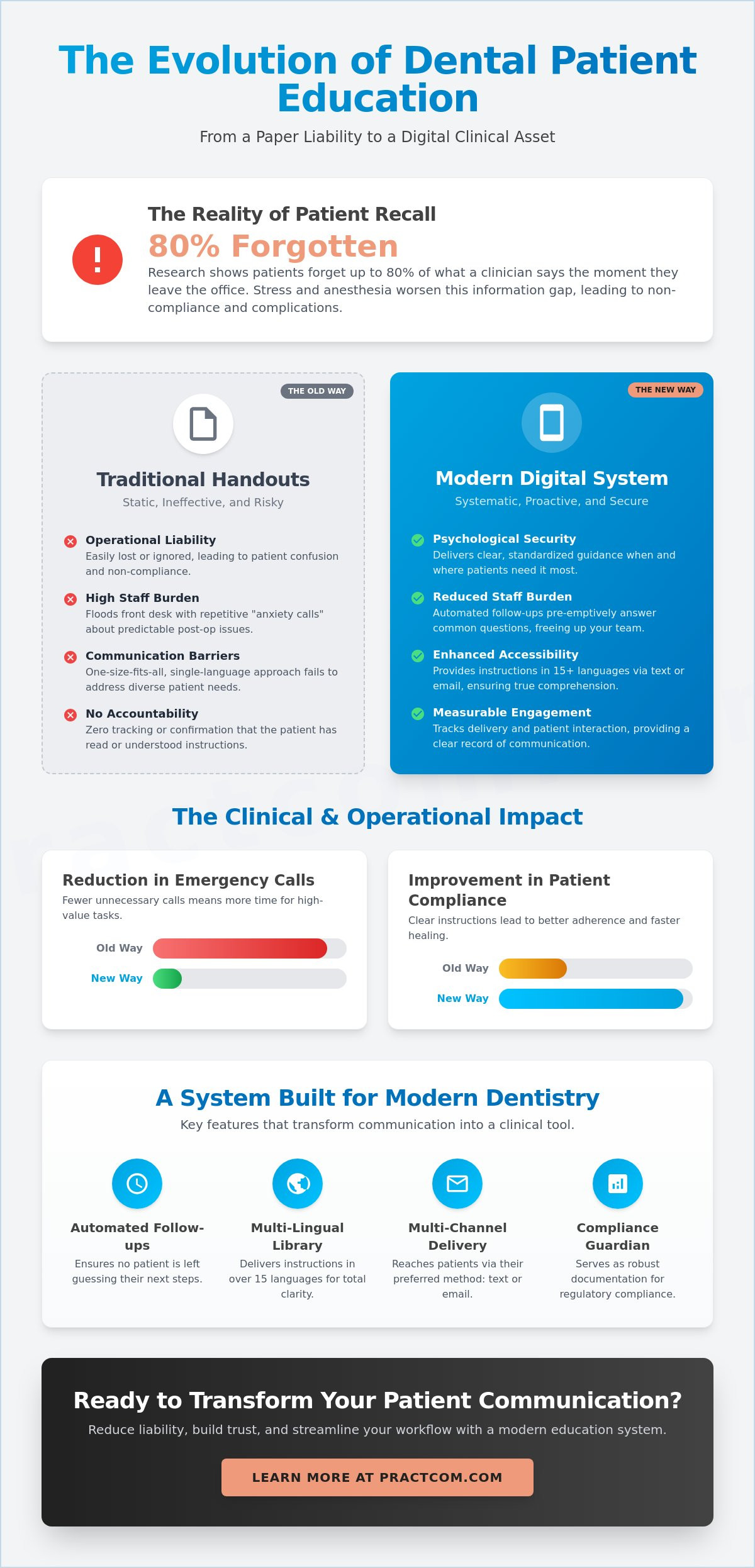
Digital Delivery vs. Traditional Brochures: A Comparison
Traditional dental patient education often relies on bulky brochure packs that consume physical storage space and drain your overhead through recurring printing costs. Beyond the expense, paper creates a massive “engagement gap.” Once a patient walks out with a pamphlet, you lose all visibility into their recovery process. You don’t know if they read the material or if it’s sitting under a car seat. Digital delivery closes this gap by providing real-time analytics. When you can see exactly when a patient opens their instructions, you gain a level of systematic control that paper simply cannot match.
Transitioning to a paperless environment also aligns your practice with modern sustainability standards, reducing waste and streamlining your physical workflow. However, we understand that technology shouldn’t be a barrier to care. PractCom bridges this gap by offering Physical Document Printing alongside our digital suite. This ensures that even your least tech-savvy patients receive the same high-quality, standardized information as everyone else. This hybrid approach maintains a consistent brand experience across all touchpoints while respecting the diverse needs of your patient population.
The Liability of Paper Documentation
In a legal or regulatory setting, “handing out a brochure” rarely meets the standard for proof of education. Paper documents are easily lost and impossible to verify after the fact. By linking your education process to digital dental informed consent forms, you create an immutable audit trail. Digital systems provide time-stamped delivery receipts that prove exactly when the patient received their instructions. This documentation acts as a guardian of your reputation. It ensures you have the evidence needed to defend your clinical protocols if a complication arises due to patient non-compliance.
Multi-Channel Delivery: SMS, Email, and Print
Patients in 2026 live on their phones. Meeting them where they are means utilizing SMS and email for dental patient education. Text-based delivery has significantly higher open rates than email, making it an essential tool for urgent post-op care. To protect your practice, these systems must remain HIPAA compliant. This ensures that sensitive clinical data is transmitted securely and remains private. Professional platforms also manage 10DLC registration for you. This registration ensures your patient texts aren’t flagged as spam by carriers. It guarantees that your critical aftercare instructions actually reach the patient’s device without delay. This reliability is a business requirement in a high-pressure clinical setting where every minute of recovery counts.
Building a Standardized Education Workflow for Your Practice
High-pressure clinical environments leave no room for administrative guesswork. To transform your dental patient education into a reliable clinical tool, you must implement a standardized workflow that operates independently of human memory. This shift ensures every patient receives consistent guidance, which reduces operational resistance and protects your practice’s reputation. A systematic approach moves your team from a reactive state of “fixing” misunderstandings to a proactive state of clinical oversight. You can achieve this by following a structured implementation plan:
- Step 1: Audit your current templates. Review your existing instructions for clarity, tone, and technical accuracy to ensure they meet modern health literacy standards.
- Step 2: Map education touchpoints. Assign specific instruction sets to procedures like SRP, implants, or extractions so the delivery is relevant and timely.
- Step 3: Automate the trigger. Set your system to deliver instructions via SMS or email immediately after the appointment is completed in your workflow.
- Step 4: Train on visualization. Ensure your clinical team knows how to use smile design tools to show patients before and after cosmetic changes, which builds immediate trust in the proposed outcome.
- Step 5: Monitor through a dashboard. Use a practice performance dashboard to track open rates and engagement, allowing you to identify which patients might need additional follow-up.
By following these steps, you create a comprehensive ecosystem where no part of the professional communication process is left to chance. To begin automating your clinical workflows, you can start your free trial of the PractCom suite today.
Standardizing Post-Op Templates
Consistency is the guardian of your clinical reputation. Every clinician in your practice should use the same clinical language to avoid confusing the patient with conflicting advice. Utilizing a library of 80+ post-treatment templates allows you to save hours of drafting time while maintaining a high standard of care. These templates provide a solid foundation of safety instructions that you can customize for specific patient needs without compromising the core clinical requirements. This standardization provides the psychological security your team needs to work efficiently in a fast-paced environment.
Integrating Education into the Referral Process
The transition between a general practitioner and a specialist is a high-risk point for patient drop-off. If the specialist provides different educational materials than the GP, the patient’s trust can erode. Implementing dental referral management software ensures that education carries through the entire referral loop. By educating the patient on the “why” behind the referral and providing consistent instructions across both offices, you reduce anxiety and increase the likelihood of treatment completion. This unified approach strengthens the professional ally relationship between practices and ensures the patient feels supported throughout their entire journey.
Enhancing Patient Trust with PractCom’s Communication Suite
PractCom functions as your professional ally by managing the high-volume communication tasks that often lead to team burnout. In a high-pressure clinical environment, you need a system that handles the heavy lifting of administrative oversight. Our all-in-one platform provides a stabilized environment where documentation is never left to chance. With a library of 80+ post-treatment templates, your practice can deliver precise instructions for every procedure from simple fillings to complex implant surgeries. This volume of resources ensures that your team spends less time drafting and more time focusing on direct patient care.
Building trust in cosmetic dentistry requires more than just verbal promises. Our Smile Design tool allows you to show patients before and after cosmetic changes, creating a visual bridge between clinical possibility and their personal expectations. This transparency is essential for boosting case acceptance and ensuring patients feel confident in their investment. For multi-location practices and DSOs, PractCom offers a way to maintain standardized dental patient education across every office. This consistency protects your brand’s reputation and ensures that your regulatory compliance remains uniform across your entire organization.
Why PractCom is the Essential Peer-to-Peer Solution
Our platform was founded by dental professionals who understand the daily operational stress of a modern practice. We’ve designed the system to reduce operational resistance through numerical shortcuts that allow for task completion in seconds. This efficiency isn’t just a convenience; it’s a necessity for maintaining a calm, organized workflow. You can learn more about our mission and our commitment to clinical excellence on our About Us page. We speak the language of your practice because we’ve been in the operatory ourselves.
Getting Started with Frictionless Education
Transitioning to a digital-first model for dental patient education doesn’t have to be a month-long project. Most practices can implement our standardized workflows in under 48 hours. Once active, your patients gain access to a dedicated patient portal where they can review their instructions 24/7 from any device. This accessibility provides the psychological security patients need during their recovery journey. If you’re ready to see how our templates and automation can stabilize your clinical communication, we invite you to Start a Free Trial today and experience the difference of a truly systematic approach.
Future-Proofing Your Clinical Communication
The transition from passive paper brochures to a systematic digital ecosystem is no longer a luxury; it’s a clinical necessity. By 2026, the practices that thrive will be those that eliminate the engagement gap and provide patients with the psychological security of accessible, multi-lingual guidance. You’ve seen how a standardized workflow reduces the administrative burden on your team while protecting your practice from liability. Modern dental patient education is about more than just sharing information; it’s about ensuring understanding through every step of the patient journey.
You don’t have to manage this transition alone. With access to 80+ professional post-op templates, support for 15+ languages, and our advanced Smile Design visualization tool, you can stabilize your practice’s communication in less than 48 hours. It’s time to move from operational resistance to systematic control. Start your free trial of PractCom’s instruction library today and experience how an all-in-one platform can transform your patient compliance and practice efficiency. You have the tools to build a more predictable, trust-based clinical environment starting now.
Frequently Asked Questions
How does digital patient education improve treatment outcomes?
Digital dental patient education improves outcomes by providing immediate, searchable access to aftercare guidance. This reduces the risk of common post-operative errors that lead to complications like dry socket or infection. By ensuring patients understand the “why” behind their instructions, you encourage higher compliance and faster healing times. This systematic delivery provides a protective layer for both the patient and the practice, ensuring clinical intent is followed exactly.
Is automated patient messaging HIPAA compliant?
Yes, our automated messaging is designed to be fully HIPAA compliant. We utilize encrypted channels to protect sensitive clinical data during transmission to the patient’s device. This provides your team with regulatory reassurance and ensures that your practice meets all legal requirements for digital communication. It functions as a guardian of your reputation by maintaining the highest standards of data privacy and security in every text or email sent.
Can I customize the post-op instruction templates in PractCom?
You can customize any of the 80+ templates in our post-treatment library to fit your practice’s specific protocols. This flexibility allows you to maintain standardized safety instructions while adjusting the tone or technical details for your specific procedures. It ensures that your clinical voice remains consistent across all patient touchpoints. This customization helps eliminate operational resistance by aligning our system with your team’s established clinical workflows.
How do patients access their education materials at home?
Patients access their education materials through a secure patient portal, which they can reach via a link sent by SMS or email. This mobile-first approach ensures they can review their instructions anywhere, whether they’re at the pharmacy or resting at home. It removes the friction of lost paper documents and provides 24/7 access to critical care information. This accessibility ensures that patients always have a reliable clinical reference at their fingertips.
What languages are supported for dental patient instructions?
We currently support more than 15 languages for all clinical documents and instructions. Providing dental patient education in a patient’s primary language is an ethical and clinical necessity in diverse populations. This support ensures that complex instructions aren’t lost in translation, which reduces the risk of post-operative emergencies caused by language barriers. It establishes your practice as an inclusive, forward-thinking provider that values every patient’s safety and understanding.
Do I need a full Practice Management Software (PMS) to use PractCom?
No, you don’t need a full Practice Management Software (PMS) to utilize our platform. PractCom is a specialized all-in-one communication suite that focuses specifically on clinical intelligence and patient engagement. It works as a powerful ally alongside your existing administrative tools to handle the high-pressure demands of modern clinical communication. It bridges the gap that standard management software often leaves behind by focusing on systematic delivery and documentation.
How does smile design technology help with patient education?
Smile design technology allows patients to visualize their final results by showing before and after cosmetic changes. This visual education tool transforms abstract treatment plans into tangible outcomes, which helps patients feel more confident in their decisions. By making the results visible, you reduce anxiety and build a stronger professional bond with your patients. It acts as a persuasive clinical tool that significantly improves case acceptance for cosmetic procedures.
What happens if a patient prefers physical paper instructions?
If a patient prefers physical instructions, our platform includes a Physical Document Printing feature. This allows your team to provide the same standardized, high-quality information on paper without breaking your digital workflow. It ensures that every patient, regardless of their technology preferences, receives the exact same standard of care and documentation. This hybrid capability removes operational resistance and ensures your practice remains accessible to all demographics.

Article by
Cary Ganz DDS
Dr. Cary H. Ganz is a dentist, prosthodontist, entrepreneur, lecturer, and author with more than 50 years of experience in clinical dentistry and dental technology. Throughout his career, he has combined hands-on patient care with a deep understanding of how technology can improve dental practice operations, communication, documentation, and patient outcomes.
In addition to his clinical background, Dr. Ganz has held significant leadership roles in the dental technology industry, including Past Owner and Vice President of Clinical Affairs at DEXIS Digital Radiography and Past Vice President of Clinical Affairs at Denticon Practice Management Software. His business experience includes product development, clinical strategy, dental software innovation, practice management solutions, and educating dental professionals on the effective use of technology in modern dentistry.
Today, Dr. Ganz continues to focus on creating practical technology solutions for dental practices, including PractCom, a comprehensive dental practice communication platform designed to improve patient communication, documentation, compliance support, referrals, and overall practice efficiency. His work reflects a career-long commitment to helping dentists deliver better care while making their practices more organized, efficient, and protected.
No responses yet