
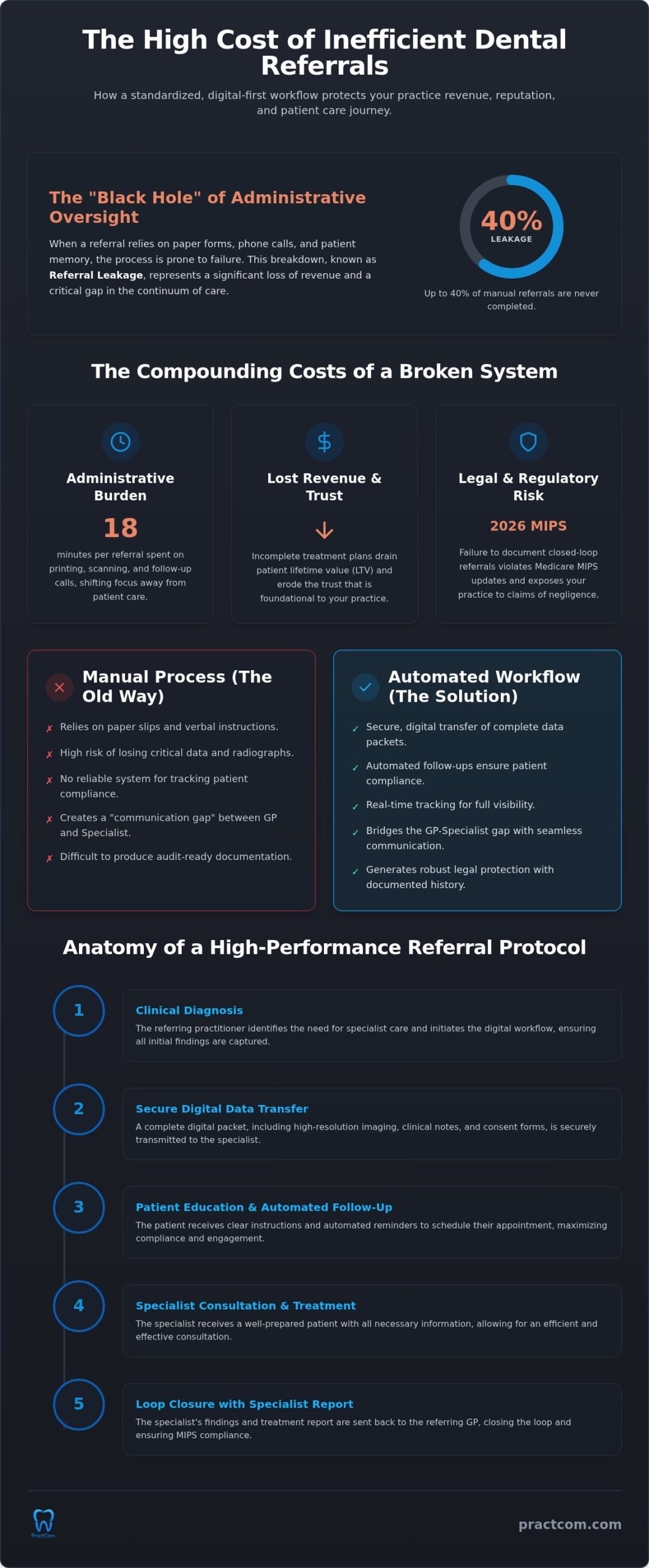
Did you know that up to 40% of manual dental referrals are never completed, essentially vanishing into a black hole of administrative oversight? This staggering rate of referral leakage doesn’t just represent lost revenue; it signals a breakdown in the patient care journey that leaves your practice vulnerable. To protect your reputation and your bottom line, you need a standardized dental referral workflow that moves beyond the limitations of paper forms and unreturned phone calls.
It’s frustrating to send a patient to a specialist only to realize weeks later that they never made the appointment, or to receive a clinical report that’s missing critical data. You aren’t alone in feeling that the handoff process is often the weakest link in your clinical operations. This guide will show you how to implement a digital-first, closed-loop system that ensures patient compliance and robust legal documentation. We’ll explore the latest 2026 regulatory requirements, including Medicare MIPS updates for documented referrals, and provide a clear roadmap for bridging the communication gap between general practitioners and specialists.
Key Takeaways
- Discover how a standardized dental referral workflow eliminates “referral leakage” and protects your practice revenue from administrative oversight.
- Learn to identify the anatomy of a high-performance protocol, moving from clinical diagnosis to secure digital data transfer without losing critical radiographs.
- Compare the efficiency of manual versus automated systems to reduce the time-to-completion and eliminate the psychological toll of paper-based tracking.
- Follow a structured five-step implementation plan to audit your current dropout rates and select a communication suite that bridges the GP-Specialist gap.
- Understand how integrating multi-language support and automated follow-ups ensures patient compliance and provides robust legal protection through documented communication.
The Hidden Cost of an Inefficient Dental Referral Workflow
Operational disorganization in the referral process is a silent profit killer. When a general practitioner identifies a need for specialist care, the transition should be seamless, yet research indicates that 30% to 40% of manual dental referrals are never completed. This phenomenon, known as referral leakage, represents a significant drain on practice revenue and, more importantly, a compromise in patient health. When your dental referral workflow relies on paper slips and verbal instructions, you aren’t just losing track of a procedure; you’re losing the patient’s trust and their lifetime value to your practice.
The burden of managing these manual systems often falls on your administrative team. On average, a dental patient coordinator spends 18 minutes per referral on tasks like printing, scanning, and making follow-up calls. This administrative friction creates a high-pressure environment where errors are inevitable. Moving toward electronic referral systems allows your staff to reclaim this time, shifting their focus from paper-chasing to patient engagement. Without a standardized digital bridge, the “communication gap” between GPs and specialists persists, leading to incomplete clinical data and delayed treatments.
Quantifying Referral Leakage in Modern Dentistry
Referral leakage is a preventable administrative failure. Beyond the immediate loss of the referred procedure, the financial impact extends to the patient’s lifetime value (LTV). If a patient feels neglected during the handoff process, they’re less likely to return to your practice for future care. In a 2026 clinical landscape where patient acquisition costs remain high, retaining existing patients through a reliable referral loop is a business necessity. You can’t afford to let 40% of your treatment plans evaporate because of a broken tracking system.
The Risk Management Perspective: Beyond Clinical Care
Documenting the referral handoff is no longer just a best practice; it’s a legal and regulatory requirement. As of 2026, Medicare’s MIPS updates require documented, closed-loop referrals where the specialist’s findings must be returned to the referring provider to consider the case complete. Failing to track this loop leaves your practice vulnerable to claims of clinical negligence if a patient’s condition worsens due to lack of follow-through.
A robust system ensures that every step is recorded, providing you with the psychological security that your documentation is audit-ready. This includes ensuring the patient has provided informed consent for the referral itself. To understand how this fits into your broader compliance strategy, review our guide on Digital Dental Informed Consent Forms: The 2026 Guide to Clinical Compliance. While PractCom is not a full PMS, it functions as a protective guardian for your reputation by automating these critical touchpoints and ensuring no patient falls through the cracks.
The Anatomy of a High-Performance Referral Protocol
A high-performance dental referral workflow functions as a synchronized loop rather than a one-way handoff. It isn’t enough to simply identify a clinical need; you must engineer a system that guides the patient from your chair to the specialist’s office and back again. This protocol typically follows five distinct stages: clinical diagnosis, secure digital data transfer, patient education, automated follow-up, and the final loop closure with a specialist report. By standardizing these steps, you eliminate the ambiguity that leads to patient dropout and administrative errors.
Transitioning to an automated system allows you to manage these stages with technical precision. Instead of relying on a patient to remember instructions, your practice can trigger a sequence of events that maintains momentum. If you’re interested in seeing how automation can stabilize your front-office operations, you can explore our referral management tools to begin the transition away from manual tracking.
Phase 1: The Digital Handoff
The digital handoff is the foundation of building a safe referral process. Moving away from paper slips ensures that critical clinical data isn’t lost in transit. A modern handoff must include high-resolution imaging, digital consent forms, and a clear narrative explaining the “why” behind the referral. When a specialist receives a complete digital packet immediately, they’re better prepared to provide care, which reflects positively on your practice’s professional standards. This immediate data transfer removes the friction of waiting for mailed radiographs or illegible faxed notes.
Phase 2: Patient Compliance and Education
Patient anxiety is a leading cause of referral leakage. You can mitigate this by using post-treatment instructions that clearly prepare the patient for what to expect at the specialist’s office. Language barriers often compound this anxiety; therefore, providing these instructions in the patient’s native tongue is an ethical and professional necessity. PractCom supports communication in 15 languages, ensuring that every patient receives clear, actionable data. Research suggests that a patient who fully understands the clinical necessity of their treatment is up to 40% more likely to follow through with the specialist visit. By delivering automated, multi-language follow-ups, you provide the psychological security patients need to move forward with their care plan.
Finally, the loop only closes when the specialist’s report is received and reviewed by the GP. This final step is critical for clinical continuity and meets the 2026 MIPS requirements for documented care coordination. Without this feedback, the workflow remains open, leaving both the patient and the practice in a state of clinical uncertainty.
Manual vs. Automated Referral Management Systems
The efficiency of your dental referral workflow depends entirely on the infrastructure supporting it. While manual systems rely on the hope that a patient won’t lose a paper slip, automated systems rely on data. Manual referral coordination is an invisible expense; it costs your practice in lost time and lost patients. When you transition to a digital system, you replace the 18 minute administrative hurdle of printing, faxing, and calling with a streamlined process that takes seconds. This shift doesn’t just save time; it eliminates the common errors that plague traditional handoffs, such as lost radiographs or illegible clinical notes that frustrate specialists.
Scalability is where the contrast becomes most apparent. For DSOs and multi-location practices, manual workflows are a liability. You can’t maintain clinical standards across five or ten locations using disparate paper logs. Automation provides a centralized source of truth, ensuring that every referral follows the same high-performance protocol regardless of which staff member initiates it. This standardization is what transforms a chaotic office into a stabilizing force for patient care.
The Problem with the “Paper Slip” Mental Model
Many practices still operate under the “paper slip” mental model, where the referral process ends the moment the patient leaves the chair. This often leads to “referral ghosting,” where patients lose their physical slips or simply forget the clinical necessity of the visit. Your front office then spends hours calling specialists to check on appointment statuses, a task that is both tedious and inefficient. By standardizing the GP-Specialist communication channel through a digital platform, you remove the patient as the primary courier of clinical data. This ensures the specialist has exactly what they need before the patient even calls to schedule.
The ROI of Automation in Clinical Communication
Calculating the ROI of automation starts with the hours your team reclaims each week. Automating patient follow-ups and specialist notifications can save a single coordinator several hours of labor every month. Beyond the clock, Mastering Dental Referral Management Software in 2026 allows you to build stronger, more professional relationships with your specialist partners. They receive clean, actionable data, and you receive the psychological security that your patients are being tracked properly.
Using a Practice Performance Dashboard is essential for identifying where your specific bottlenecks exist. It allows you to see exactly where patients are dropping out of the loop, whether it’s at the initial appointment booking or the final report stage. This level of oversight isn’t about technical speed alone; it’s about providing “administrative warmth.” It shows your patients and your partners that you’re organized, protective of their health, and forward-thinking. While PractCom is not a full PMS, it serves as the dedicated communication suite that ensures no part of this professional ecosystem is left to chance.
5 Steps to Implementing a Standardized Referral Protocol
Moving from a reactive state to a proactive system requires more than just better intentions; it requires a structured implementation plan. Standardizing your dental referral workflow is an active process that shifts the responsibility of care coordination from the patient’s memory to your practice’s digital infrastructure. By following a specific sequence of administrative actions, you can transform the handoff process from a point of vulnerability into a point of clinical strength. This ensures that every referred patient is tracked, every specialist is held accountable, and every clinical outcome is documented.
Auditing Your Current Referral Leakage
You cannot fix what you haven’t measured. The first step in any optimization strategy is to audit your existing records to identify where patients are dropping out of the loop. Use your performance dashboard to quantify your current completion rate; if you’re like most manual practices, you may find that 30% to 40% of referrals never result in a specialist visit. Look for patterns in your data, such as specific specialists who consistently fail to send reports back or certain procedures that have higher dropout rates. Setting a firm benchmark for a 90% follow-through rate provides your team with a clear, measurable goal that moves the practice toward a higher standard of care.
Once you understand your baseline, the next phase involves selecting a communication suite that integrates seamlessly with your clinical documentation. While PractCom is not a full PMS, it functions as the dedicated engine for this process, allowing you to train staff on a “Referral First” mentality during checkout. Your team should be equipped to confirm the specialist appointment before the patient leaves the building, rather than handing over a paper slip and hoping for the best. Additionally, establish a “Report-Back” deadline with your preferred specialist network. Making it clear that your practice requires a digital report within 48 hours of treatment creates a professional expectation that “closes the loop” and meets 2026 regulatory requirements.
Preparing the Patient for the Handoff
Patient engagement is a critical component of a digital-first dental referral workflow. You must address the psychological barriers to care, such as anxiety and confusion, by delivering pre-specialist instructions in the patient’s native language. PractCom allows you to send these documents via SMS or email in 15 different languages, ensuring total clarity. Utilizing digital informed consent at this stage also helps set realistic expectations for the specialist procedure, which significantly improves compliance. When a patient understands the clinical necessity and the logistics of their next steps, they’re far more likely to follow through. Ready to standardize your practice operations? Start your free PractCom trial today to begin automating your patient follow-ups and specialist notifications.
Closing the Loop: How PractCom Empowers Referral Success
The final stage of a high-performance dental referral workflow is the transition from administrative tracking to clinical realization. PractCom functions as the stabilizing force in this process by integrating a dedicated referral management system with an extensive Post-Treatment Instruction Library. This synergy ensures that the handoff is not just a data transfer but a comprehensive patient preparation. By providing clear, automated instructions, you move the patient from a state of clinical uncertainty to one of informed compliance.
Automated follow-ups are the engine behind reducing “no-show” rates at specialist offices. When a patient receives timely SMS and email reminders in their native tongue, the likelihood of appointment follow-through increases dramatically. PractCom’s support for 15 languages removes the common barrier of miscommunication that often leads to referral leakage. This level of oversight provides the psychological security practitioners need, knowing that their patients are supported throughout the specialist loop without requiring constant manual intervention from staff.
Beyond the Referral: A Holistic Communication Suite
PractCom is not a full PMS; instead, it’s a specialized communication tool designed to bridge the gaps that traditional software often misses. With over 80 pre-built templates, your team can provide expert-level guidance for any clinical scenario in seconds. This level of clarity directly impacts the Dental Patient Experience, transforming a complex referral into a manageable, well-documented journey. The patient portal further strengthens this loop by keeping all digital consent forms and instructions in one secure, accessible location, ensuring both the GP and the patient have a clear, audit-ready record of the care plan.
Final Implementation: The Next Step for Your Practice
Moving into 2026, the shift toward a paperless, automated workflow is no longer optional for practices that value efficiency and legal protection. While the system is digital-first, it remains grounded in the logistical realities of modern dentistry by offering physical document printing for patients who prefer traditional paper copies. This flexibility ensures that your practice remains accessible to all demographics while maintaining a sophisticated backend for tracking and compliance. You don’t have to manage the stress of manual tracking or the risk of incomplete clinical data any longer. You can optimize your referral workflow now at PractCom and reclaim the time your team needs to focus on high-value patient care.
Secure Your Clinical Future Through Standardized Communication
Mastering the dental referral workflow is no longer just an administrative goal; it’s a professional necessity in a landscape defined by strict 2026 regulatory standards. You’ve seen how referral leakage drains revenue and compromises patient care, but you also have the tools to stop it. By moving from the uncertainty of paper slips to the precision of a digital-first system, you protect your reputation and your patients’ health.
PractCom serves as your reliable ally, offering 15-language support for all clinical documents and a library of 80+ pre-built post-treatment templates. Trusted by national dental networks and DSOs, our platform bridges the gap between GPs and specialists with technical accuracy and administrative warmth. It’s time to eliminate operational resistance and ensure every patient follows through with their care plan. Streamline your practice workflow and start your free trial today. Your team deserves the confidence of a standardized system, and your patients deserve the clarity of a closed-loop journey.
Frequently Asked Questions
What is the most common cause of dental referral leakage?
The most common cause of dental referral leakage is the reliance on manual, paper-based tracking systems that fail to close the communication loop. When a practice hands a patient a physical slip and expects them to manage the handoff, the risk of “referral ghosting” increases significantly. Administrative oversight often occurs when there is no centralized digital record to trigger follow-ups, leading to a breakdown in the patient care journey and lost revenue.
How does digital referral management improve specialist relations?
Digital referral management improves specialist relations by providing clean, actionable clinical data and high-resolution imaging in a standardized format. Specialists appreciate receiving the “why” behind a referral immediately, which allows them to prepare for the patient visit more effectively. This technical precision reduces the friction of missing radiographs or illegible notes, positioning your practice as a professional and organized partner within the specialist network.
Can I send referral instructions in multiple languages?
Yes, you can send referral and post-treatment instructions in 15 different languages to ensure total patient clarity. Language barriers are a significant cause of patient anxiety and non-compliance during the handoff process. By delivering automated instructions in the patient’s native tongue via SMS or email, you address these psychological barriers and significantly improve the likelihood that the patient will follow through with the specialist appointment.
Is a referral management system the same as a Practice Management Software (PMS)?
No, a referral management system like PractCom is not a full Practice Management Software (PMS). While a PMS handles general scheduling and billing, PractCom is a dedicated communication and documentation suite that bridges specific clinical gaps. It integrates with your existing workflow to provide specialized tools like a post-treatment instruction library and digital informed consent, which are often underdeveloped or missing in standard PMS platforms.
How do automated follow-ups help with patient compliance?
Automated follow-ups help with patient compliance by maintaining consistent engagement after the patient leaves your chair. These triggers remind the patient of the clinical necessity of their specialist visit and provide a secure link to their instructions. By automating these touchpoints, you reduce the “no-show” rate at specialist offices and ensure the dental referral workflow remains active without requiring additional labor from your front office team.
What clinical data should always be included in a dental referral?
A comprehensive dental referral should always include high-resolution imaging, a clear clinical narrative explaining the reason for the referral, and the patient’s relevant medical history. It’s also essential to include digital informed consent documentation and specific instructions for the specialist. Providing this data in a secure, digital packet ensures the specialist has a complete understanding of the case, which leads to better clinical outcomes and a smoother patient experience.
Is digital referral tracking HIPAA compliant?
Yes, digital referral tracking is designed to meet and exceed HIPAA requirements for the secure transfer of protected health information (PHI). As of 2026, regulatory standards emphasize the need for encrypted communication and auditable trails for all patient data transfers. Using a secure platform ensures that clinical reports and radiographs are handled with the necessary technical precision to protect your practice from compliance risks and legal liabilities associated with data breaches.
How can I track the performance of my referral network?
You can track the performance of your referral network by using a dedicated performance dashboard to monitor key metrics such as patient dropout rates and specialist report-back times. This data allows you to identify “unresponsive” specialists and quantify the follow-through rate for specific procedures. Having this level of oversight enables you to make data-driven decisions about your preferred network, ensuring you partner with specialists who prioritize clinical coordination and loop closure.

Article by
Cary Ganz DDS
Dr. Cary H. Ganz is a dentist, prosthodontist, entrepreneur, lecturer, and author with more than 50 years of experience in clinical dentistry and dental technology. Throughout his career, he has combined hands-on patient care with a deep understanding of how technology can improve dental practice operations, communication, documentation, and patient outcomes.
In addition to his clinical background, Dr. Ganz has held significant leadership roles in the dental technology industry, including Past Owner and Vice President of Clinical Affairs at DEXIS Digital Radiography and Past Vice President of Clinical Affairs at Denticon Practice Management Software. His business experience includes product development, clinical strategy, dental software innovation, practice management solutions, and educating dental professionals on the effective use of technology in modern dentistry.
Today, Dr. Ganz continues to focus on creating practical technology solutions for dental practices, including PractCom, a comprehensive dental practice communication platform designed to improve patient communication, documentation, compliance support, referrals, and overall practice efficiency. His work reflects a career-long commitment to helping dentists deliver better care while making their practices more organized, efficient, and protected.
No responses yet