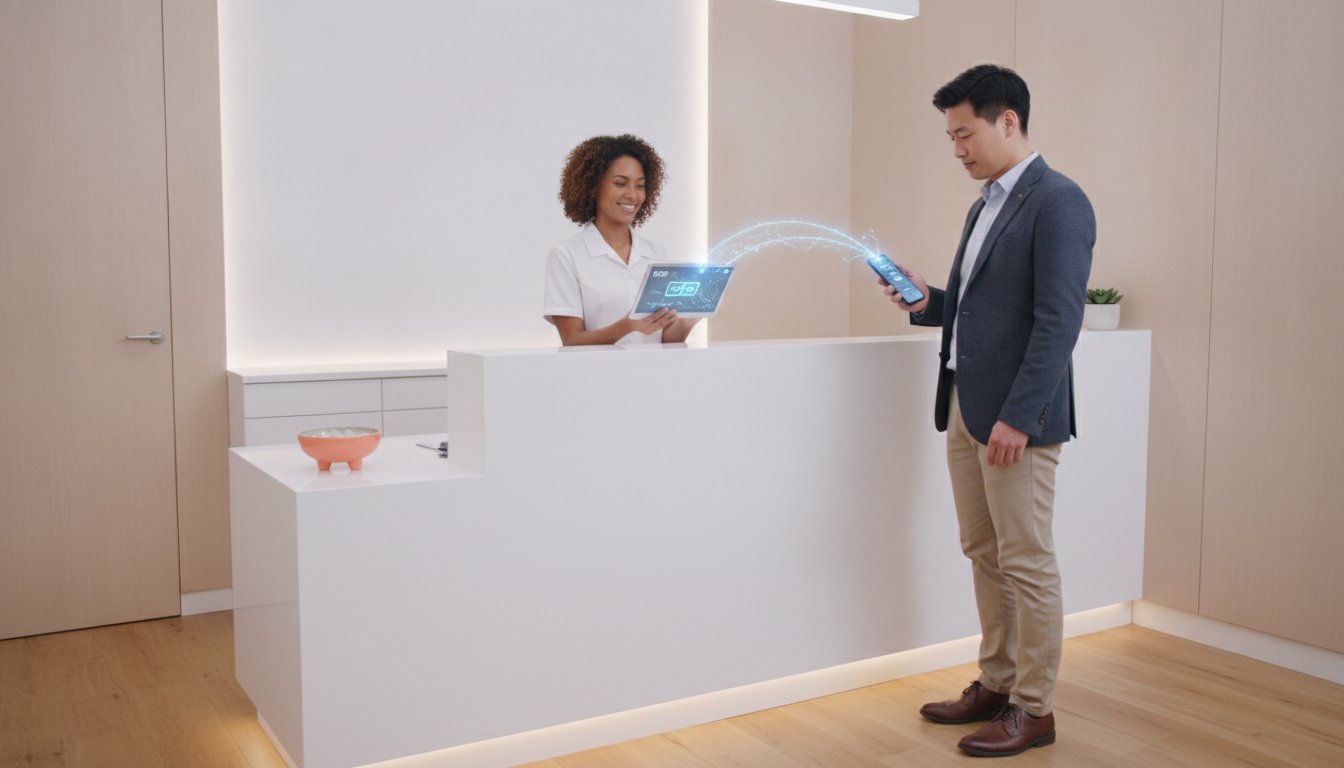
What if your front desk wasn’t just a scheduling hub, but a high-fidelity clinical safeguard that protected your practice from a costly compliance error? You likely feel the daily pressure of staff turnover and the constant worry that a missed post-op instruction or an outdated privacy notice could trigger a regulatory nightmare. It’s exhausting to manage a team that’s buried in follow-up calls while trying to keep up with the latest 2026 encryption requirements. Staying ahead of dental front office technology trends is no longer about convenience; it’s about survival in a landscape where manual documentation is a professional liability.
We understand that your team’s time is your most valuable asset. Discover the emerging technologies that are transforming dental front offices from simple scheduling hubs into high-efficiency clinical communication centers. This article previews the five essential shifts, from AI-driven automation to multi-language patient portals, that will reduce your administrative burden, mitigate legal risks, and improve patient treatment compliance. You’ll learn how to move from the resistance of manual tasks to the confidence of a standardized, tech-enabled system that secures both your reputation and your revenue.
Key Takeaways
- Learn why relying solely on your Practice Management Software creates operational gaps and how specialized dental front office technology trends are shifting toward integrated, clinical-first communication.
- Discover how automated post-treatment instruction libraries eliminate the clinical risk of handwritten notes while reducing the burden of repetitive follow-up phone calls on your team.
- Understand the legal necessity of providing digital informed consent and documentation in multiple languages to protect your practice against compliance violations in an increasingly diverse patient landscape.
- Identify how a digital referral management system can reclaim lost revenue by closing the 25-50% referral leakage gap common in traditional paper-based practices.
- Explore the strategy for adding a specialized patient communication platform that functions as a guardian of your legal standing without requiring a complex software overhaul.
The 2026 Dental Front Office Landscape: Moving Beyond Simple Automation
The dental landscape in 2026 has reached a tipping point where traditional hiring can’t keep pace with operational demands. You’ve likely noticed that finding and retaining skilled front-desk personnel is becoming increasingly difficult and expensive. This staffing reality means that adding more employees to the front office is no longer a viable scaling strategy for a modern practice. Instead, the focus has shifted toward dental front office technology trends that prioritize precision over presence. These tools don’t just automate tasks; they adopt a “Patient-Ally” persona, acting as a bridge between complex clinical procedures and the patient’s need for clear, accessible guidance.
The Staffing Crisis as a Catalyst for Tech Adoption
High turnover rates in 2026 continue to plague the industry, with the cost of replacing a single administrative staff member often reaching thousands in lost productivity and training time. When your team is in constant flux, the risk of a documentation error or a HIPAA compliance oversight skyrockets. Technology provides a regulatory safety net by standardizing every interaction, ensuring that even a new hire follows your exact clinical protocols. Systematized technology acts as an ever-present office manager that remains vigilant against compliance gaps while your human team focuses on face-to-face patient care. This shift toward specialization often extends to the financial side of the practice; by delegating complex revenue cycles to experts like HPC Healthcare Partners, healthcare providers can ensure billing accuracy without increasing the administrative load on their staff.
From PMS-Centric to Ecosystem-Centric Workflows
While foundational dental software like your Practice Management System (PMS) remains necessary for billing and scheduling, it’s no longer enough to handle the nuances of modern clinical communication. We are seeing a move toward ecosystem-centric workflows where specialized tools like PractCom outperform the generic modules found in all-in-one systems. These specialized platforms leverage advanced API integrations and mandatory 10DLC registration for SMS strategies to ensure high deliverability and security. By focusing on high-utility, low-friction tools, you can eliminate software fatigue while gaining the technical precision required for informed consent and post-op care.
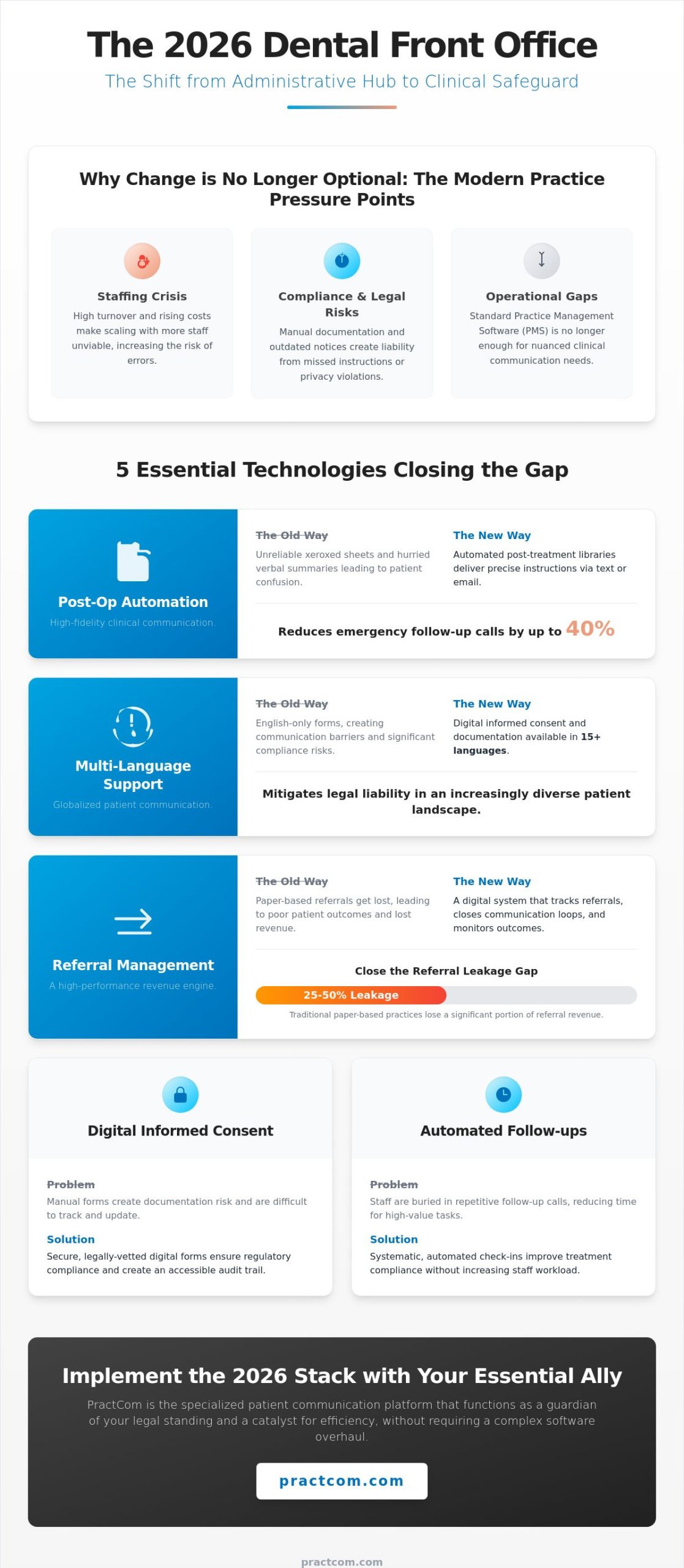
The 2026 dental front office is defined by five key technologies that close the gap between the front desk and the operatory:
- Post-Treatment Instruction Libraries: Automated, high-fidelity clinical guidance delivered via text or email.
- Digital Informed Consent Forms: Secure, legally-vetted documentation that ensures regulatory compliance.
- Multi-Language Communication: Support for 15+ languages to bridge demographic gaps and mitigate liability.
- Specialized Referral Management Systems: Digital ecosystems that stop revenue leakage and track patient outcomes.
- Automated Patient Follow-ups: Systematic check-ins that improve treatment compliance without increasing staff workload.
Trend 1: High-Fidelity Clinical Communication & Post-Op Automation
High-fidelity clinical communication represents a shift from “telling” a patient what to do to providing a persistent, accessible record of care. In 2026, the trend of “Frictionless Aftercare” has officially replaced the unreliable xeroxed sheet and the hurried verbal summary. When you utilize automated post-treatment libraries, you ensure every patient receives the exact instructions they need, delivered to their preferred device the moment they leave the chair. This level of technical precision is a cornerstone of data-driven practice management, as it removes human memory from the recovery equation.
The impact on your front office is immediate. By providing clear, digital instructions, practices frequently report a reduction in emergency phone calls by up to 40%. This significantly lowers the “administrative noise” that typically distracts your team from high-value tasks like treatment presentation and schedule optimization. Beyond the numbers, there is a profound sense of psychological security for both staff and patients. Your team no longer has to wonder what was said chairside, and your patients leave with the confidence that their provider is watching over their recovery even after they go home.
The End of the ‘Verbal Instruction’ Era
Relying on verbal communication is a significant clinical risk. Studies indicate that patients forget between 40-80% of medical information immediately after hearing it. Staying ahead of dental front office technology trends means recognizing that verbal instructions are no longer the standard of care. Digital post-op instructions provide a vital legal audit trail, documenting exactly what information was delivered and when it was accessed. For a detailed roadmap on implementing this, see our guide on Automated Dental Post-Op Instructions: The 2026 Guide to Frictionless Aftercare.
Multi-Channel Delivery: SMS, Email, and Print
Patients in 2026 demand flexibility in how they receive medical data. While the vast majority prefer the convenience of an SMS or email, the “Hybrid Office” trend highlights that physical document printing remains a necessity for certain demographics, particularly elderly patients who value a tangible reference. Modern systems allow your team to toggle between these channels with a single click. Furthermore, automated follow-ups ensure the patient feels supported without a manual call from the front desk, closing the clinical-administrative gap through systematic oversight. If you want to see how these automated touchpoints can stabilize your workflow, you can explore how our platform secures your post-op communication.
Trend 2: Globalized Patient Communication and Multi-Language Documentation
The 2026 demographic landscape is shifting rapidly, and your practice must adapt to remain competitive. Relying on English-only documentation is no longer just a barrier to care; it’s a significant professional liability. One of the most impactful dental front office technology trends is the move toward “Inclusive Dentistry.” By leveraging platforms that provide documentation and instructions in 15+ languages, you bridge the communication gap that often leads to treatment refusal. When patients fully understand the clinical rationale and the expected outcomes in their native language, they’re significantly more likely to move forward with necessary procedures.
Misunderstandings regarding post-op care or financial responsibilities frequently lead to clinical errors and administrative friction. Adopting a robust digital workflow and practice management strategy must include multi-language support to ensure clarity across every patient touchpoint. This systematic approach reduces the risk of patients mismanaging their recovery due to a language barrier. It protects your practice from preventable complications and the administrative burden of resolving avoidable patient complaints, ensuring your team isn’t bogged down by repetitive explanations.
Regulatory Reassurance through Translation
True informed consent is both a legal requirement and an ethical necessity. You can’t accurately claim a patient has consented if they didn’t fully comprehend the risks and benefits explained in a language they don’t master. Providing digital dental informed consent forms in a patient’s native language creates a secure, verifiable documentation trail. This proactive measure safeguards your professional reputation and ensures that your practice meets the highest standards of regulatory compliance without adding extra stress to your front-desk team.
Scaling with DSOs: The Multi-Location Language Challenge
Large dental groups face the daunting task of standardizing care across diverse geographic regions with varying language needs. Centralized communication platforms allow DSOs to maintain a consistent clinical voice while adapting to local demographic realities with ease. This is why PractCom for DSOs is becoming the preferred standard for large-scale clinical documentation and patient engagement. Standardizing inclusive communication yields a measurable return on investment by maximizing patient retention and treatment throughput across every location in the organization.
Trend 3: Specialized Referral Management as a Revenue Engine
Referral leakage is a quiet drain on your practice’s bottom line that often goes unnoticed until you analyze the data. Industry reports suggest that between 25% and 50% of dental referrals are never actually completed. This failure represents a massive loss in potential revenue and a breakdown in the continuity of patient care. One of the most critical dental front office technology trends for 2026 involves moving away from the unreliable paper referral slip toward secure, digital referral ecosystems. These systems don’t just send information; they nurture the referral through automated touchpoints until the patient is safely booked in the specialist’s chair.
By shifting to a digital model, your front office transforms from a passive messenger into a proactive revenue coordinator. Specialized technology ensures that the specialist receives all necessary clinical data and imaging instantly, eliminating the friction that often prevents patients from following through. This transition also builds stronger relationships with your specialist network, as they appreciate the clarity and completeness of the data you provide. It’s a systematic way to ensure that your clinical recommendations result in actual treatment, securing both patient health and practice growth.
Closing the Specialist Loop
The 2026 trend of “Integrated Specialty Circles” focuses on a seamless data transfer between the GP and the specialist. When you use dedicated referral tracking software, your front office gains a level of efficiency that manual logs simply can’t match. It eliminates the guesswork and the endless follow-up calls to see if a patient ever made their appointment. This systematic approach ensures that clinical data and imaging move securely, protecting patient privacy while improving the speed of care. To dive deeper into these tools, read our detailed guide on Mastering Dental Referral Management Software in 2026.
Referral Tracking as Practice Growth
Modern front offices now treat referral management as a strategic growth engine. By utilizing a practice performance dashboard, you can identify exactly which referral partners are providing the highest value and which relationships need more attention. Automated patient follow-ups play a crucial role here; they act as a persistent reminder to the patient, increasing the conversion rate of a referral into an actual visit. This technology is often the hidden revenue driver of a successful 2026 practice. It transforms a passive administrative task into a proactive clinical-administrative bridge that keeps patients within your trusted network. If you’re ready to stop the revenue leakage in your practice, see how our Referral Management System can secure your specialty network today.
Implementing the 2026 Stack: Why PractCom is the Essential Ally
Adopting the latest dental front office technology trends shouldn’t feel like a forced march through complex software transitions. In the high-pressure environment of a modern practice, you need a stabilizing force that protects your reputation without adding to your team’s cognitive load. PractCom functions as a guardian of your legal standing by replacing the fallibility of human memory with a standardized, systematic approach to patient communication. By moving away from the resistance of manual tasks, your team can finally operate with the confidence that no clinical instruction or consent form has been overlooked.
One of the most significant advantages of the 2026 stack is the “Zero-Resistance” implementation model. You don’t need to undergo a disruptive Practice Management Software (PMS) overhaul to gain these advanced capabilities. This modular approach mirrors how industrial firms explore Digitalisation Vision & Roadmap Consulting to integrate specialized solutions into their existing workflows. PractCom is designed to work alongside your existing systems, filling the specialized gaps that generic modules often ignore. This allows you to upgrade your clinical-administrative bridge immediately, ensuring that your front office becomes a center for documentation excellence rather than a source of operational anxiety.
Why Specialized Solutions Outperform PMS Modules
Generic PMS templates often lack the clinical nuance required for complex procedures. The PractCom Post-Treatment Instruction Library provides a level of depth that ensures patients receive precise, high-fidelity guidance tailored to their specific recovery needs. Beyond basic instructions, a dedicated patient portal is now an essential requirement for modern engagement, providing a secure space for patients to access their records and consent forms. Additionally, the integration of Smile Design tools allows your front-office team to provide immediate cosmetic treatment visualization, which significantly increases case acceptance by making the clinical outcome feel tangible and attainable.
Getting Started: The Path to a High-Tech Front Office
The transition to a more efficient workflow begins with a simple audit of your current communication gaps. Identify where your team spends the most time on repetitive phone calls or where documentation feels inconsistent. Once these friction points are clear, you can trial specialized technology in specific areas, such as automated follow-ups or digital consent, without disrupting your daily clinical rhythm. This incremental approach allows your staff to acclimate to the new system while seeing the immediate benefit of a reduced administrative burden. To secure your practice’s future and move toward a more protected, efficient office, start your free trial with PractCom today.
Secure Your Practice’s Legacy in a Tech-Driven Era
The shift toward high-fidelity clinical communication is no longer a luxury; it’s a professional necessity for any practice aiming to thrive in 2026. By embracing these dental front office technology trends, you move from the operational disorganization of manual tasks to the psychological security of a standardized system. You’ve seen how automated post-op libraries, inclusive multi-language documentation, and digital referral ecosystems can significantly reduce administrative noise while protecting your practice from regulatory risk. This transition allows your team to focus on patient care rather than documentation compliance.
PractCom was built by dental professionals who understand the physical and logistical realities of your daily workflow. With a library of 80+ post-treatment templates and support for 15 languages, our platform ensures clinical accuracy and patient understanding across every demographic. It’s time to replace the limitations of human memory with a reliable professional ally that functions as a guardian of your reputation. Secure your practice with PractCom’s clinical communication suite and start your free trial today. We look forward to helping you build a more efficient, protected, and profitable practice.
Frequently Asked Questions
What are the biggest dental front office technology trends for 2026?
High-fidelity clinical communication, multi-language documentation, and digital referral ecosystems are the dominant trends defining the current landscape. These technologies move beyond simple scheduling to bridge the gap between administrative tasks and clinical necessity. By automating complex follow-ups and consent, practices can maintain a standardized level of care regardless of staff turnover or human memory limitations.
How does automated dental post-op communication reduce practice liability?
Automated communication creates a verifiable digital audit trail that proves exactly what information was delivered and when the patient accessed it. Since patients often forget a significant portion of verbal instructions immediately, providing persistent digital records mitigates the risk of clinical complications caused by patient error. This systematic approach ensures your practice meets the high documentation standards required in a modern clinical environment.
Is AI-powered dental front office software worth the investment?
AI-powered systems are worth the investment when they address specific operational friction points like scheduling, insurance verification, and patient triage. These tools allow your team to reclaim hours of productive time by handling repetitive data entry and basic inquiries. In a market defined by labor shortages, AI functions as a stabilizing force that maintains practice efficiency without increasing your headcount.
How can technology help with the dental staffing shortage?
Technology acts as an ever-present office manager that standardizes workflows, making it easier for new or rotating staff to perform at a high level. By automating time-consuming tasks like post-op follow-ups and referral tracking, you reduce the burnout that leads to high turnover. This allows your remaining team to focus on high-value patient interactions, making your practice less vulnerable to staffing fluctuations.
What is the difference between a PMS and a specialized dental communication suite?
A Practice Management Software (PMS) is a generalist tool focused on billing and scheduling, whereas a specialized communication suite provides deep clinical documentation and engagement features. While a PMS handles the business basics, a specialized suite offers high-utility tools like multi-language consent forms and automated instruction libraries. Using a specialized platform ensures that clinical communication isn’t treated as a secondary feature of your administrative software.
How do digital informed consent forms improve patient compliance?
Digital informed consent forms improve compliance by allowing patients to review risks and benefits in a low-pressure environment, often in their native language. When patients aren’t rushed through paperwork in the waiting room, they develop a deeper understanding of the procedure and the necessary aftercare. This clarity leads to higher treatment acceptance and a more disciplined approach to post-operative recovery protocols.
Why is multi-language support important for dental practices in 2026?
Multi-language support is essential because it addresses the diverse demographic reality of modern patient populations where English may not be the primary language. Providing documentation in 15+ languages is a critical component of dental front office technology trends that prioritize inclusive care. It ensures true informed consent and reduces the clinical risk of patients misinterpreting post-treatment care due to a language barrier.
How much does dental front office technology typically cost?
Costs for front office technology vary widely based on the complexity of the platform and the size of your practice. Cloud-based solutions generally involve a monthly subscription fee, while more comprehensive systems may include initial implementation or training costs. You should evaluate the price against the potential ROI from reduced staff burnout, fewer emergency calls, and reclaimed revenue from closed referral loops.
Article by
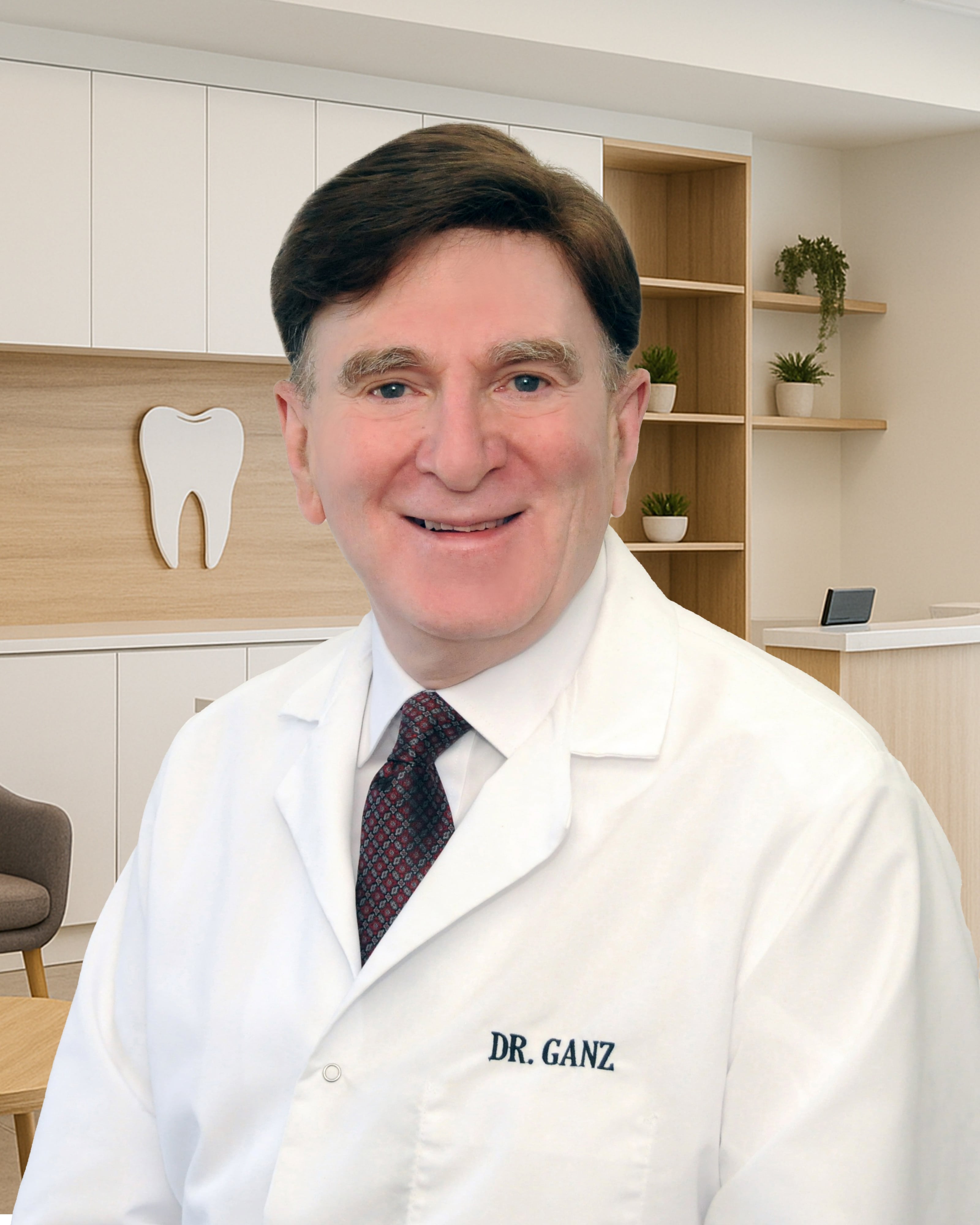
Cary Ganz DDS
Dr. Cary H. Ganz is a dentist, prosthodontist, entrepreneur, lecturer, and author with more than 50 years of experience in clinical dentistry and dental technology. Throughout his career, he has combined hands-on patient care with a deep understanding of how technology can improve dental practice operations, communication, documentation, and patient outcomes.
In addition to his clinical background, Dr. Ganz has held significant leadership roles in the dental technology industry, including Past Owner and Vice President of Clinical Affairs at DEXIS Digital Radiography and Past Vice President of Clinical Affairs at Denticon Practice Management Software. His business experience includes product development, clinical strategy, dental software innovation, practice management solutions, and educating dental professionals on the effective use of technology in modern dentistry.
Today, Dr. Ganz continues to focus on creating practical technology solutions for dental practices, including PractCom, a comprehensive dental practice communication platform designed to improve patient communication, documentation, compliance support, referrals, and overall practice efficiency. His work reflects a career-long commitment to helping dentists deliver better care while making their practices more organized, efficient, and protected.
No responses yet