
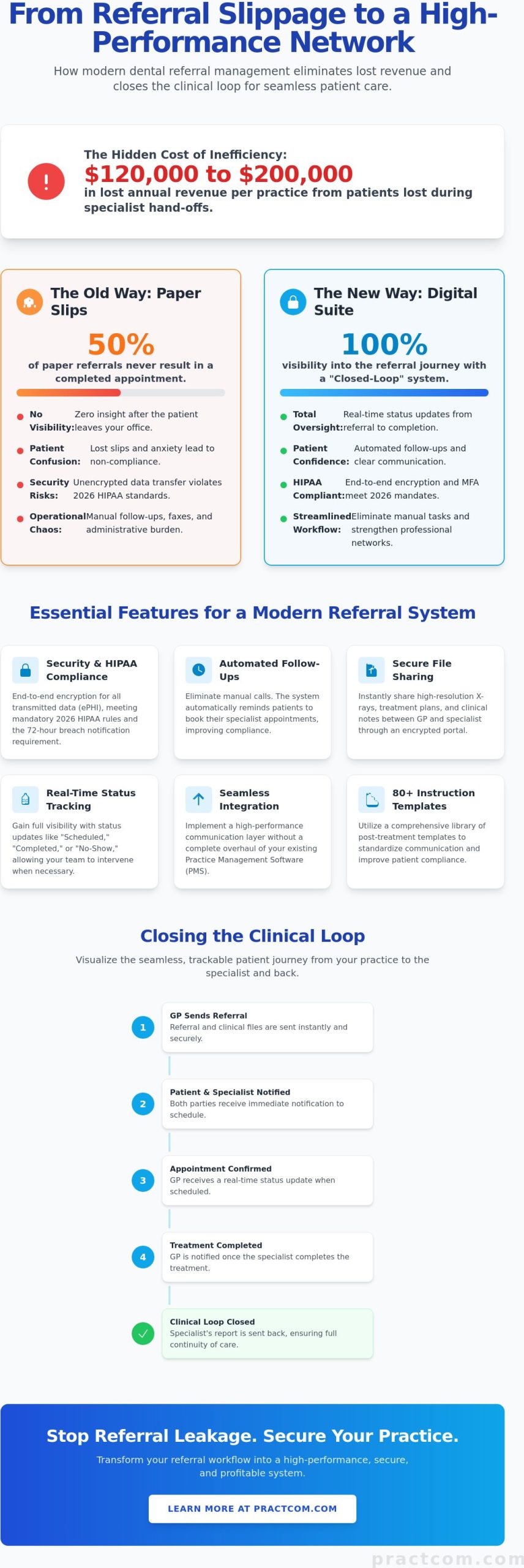
Did you know that dental practices operating without a digital system lose between $120,000 and $200,000 in annual revenue simply because patients vanish during the specialist hand-off? You likely feel the frustration of seeing a carefully planned treatment path stall because a paper referral slip was lost or a patient felt too overwhelmed to call the specialist. It’s a common operational stressor that compromises clinical continuity and weakens the professional bond between general practitioners and specialists.
By implementing modern dental referral management software, you can replace manual, error-prone tracking with a standardized system that ensures no patient falls through the cracks. This transition moves your practice from the resistance of administrative chaos to the confidence of a high-performance network. It’s about protecting your reputation and your patient’s health simultaneously.
In this 2026 guide, we explore how to eliminate referral slippage using automated tools, navigate the latest mandatory HIPAA encryption requirements, and utilize secure file sharing to maintain clinical oversight. You will learn the exact steps to transform a disjointed hand-off into a seamless, trackable experience that improves patient compliance and strengthens your professional relationships.
Key Takeaways
- Bridge the communication gap between general practitioners and specialists to ensure clinical continuity and patient safety across every referral.
- Discover how modern dental referral management software automates patient follow-ups and secures clinical file sharing to eliminate revenue loss from referral leakage.
- Integrate digital informed consent into your referral workflow to reduce specialist liability and ensure patients understand the clinical necessity of their treatment.
- Audit your current referral slippage and implement a high-performance communication layer without the need for a full Practice Management Software overhaul.
- Utilize a comprehensive library of over 80 post-treatment instruction templates to standardize communication and improve patient compliance during the specialist hand-off.
What is Dental Referral Management Software?
Think of dental referral management software as a specialized communication bridge that connects general practitioners (GPs) with their specialist network. It transforms the often-chaotic hand-off into a structured, trackable clinical event. Instead of relying on a patient to remember a specialist’s name or keep track of a business card, this technology creates a digital pathway that follows the patient from your chair to the specialist’s office. It’s a stabilizing force in an industry where communication breakdowns are the leading cause of lost revenue and compromised care.
The primary goal is to maintain clinical continuity by managing the electronic exchange of health care information. This includes sharing high-resolution digital X-rays, complex treatment plans, and detailed clinical notes. Most importantly, it ensures your practice remains compliant with the strict 2026 HIPAA Security Rule updates, which now mandate encryption for all transmitted data and require multi-factor authentication (MFA) for system access. By moving away from manual tasks, you gain the psychological security of knowing every referral is documented and secure.
Traditional paper-based methods are inherently leaky. Industry data indicates that up to 50% of paper referrals never result in a completed appointment. This “referral slippage” represents a significant clinical failure. Implementing a “closed-loop” system ensures that the referring doctor has total visibility. You don’t have to guess if a patient followed through; the system confirms when they schedule, when they arrive, and when the specialist completes the treatment. This level of oversight is why many practices choose to integrate specialized communication tools into their daily workflow.
The Problem with Traditional Referral Slips
Patients are human and prone to error under stress. They lose paper slips, forget the specialist’s name, or feel too anxious to make the initial phone call. Once a patient walks out your door with a piece of paper, you lose all visibility into their progress. You’re left waiting for a faxed report that may never arrive, or worse, you discover months later that the treatment was never started. Physical slips and unencrypted emails also pose significant security risks. In 2026, failing to use encrypted transmission methods is a direct violation of federal standards, exposing your practice to the updated 72-hour breach notification requirement.
The Role of Technology in Modern Dental Networks
Modern digital tools facilitate instant communication between oral surgeons, orthodontists, and GPs. Instead of weeks of silence, you receive real-time status updates such as “Scheduled,” “Completed,” or “No-show.” This allows your administrative team to intervene immediately if a patient fails to book their appointment. It’s helpful to view this technology as the clinical nervous system of a dental network, coordinating every move to ensure the patient receives the care they need without delay. This proactive approach reduces operational resistance and builds a stronger, more reliable professional alliance between you and your specialists.
Essential Features of Modern Referral Systems in 2026
Modern dental referral management software isn’t just a digital address book; it’s a sophisticated tool designed to eliminate the administrative friction that stalls treatment. By 2026, specific features have moved from optional extras to essential business requirements. These tools provide the psychological security you need to manage a high-volume practice without losing clinical oversight. They act as a protective layer for your reputation, ensuring that every hand-off is professional and every patient feels supported.
Security and HIPAA Compliance
Security is the bedrock of clinical communication. With the 2026 HIPAA updates, mandatory encryption is now the standard for all electronic Protected Health Information (ePHI). High-performance systems allow you to securely share a patient’s vital medical information, including digital X-rays and clinical notes, through end-to-end encrypted channels. This protects your practice from the shortened 72-hour breach notification window and ensures you meet the latest biannual vulnerability scanning requirements.
Patient Engagement and Multi-Language Support
A referral often fails because the patient doesn’t understand the next steps or feels overwhelmed by the process. Language barriers significantly amplify this risk in diverse communities. Modern systems address this by providing automated SMS and email notifications in the patient’s native language. PractCom offers 15-language support for all referral documents, which acts as a gold standard for both regulatory compliance and patient comfort. When a patient receives clear, translated instructions on their phone, their anxiety decreases and their compliance increases.
Beyond simple communication, a centralized dashboard is critical for tracking referral volume and conversion rates. You need to know which specialists are returning reports and which patients are becoming “no-shows” before the revenue is lost. Automated follow-ups act as a pre-emptive strike against referral leakage, nudging the patient to schedule their appointment without your front desk making a single phone call. If you want to see how these features work in a live environment, you can explore a streamlined communication setup that bridges the gap between your office and the specialist. This visibility allows you to build a high-performance network based on actual data rather than anecdotal evidence.
Beyond the Hand-off: Closing the Clinical Loop
A referral is only as effective as the patient’s willingness to attend the appointment. If a patient leaves your office confused about the clinical “why,” the most sophisticated data transfer in the world won’t prevent a no-show. High-performance dental referral management software bridges this gap by transforming the hand-off into an educational experience. It ensures the patient understands the clinical necessity of specialized care before they even walk out your door.
The American Medical Association emphasizes that a frictionless exchange of medical information is the gold standard for modern care teams. This interoperability shouldn’t just exist between providers; it must extend to the patient. By closing the clinical loop, you move from a passive hand-off to an active partnership. This approach reduces operational resistance and positions you as a protective guardian of the patient’s long-term health. It’s about moving from the resistance of manual tasks to the confidence of a standardized, patient-centered system.
Integrating Informed Consent and Instructions
Integrating Digital Dental Informed Consent Forms into the initial referral process provides psychological security for both the patient and the specialist. When a patient reviews and signs consent forms in the comfort of their own home, their anxiety regarding complex procedures like endodontics or oral surgery decreases. This early intervention also reduces specialist liability by ensuring the patient is fully briefed on risks and alternatives well in advance. Providing “pre-op” instructions through the referral platform prepares the patient for the logistical realities of their upcoming treatment, which directly improves follow-through and compliance.
Visual Consultation and Smile Design
Visual aids are powerful motivators for case acceptance, especially for referred orthodontic or periodontal work. Using cosmetic visualizations and smile design tools allows you to show a patient the projected outcome of their specialized treatment plan. Seeing a “before and after” change creates an immediate emotional connection to the recommended care. It shifts the conversation from a clinical requirement to a personal desire for a better outcome. These visual tools act as a critical bridge between your clinical diagnosis and the patient’s motivation to complete the journey. They provide the “why” that technical jargon often fails to communicate.
Implementing a Seamless Workflow Without a New PMS
Many practitioners believe that fixing a broken referral process requires a total overhaul of their Practice Management Software (PMS). This is a costly misconception. The downtime, data migration risks, and staff retraining associated with a full PMS switch can paralyze a practice for months. You don’t need to replace your entire foundation to stop referral leakage. Instead, you can add a specialized communication layer that integrates with your existing tools. This approach provides a stabilizing force without the administrative trauma of a system-wide migration.
The first step is a clinical audit. You must identify exactly where your communication breaks down. Is it the front desk forgetting to send the digital X-rays? Or is it the patient losing the paper slip in their car? Once you’ve identified these gaps, you can implement a dental referral management software that acts as a pre-emptive strike against these failures. By following a structured implementation plan, you move from operational disorganization to systematic control in a matter of days, not months.
- Step 1: Audit your slippage. Calculate the gap between referrals written and appointments confirmed by specialists to find your “leakage rate.”
- Step 2: Select a specialized suite. Choose a platform that focuses on patient engagement and secure file sharing rather than just billing.
- Step 3: Standardize documentation. Train your team to use digital informed consent forms and automated follow-ups for every outgoing referral.
- Step 4: Monitor the ROI. Use a Practice Performance Dashboard to track your specialist network’s conversion rates in real-time.
The “All-in-One” vs. “Best-in-Class” Debate
Generic PMS modules often lack the technical precision required for high-performance clinical communication. Specialized tools are built specifically to bridge the gap between complex professional procedures and patient understanding. They offer faster staff adoption because they’re designed for ease of use in high-pressure environments. You can see how these focused systems differ from broad platforms by reviewing this PractCom vs Modento comparison, which highlights the benefits of a communication-first approach.
Training Your Team for Referral Success
Success depends on the conversation in the operatory. Your clinical team should explain the “why” behind the referral while the patient is still in the chair. Once the referral is initiated in the software, your front office can rely on automated SMS and email notifications to handle the heavy lifting. This saves hours of administrative time and ensures no patient is forgotten. If you’re ready to see how this workflow functions in your specific environment, you can start your implementation journey today and begin capturing that lost revenue immediately.
PractCom: The Allied Communication Suite for High-Performance Referrals
PractCom functions as the essential layer of communication between your existing Practice Management Software and your patients. While your PMS handles the billing and scheduling, PractCom acts as a guardian of the clinical relationship. It ensures that every referral is backed by clear, professional, and accessible information. By using this dental referral management software, you eliminate the operational resistance that often leads to patient confusion and referral slippage. It positions your practice as a stabilizing force, providing the psychological security patients need when transitioning to a specialist.
The system includes a comprehensive Post-Treatment Instruction Library with 80+ templates, allowing you to provide immediate clinical guidance for every specialty procedure. This standardization ensures that no matter who is in the chair, the patient receives consistent, high-quality information. To bridge the communication gap in diverse communities, PractCom provides email and text delivery in 15 languages. It also includes physical document printing capabilities, ensuring that older patients or those with limited digital access aren’t left behind. This commitment to accessibility is a clinical necessity in the modern landscape, protecting your reputation and your patient’s health.
Why PractCom is Different
Our approach prioritizes clinical documentation and patient education over simple scheduling logistics. We believe that a patient who understands their treatment is a patient who shows up. The integrated Smile Design tool is a unique differentiator for cosmetic referrals, allowing you to show patients their projected results before they meet the specialist. This visual motivation significantly increases case acceptance for elective procedures. You can learn more about our clinical-first philosophy to see how we stabilize high-pressure clinical environments through technical precision and administrative warmth.
Getting Started with Smarter Referrals
Implementing a new system shouldn’t disrupt your daily operations. You can start a free trial of PractCom today without the need for a full PMS overhaul or risky data migration. For large-scale operations, our platform is designed to support DSOs and multi-location practices through a unified performance dashboard. This allows leadership to monitor referral health and conversion rates across the entire organization from a single pane of glass. It’s time to move from the anxiety of manual tracking to the confidence of a standardized communication ecosystem. Start your free trial today to secure your practice’s clinical continuity and build a high-performance specialist network.
Securing Clinical Continuity in the 2026 Landscape
Transitioning to a high-performance specialist network is a clinical and regulatory necessity. By moving away from manual tracking, you eliminate the operational resistance that leads to revenue loss and patient confusion. You’ve seen how the right dental referral management software acts as a stabilizing force, ensuring that every hand-off is documented, encrypted, and understood by the patient. This systematic control protects your reputation while providing the psychological security your team needs to thrive in a high-pressure environment.
You don’t have to navigate this transition alone. With access to 80+ clinical post-treatment templates, digital consent forms in 15 languages, and an integrated Practice Performance Dashboard, you can close the clinical loop with technical precision. It’s time to replace the uncertainty of paper slips with the confidence of a standardized communication ecosystem. Master your referral workflow with a PractCom Free Trial and begin securing your practice’s clinical continuity today. Your patients deserve a seamless journey, and your practice deserves the stability of a high-performance network.
Frequently Asked Questions
What is dental referral management software?
Dental referral management software is a specialized digital platform that facilitates the secure transfer of patient information between general practitioners and specialists. It replaces traditional paper-based methods with a trackable, encrypted system that ensures clinical continuity. By centralizing documentation and communication, it eliminates the administrative “black hole” where many referrals are lost. This technology allows both offices to monitor the patient’s progress in real-time, moving from manual tasks to a standardized system.
Do I need to switch my Practice Management Software to use a referral tool?
You don’t need to replace your existing Practice Management Software (PMS) to implement a modern referral system. These tools are designed to function as an allied communication layer that integrates with your current workflow. This approach avoids the massive disruption and cost of a full system overhaul. It allows your team to maintain their familiar billing and scheduling environment while gaining advanced patient education and tracking capabilities that generic PMS modules often lack.
How does referral software help with HIPAA compliance?
Modern platforms ensure compliance by providing end-to-end encryption for all transmitted electronic Protected Health Information (ePHI). With the 2026 HIPAA updates, mandatory encryption and multi-factor authentication (MFA) are now clinical requirements for all dental practices. The software also manages Business Associate Agreements (BAAs) and provides secure patient portals for document access. This protects your practice from the shortened 72-hour breach notification window and reduces the anxiety of potential regulatory failures.
Can I track referrals for multiple specialists in one dashboard?
Yes, a centralized Practice Performance Dashboard allows you to monitor your entire specialist network from a single interface. You can track outgoing referrals to oral surgeons, orthodontists, and periodontists simultaneously to identify exactly where communication breaks down. This visibility provides data-driven insights into which specialists are returning reports promptly. It transforms anecdotal feedback into objective performance metrics, helping you build a high-performance network based on actual patient outcomes.
How much does dental referral software typically cost?
The cost of dental referral management software varies depending on the level of automation and patient engagement features required. Some entry-level tools focus solely on file transfer, while comprehensive suites include patient portals, multi-language support, and automated follow-ups. Many practices find the investment is quickly offset by the reduction in referral leakage. Since lost referrals can cost a practice over $120,000 annually, the system often pays for itself by capturing that lost revenue.
Will referral software help reduce patient no-shows?
Digital systems significantly reduce no-shows by using automated SMS and email follow-ups to nudge patients toward their appointments. Beyond simple reminders, these platforms provide clinical education that explains the necessity of the specialist visit. When a patient understands the “why” behind their treatment, their compliance increases. Implementing automated tracking can lead to a 40% reduction in patient no-shows, ensuring that your clinical recommendations result in actual completed care.
Can I share X-rays and large files through these platforms?
These platforms are specifically built to handle high-resolution digital X-rays and large clinical datasets that traditional email cannot securely support. They provide a secure environment for sharing 3D imaging and complex treatment plans without compromising file quality. This ensures the specialist has all the necessary diagnostic information before the patient arrives. It eliminates the operational resistance of specialists calling your office to request missing or unreadable files, saving your staff hours of administrative time.
Does the software support multiple languages for patient instructions?
High-performance systems offer multi-language support to ensure all patients understand their post-treatment instructions and referral details. For example, some platforms provide documentation in 15 different languages to accommodate diverse patient demographics. This accessibility is a clinical necessity that reduces anxiety and improves follow-through for non-English speaking patients. It ensures that language barriers don’t become a roadblock to essential specialized care, protecting both your patient’s health and your professional reputation.

Article by
Cary Ganz DDS
Dr. Cary H. Ganz is a dentist, prosthodontist, entrepreneur, lecturer, and author with more than 50 years of experience in clinical dentistry and dental technology. Throughout his career, he has combined hands-on patient care with a deep understanding of how technology can improve dental practice operations, communication, documentation, and patient outcomes.
In addition to his clinical background, Dr. Ganz has held significant leadership roles in the dental technology industry, including Past Owner and Vice President of Clinical Affairs at DEXIS Digital Radiography and Past Vice President of Clinical Affairs at Denticon Practice Management Software. His business experience includes product development, clinical strategy, dental software innovation, practice management solutions, and educating dental professionals on the effective use of technology in modern dentistry.
Today, Dr. Ganz continues to focus on creating practical technology solutions for dental practices, including PractCom, a comprehensive dental practice communication platform designed to improve patient communication, documentation, compliance support, referrals, and overall practice efficiency. His work reflects a career-long commitment to helping dentists deliver better care while making their practices more organized, efficient, and protected.
No responses yet