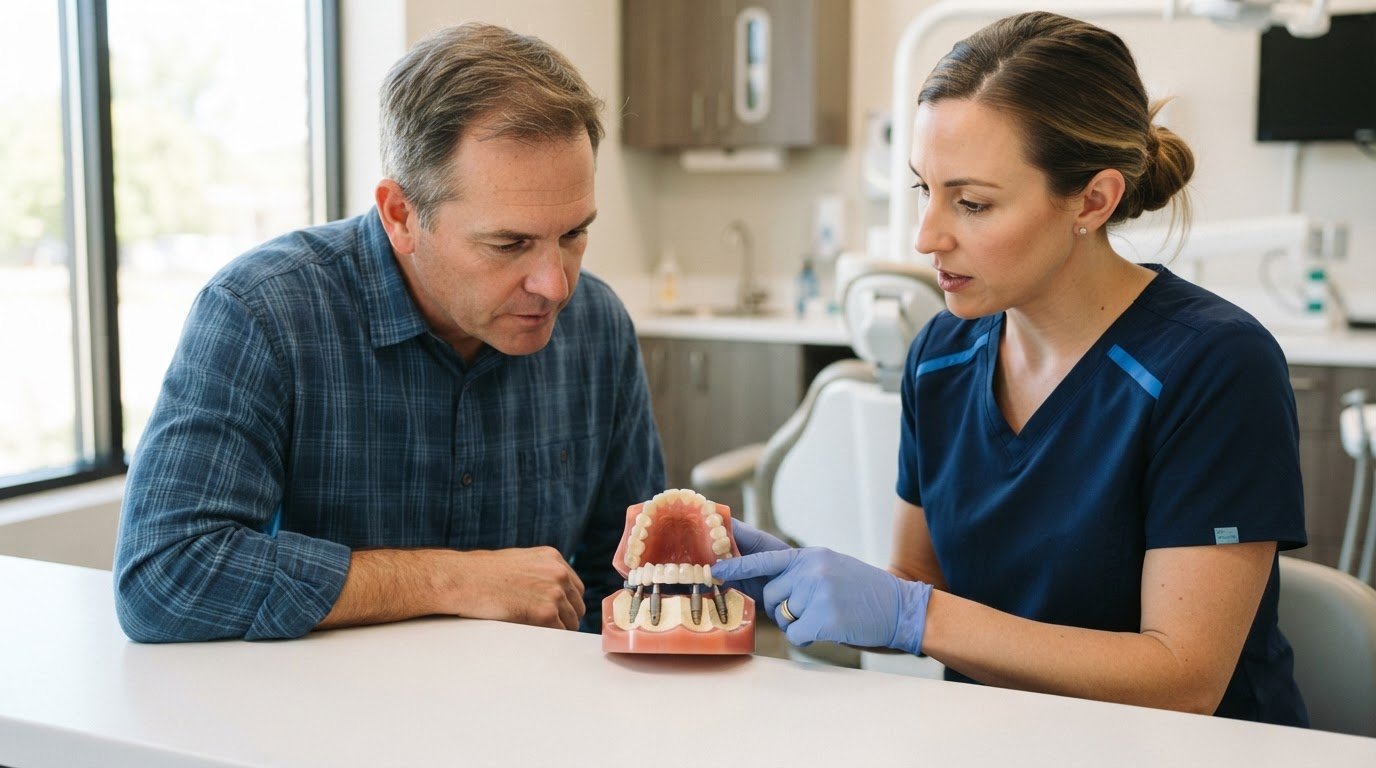
Four implants support a full arch of replacement teeth in the All-on-4 approach. Clear patient education for all-on-4 implants starts with this simple answer: the usual plan is four implants per arch. Their placement and your healing process help determine what treatment involves.
It’s understandable to want more than a number before considering a major dental procedure. You’ll learn what All-on-4 implants are, which health and jawbone factors affect candidacy, and how healing progresses from initial recovery to implant integration. The article also explains how four implants support a full arch, so you can follow the treatment plan and understand the questions to discuss with your dental team.
Key Takeaways
- All-on-4 typically uses four implants to support a full arch of replacement teeth.
- Jawbone health and factors such as gum disease, chronic illness, and smoking can influence candidacy.
- Healing includes an initial recovery period followed by time for the implants to integrate with the jawbone.
- Fixed implant-supported teeth differ from removable dentures, and understanding those trade-offs can help you prepare for a treatment discussion.
What are All-on-4 Dental Implants?
All-on-4 uses four titanium implants to support a fixed set of replacement teeth across one dental arch. Clear patient education for all-on-4 implants explains how this arrangement differs from removable dentures and what treatment involves.
Benefits and Limitations Compared With Dentures
Traditional dentures are removable; All-on-4 teeth are fixed to implants and don’t shift unexpectedly like removable dentures can. That difference may suit people seeking a stable set of teeth without adhesives. The trade-off is surgery and healing before the final restoration. Patient education for all-on-4 implants should clarify both the fixed design and the treatment commitment, so patients can weigh practical benefits against the process.
Appearance, Eating, and Speaking Outcomes
A full-arch restoration replaces missing teeth with a connected set, supporting appearance and everyday function. Stable teeth may make eating and speaking feel more predictable than removable dentures that move during use. All-on-4 can support around 10-14 replacement teeth in an arch. The number and final design depend on the restoration plan, so discuss how the proposed teeth are intended to fit your mouth.
Surgery Steps
During surgery, the dentist places four titanium implants in the jaw. In the typical configuration, two sit toward the front and two toward the back; posterior implants may be angled up to 45 degrees. For suitable cases, a provisional fixed prosthesis may be provided on the same day as implant placement. This temporary set supports the transition while healing progresses toward the final restoration.
Dental insurance coverage depends on your policy and treatment. Ask your insurer how your plan covers implant surgery and the restoration. Medicare coverage also depends on the applicable coverage rules.
All-on-4 implant costs in the United States vary by treatment plan, restoration, and any additional procedures. Request an itemized estimate that separates these parts of care.
Patient candidacy and health considerations
All-on-4 candidacy depends on oral health, jawbone structure, and the treatment plan. A consultation combines imaging and health-history review to assess these factors.
Candidacy Assessment
A dentist assesses whether your mouth and health can support the procedure by reviewing your teeth, gums, medical history, and jawbone images. People who have lost all teeth in either arch are common candidates, but age alone does not determine suitability. Share any health conditions, medications, and recent surgeries before treatment so they can inform planning.
Imaging, including 3D scans, helps assess jawbone structure and guide where implants are placed. Gum health also matters because infection and inflammation can affect the tissues around implants. The assessment connects these findings to a treatment plan, rather than relying on tooth loss alone.
Jawbone Density and Bone Loss
Jawbone density matters because implants need bone support to attach securely. Bone loss can change the available space and influence where implants are placed, so imaging helps the dentist evaluate the arch before surgery. Treatment-planning criteria in the All-on-4 manual include a minimum bone width of 5 mm, with bone-height thresholds of 10 mm in one criterion and 8 mm in another.
These measurements are planning criteria, not a substitute for evaluating your individual anatomy. A dentist considers your jawbone’s shape and condition alongside gum health and medical history. If the available bone affects the proposed plan, ask which alternative approaches fit the findings.
Consultation Questions
Focus your questions on the findings, the plan, and what to expect. Ask what the images show about your jawbone, how gum health affects candidacy, and why the proposed implant positions suit your arch. You can also ask how health conditions or medications may affect surgery and healing.
Clarify what happens if the planned approach changes, what to expect from temporary teeth, and which care instructions to follow after surgery. These questions turn clinical findings into practical expectations, including how to manage bacteria and attend follow-up care.
For dental practices, a patient portal can support clear communication as candidates review treatment information and care instructions.
How Long is the Healing Process after Surgery?
Healing includes an early recovery stage and a longer period of bone integration. Understanding each stage helps explain why temporary teeth may be placed before permanent ones.
Healing and Implant Integration
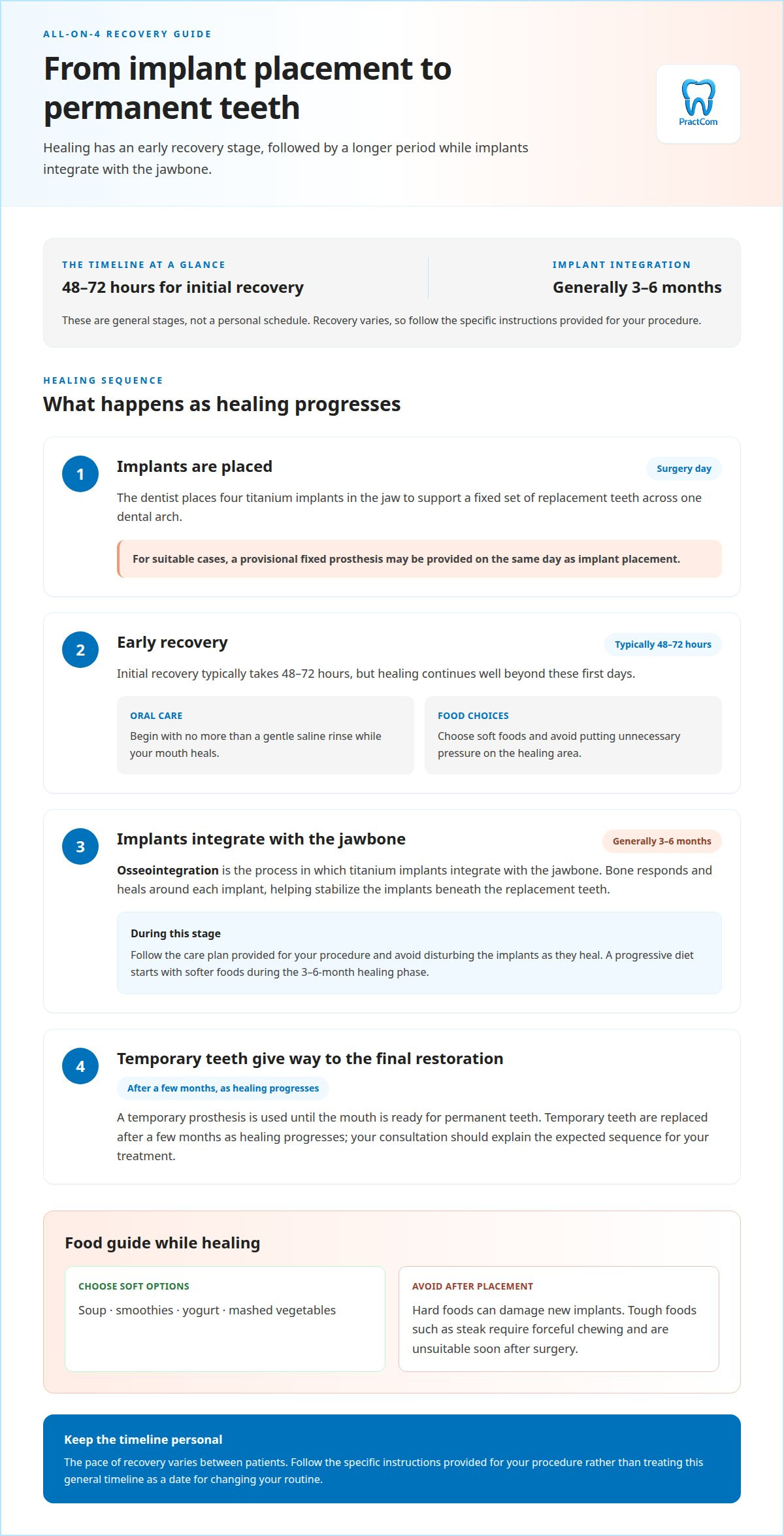
Osseointegration is the process in which titanium implants integrate with the jawbone. This matters because bone support helps stabilize the implants beneath the replacement teeth. The integration period generally lasts 3-6 months, while the bone responds and heals around each implant. During this time, follow the care plan provided for your implant procedure and avoid disturbing the implants as they heal.
Healing Time After Placement
Initial recovery typically takes 48-72 hours, although the full healing process continues beyond those first days. The implants can take several months to fuse with the jawbone, and a temporary prosthesis is used until the mouth is ready for permanent teeth. Temporary teeth are replaced after a few months as healing progresses. Your consultation should explain the expected sequence for your treatment, including when the restoration may be changed.
After surgery, begin oral care with no more than a gentle saline rinse while your mouth heals. A progressive diet starts with softer foods during the 3-6-month healing phase. The pace of recovery varies between patients, so follow the specific instructions provided for your procedure rather than treating the timeline as a date for changing your routine.
Foods to Avoid During Healing
Avoid hard foods after implant placement because they can damage the new implants. Tough foods such as steak also require forceful chewing, so they are unsuitable soon after surgery. Prepare soft options such as soup, smoothies, yogurt, and mashed vegetables to make meals easier without putting unnecessary pressure on the healing area.
As healing progresses, follow your dentist’s instructions about when to advance your diet. After osseointegration, patients can generally return to a normal diet while taking reasonable care with exceptionally hard or sticky foods. Newly placed implants and temporary teeth need protection; a healed restoration supports a broader range of food choices.
Number of implants per dental arch
The standard All-on-4 plan uses four dental implants for each treated arch, upper or lower. Two implants sit toward the front, and two support the back portion. The straightforward takeaway is four implants per arch, not four for the entire mouth. If both arches need treatment, the plan addresses each arch separately.
The name describes a specific arrangement, but treatment plans can vary. An All-on-4 full arch may be anchored by up to eight implants. The number depends on the planned restoration and the patient’s jawbone structure. Imaging helps the dental team assess the arch and select implant positions. That assessment explains why a consultation matters more than relying on the treatment name alone.
Conventional full-arch implant protocols commonly use 6-8 implants. That comparison shows why “full arch” does not always mean the same implant count. All-on-4 uses a defined four-implant approach, while other protocols may support a restoration with more implants. The number alone doesn’t establish which option suits a patient; placement and the condition of the jawbone are part of planning.
For an upper or lower arch, ask how the proposed number of implants relates to your dental images, bone structure, and restoration design. Clarify whether the plan covers one arch or both, and how the temporary restoration fits into treatment. This helps you understand your individual oral-health plan, not just a headline number.
After placement, hygiene remains part of caring for the restoration. Follow the dental team’s instructions for cleaning around the implants and attend routine appointments as directed. Unlike natural teeth, an implant-supported arch has components that need professional monitoring alongside everyday oral care. Clear patient explanations can help practices present these treatment details consistently. Explore patient communication tools for sharing implant information and aftercare with patients.
PractCom
PractCom helps dental practices communicate treatment information and follow-up guidance in a clear, organized way. For All-on-4 care, the Post-Treatment Instruction Library supports consistent aftercare education, while Digital Informed Consent Forms help present treatment information for review. A Patient Portal gives patients a place to access practice communications, and the Referral Management System supports referral coordination. These tools can help your team explain implant treatment and keep related communications together, without replacing clinical discussions about an individual treatment plan. If your practice wants support organizing patient communication around implant care, contact PractCom.
Turn Treatment Information Into Clear Next Steps
For a dental practice, patient education for All-on-4 implants is not just an explanation of treatment. It helps patients understand the choices in front of them, prepare for conversations with their care team, and keep guidance accessible as treatment progresses. The next step is to make those explanations consistent across consultations, consent discussions, and follow-up communication.
PractCom supports dental practices with patient communication tools, including a Post-Treatment Instruction Library, Digital Informed Consent Forms, and a Referral Management System. These resources help organize information for patients at different stages of care, while clinical teams remain responsible for individualized treatment guidance. Clear, accessible communication helps patients discuss their needs and understand what comes next.
If your practice wants to improve how it shares treatment information and coordinates patient communications, contact PractCom to discuss your options. A more organized communication process can help your team guide patients with greater clarity and confidence.
Frequently Asked Questions
Am I a candidate for All-On-4 implants?
You may be a candidate if you’ve lost all the teeth in an arch and your jawbone and oral health can support treatment. Gum disease, diabetes, a weakened immune system, smoking, medications, and recent surgeries can affect planning or healing. Bring a complete health and medication history to your consultation. Imaging and a dental examination help assess your individual situation.
Are All-On-4 implants better than dentures?
Neither option is better for everyone. All-on-4 provides a fixed restoration, while traditional dentures are removable. That distinction can affect daily routines, cleaning, and treatment expectations. For example, someone who values a nonremovable set of replacement teeth may prefer discussing implants, while someone seeking a removable option may weigh dentures differently. Compare the care requirements and surgical treatment involved, not only appearance.
How Do I Clean My Implants?
After your mouth has healed, brush and floss around implant-supported teeth as part of your regular oral-care routine. A practical routine includes brushing twice daily and flossing around the implant anchors once per day. Your dental team can show you how to clean around the restoration without disturbing healing tissues. Professional maintenance appointments every 3-6 months can help monitor gum health and implant condition.
How Long Do All-on-4s Last?
All-on-4 restorations can last 20 or more years with proper maintenance. Longevity depends in part on daily hygiene and regular dental appointments, which let the dental team assess gum health and the restoration. Keep routine visits even when the teeth feel comfortable. Report changes such as looseness or discomfort promptly, so the dental team can assess the restoration and surrounding tissues.
How Long is the Implant Surgery?
All-on-4 surgery usually takes about three hours, though the procedure can take longer if several teeth need extraction. The treatment plan and the work required during the appointment affect the schedule. At your consultation, discuss the planned procedure and anesthesia arrangements. Knowing the expected appointment length can help you plan transportation and recovery time without assuming every case follows an identical schedule.
What Are the Benefits of All-on-4?
All-on-4 can provide a fixed, implant-supported replacement for a full arch, helping avoid denture adhesives and unexpected movement associated with removable dentures. For suitable cases, a provisional fixed prosthesis may be provided on the day implants are placed. The approach can also support appearance, speaking, and eating. These advantages come with surgery, healing, and ongoing cleaning requirements, which belong in the treatment decision.

Article by
Cary Ganz DDS
Dr. Cary H. Ganz is a dentist, prosthodontist, entrepreneur, lecturer, and author with more than 50 years of experience in clinical dentistry and dental technology. Throughout his career, he has combined hands-on patient care with a deep understanding of how technology can improve dental practice operations, communication, documentation, and patient outcomes.
In addition to his clinical background, Dr. Ganz has held significant leadership roles in the dental technology industry, including Past Owner and Vice President of Clinical Affairs at DEXIS Digital Radiography and Past Vice President of Clinical Affairs at Denticon Practice Management Software. His business experience includes product development, clinical strategy, dental software innovation, practice management solutions, and educating dental professionals on the effective use of technology in modern dentistry.
Today, Dr. Ganz continues to focus on creating practical technology solutions for dental practices, including PractCom, a comprehensive dental practice communication platform designed to improve patient communication, documentation, compliance support, referrals, and overall practice efficiency. His work reflects a career-long commitment to helping dentists deliver better care while making their practices more organized, efficient, and protected.
No responses yet