
Better treatment starts with messages patients and colleagues can understand and act on. A dental office communication plan should begin with a brief team huddle, clear ways to share feedback, and consistent processes for adapting explanations to each patient’s needs. These steps help surface concerns early and keep care coordinated.
When schedules are full, communication can feel like one more task, especially when important details are shared verbally and then lost in the pace of the day. A simple, repeatable approach helps keep staff aligned, clarify patient questions, and ensure follow-through on referrals and test results.
This guide covers practical first steps for improving office communication, accommodating patients with disabilities or language needs, and prioritizing the issues that matter most. It also explains how clear, timely communication can support treatment decisions and continuity of care, without expecting every conversation to go perfectly.
Key Takeaways
- Use brief daily huddles to flag patient needs and questions, then set aside regular team meetings to address larger goals and feedback.
- Build trust by listening to understand, sharing feedback respectfully, and involving staff in decisions that affect patient care.
- Adapt conversations to each patient with plain language, active listening, and teach-back to check understanding.
- Prioritize recurring communication problems that affect care, and create reliable follow-up for referrals, patient concerns, and test results.
1. What are the first steps to improve communication in a dental office?
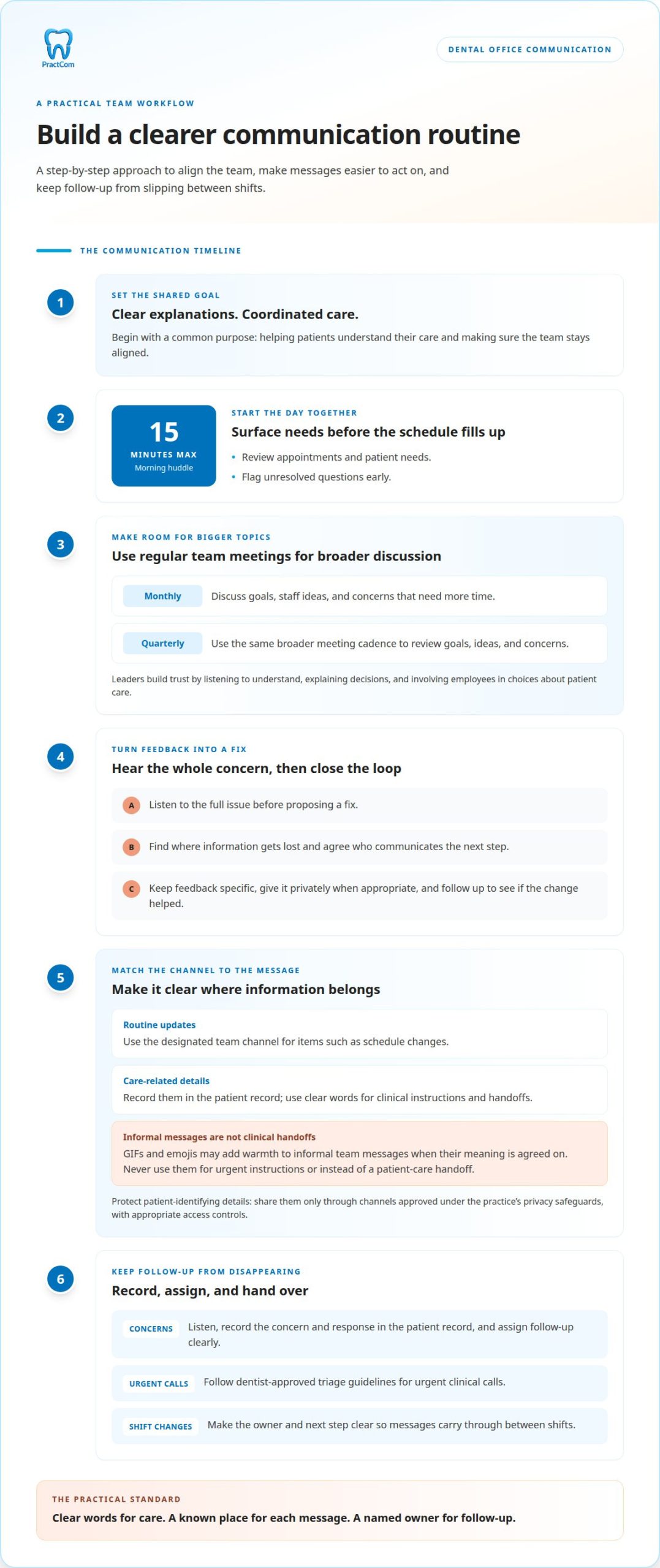
Begin with a shared goal: giving patients clear explanations and coordinated care. A morning huddle should last no more than 15 minutes, allowing team members to review appointments, patient needs, and unresolved questions. Use monthly or quarterly team meetings for broader goals, staff ideas, and concerns that need discussion. Leaders build trust by listening to understand, explaining decisions, and involving employees in choices about patient care.
When a team member raises a concern, hear the full issue before proposing a fix. If a handoff leaves treatment plans unclear, for example, identify where information gets lost and agree on who will communicate the next step. Give feedback privately when appropriate, keep it specific, and follow up to see whether the change helped. This makes it easier to raise problems before they affect patients.
GIFs and emojis can add warmth to informal team messages, but agree on what they mean first. A thumbs-up might acknowledge a routine task, while a clinical instruction needs clear words. Never use a GIF or emoji for urgent instructions or to replace a patient-care handoff. Keep patient-identifying details out of informal chats unless the channel is approved under the practice’s privacy safeguards.
A dental office communication plan should define the channels for routine updates, clinical handoffs, patient questions, and urgent messages. Dental team communication software can centralize internal updates, but staff still need clear rules about where each message belongs. For example, use a designated team channel for schedule changes and the patient record for care-related details.
What HIPAA rules apply to dental office communication with patients? Dental practices should protect patient information with privacy and security safeguards, including appropriate controls on who can access it and how it is shared. How should offices handle complaints and urgent messages? Listen, record the concern and response in the patient record, and follow dentist-approved triage guidelines for urgent clinical calls. Assign follow-up clearly so concerns and messages don’t disappear between shifts.
2. Communication accommodations for patients with disabilities or language needs
Start by asking each patient what helps them communicate comfortably. They may prefer written instructions, extra time to process information, an interpreter, or support from an advocate. Respect the patient’s choice, speak directly to them, and avoid assuming what assistance they need. Active listening means repeating concerns in your own words and inviting corrections.
For complex explanations, use plain language and pause between key points. Ask the patient to explain the plan back in their own words; this teach-back step shows where you may need to clarify. If a patient is unsure about home care after a procedure, for example, explain one step at a time and provide written guidance. Adapt the format to the patient’s access needs.
Make accommodations part of care coordination, not a last-minute surprise. Record relevant communication preferences in the appropriate patient record, then share only necessary details with the team. Before the appointment, review the schedule and patient needs so staff can prepare the room, materials, or communication support. If timing changes, promptly update the patient and the team member coordinating their care.
Patient-centered decisions require more than presenting treatment plans. Explain the recommended care, alternatives, expected steps, and costs in clear language, then invite questions before asking for the patient’s decision. How should dental offices communicate treatment plans, costs, and insurance coverage? Separate the clinical recommendation from estimated patient responsibility, explain what the estimate includes, and clarify that coverage depends on the patient’s plan. Give the patient time to consider the options.
To assess effective communication, review recurring questions, complaints, missed follow-ups, and patient feedback during team meetings. Look for patterns, such as patients repeatedly misunderstanding post-visit instructions, then revise the explanation or delivery method. Tracking these signals helps the practice respond to barriers and support long-term engagement. A patient communication platform can help organize messages and educational materials; explore accessible patient communication workflows as one way to support that process.
3. Choosing which issues to address
Not every difference in work style needs correcting. Dentists and team members may complete the same procedure in different ways without affecting patient care. Focus first on concerns that interrupt care, cause repeated confusion, or leave a task without a clear owner. This keeps collaboration practical and helps the dental team address problems effectively.
Sort concerns by their impact and how often they occur. A missed handoff about a patient’s treatment plan deserves prompt attention because it can disrupt continuity. A preference about arranging routine supplies can wait unless it creates a safety or workflow problem. Ask who is affected, what happened, and whether the issue has happened before. The answers help clarify which concerns need a shared solution.
The 80/20 Principle suggests that 80% of results come from 20% of efforts. Use it as a prioritization prompt, not a guarantee: identify the small set of communication problems causing the most disruption. For example, repeated confusion over referral follow-up may matter more than an isolated disagreement about wording. Addressing a recurring breakdown can foster more reliable teamwork than correcting every minor variation.
At a team meeting, record each issue in a simple log with its impact, frequency, owner, and next step. Keep descriptions factual: “Referral status wasn’t clear at the patient handoff” is more useful than “the front desk never communicates.” Then agree on a specific procedure, such as identifying who will update the referring provider and where that update will be recorded. Clear ownership keeps the concern from being passed between team members.
Review the log at the next scheduled meeting. Check whether the agreed change resolved the problem, and ask the people involved what still causes friction. If the issue continues, adjust the process rather than assigning blame. This brief review helps the practice focus on patterns that affect patient care while allowing harmless differences in individual work styles.
4. Communication and dental treatment outcomes
Clear communication connects a diagnosis to the patient’s next decision. A patient may hear a recommendation but interpret its purpose differently than intended. Dentists can’t control every interpretation, so they should invite questions and confirm what the patient understood. This check can reveal confusion before it affects consent, home care, or follow-up.
For diagnostic results, use a consistent process: review the result, explain what it means, tell the patient what happens next, and document the communication. Patients should receive all results in a timely manner, whether normal or abnormal. Communicate abnormal results verbally and in writing, then record a copy and confirmation of communication in the patient’s dental record. These steps create a clear account for the care team.
Pair verbal explanations with written instructions in plain language. After discussing a finding, for example, explain the recommended next step and ask the patient to summarize it. If their understanding differs, restate the key point without adding unnecessary clinical detail. Watch for pauses, expressions, or other gestures that signal uncertainty, then ask an open question instead of assuming agreement.
Team members also shape treatment outcomes through reliable handoffs. If a dentist asks a colleague to relay a result, identify who will contact the patient and where the outcome will be recorded. Before ending the exchange, repeat the task, owner, and next step. This strengthens listening skills and reduces ambiguity between clinical and administrative staff.
A dental office communication plan should make result notification and follow-up routine, not dependent on memory. Review outstanding results regularly and assign unresolved items to a responsible team member. Consistent documentation helps the practice see what was explained, how it was received, and what remains. Put these follow-up steps into a more consistent patient communication workflow.
PractCom: The All-in-One Patient Communication Platform for Dental Practices
PractCom brings patient communication tools together to help your practice share key information and follow up. Use the Post-Treatment Instruction Library to provide guidance after care, Digital Informed Consent Forms to support the consent process, and the Referral Management System to organize referral communication.
These tools can support the workflows in your communication plan, especially when instructions, consent, and referrals need consistent handling. They complement your team’s clinical conversations and judgment; they don’t replace them. Consider PractCom when you’re ready to organize these patient communication tasks in one workflow.
Contact PractCom to discuss how its communication platform can fit your practice’s needs.
Make your next communication improvement manageable
A useful dental office communication plan doesn’t need to change every workflow at once. Choose one recurring friction point, assign someone to lead the improvement, and decide how the team will assess whether the new approach is working. Once the process is established, use what you learn to guide the next adjustment.
Keep the goal practical: help patients understand what happens next and help team members know who is responsible for follow-through. Communication systems should support professional judgment, not replace the attention and care behind each interaction. A steady, focused approach can make improvement part of everyday practice rather than another project competing for time.
If you’re ready to explore how PractCom could support your practice’s patient communication workflows, contact PractCom to discuss your communication needs. A thoughtful next step can help your team build clearer, more consistent communication over time.
Frequently Asked Questions
What are the first steps to improve communication in a dental office?
Start by mapping where information changes hands, from appointment booking to post-visit instructions. Choose one recurring breakdown, such as unclear ownership of rescheduling calls, and document the current process. Then assign a responsible role, define the next action, and review whether the new workflow closes the gap. Starting with one defined problem makes improvement easier to assess and adjust.
What methods of communication are used in dentistry?
Dental practices use in-person conversations, telephone calls, written forms, email, text messages, and patient portals. The best method depends on the message: a clinical discussion may need direct conversation, while routine appointment details may suit a brief written message. Visual aids can also help explain a procedure. Use communication channels with privacy safeguards appropriate to the information being shared.
Why Strong Communication is a Game-Changer in Dental Practice?
Strong communication helps patients make informed choices and gives staff a clearer basis for coordinating their work. For example, patients who understand the purpose of a proposed procedure can raise relevant questions before deciding. Clear internal messages also help prevent conflicting instructions. Communication supports better care, but it cannot control how everyone interprets a message, so teams should invite clarification.
How do dental practices communicate with patients before, during, and after appointments?
Before an appointment, practices can share preparation details and confirm essential visit information. During the visit, clinicians explain findings and options, then pause for questions. Afterward, patients need clear instructions on home care and next steps. A written reminder about when to call the practice, for example, can make post-visit guidance easier to use than conversation alone.
What are effective ways to reduce dental appointment no-shows and cancellations?
Use appointment reminders that state the date and time and explain how to report a scheduling conflict. Confirm contact details during routine interactions, since outdated information can interrupt reminders. Make cancellation and rescheduling instructions clear, then use the released appointment time according to office procedures. Reviewing recurring missed appointments can help identify communication gaps, such as unclear booking details or hard-to-find instructions.
Which communication channels work best for dental practices: phone, text, email, or patient portals?
No single channel works best for every message. Phone calls allow real-time discussion, texts suit brief reminders, email can carry longer written information, and patient portals can organize documents for later access. Match the channel to urgency, complexity, patient preference, and privacy needs. For a change that requires discussion, use a direct conversation rather than relying only on a short message.

Article by
Cary Ganz DDS
Dr. Cary H. Ganz is a dentist, prosthodontist, entrepreneur, lecturer, and author with more than 50 years of experience in clinical dentistry and dental technology. Throughout his career, he has combined hands-on patient care with a deep understanding of how technology can improve dental practice operations, communication, documentation, and patient outcomes.
In addition to his clinical background, Dr. Ganz has held significant leadership roles in the dental technology industry, including Past Owner and Vice President of Clinical Affairs at DEXIS Digital Radiography and Past Vice President of Clinical Affairs at Denticon Practice Management Software. His business experience includes product development, clinical strategy, dental software innovation, practice management solutions, and educating dental professionals on the effective use of technology in modern dentistry.
Today, Dr. Ganz continues to focus on creating practical technology solutions for dental practices, including PractCom, a comprehensive dental practice communication platform designed to improve patient communication, documentation, compliance support, referrals, and overall practice efficiency. His work reflects a career-long commitment to helping dentists deliver better care while making their practices more organized, efficient, and protected.
No responses yet