
Treatment acceptance is shaped most directly during the consultation and treatment presentation, but the patient’s experience starts well before the appointment. Improving the dental patient journey map means seeing how each interaction, from online research and booking to follow-up after care, affects trust and confidence.
It’s easy to focus on the clinical visit, but patients also notice how easily they can find information, get a response, understand their options, and know what happens next. A journey map brings these touchpoints together so your team can spot friction and make the experience more consistent. This article explains what a dental patient journey includes, why the consultation matters for treatment acceptance, and how thoughtful communication before and after a visit can support patient loyalty. You’ll also learn how mapping the journey connects everyday interactions into a clearer, more supportive experience.
Key Takeaways
- Focus on the consultation and treatment presentation, where clear explanations can help patients understand their options and feel confident about next steps.
- Map interactions from online research through in-office care and follow-up to spot friction points across the full experience.
- Use consistent, helpful follow-ups after treatment to reinforce care instructions and support patients’ return to the practice.
- Review each touchpoint from the patient’s perspective to find practical ways to make communication clearer and care feel more connected.
Which stage most affects treatment acceptance?
The consultation and treatment presentation most directly influence acceptance, but earlier interactions shape a patient’s readiness to decide. Map phone contact, scheduling, clinical explanations, and cost discussions to identify where confidence may break down.
Phone Inquiries and Responsiveness
Phone responsiveness describes how quickly and clearly a practice handles appointment inquiries, missed calls, and patient questions. A delayed or confusing response can stop a prospective patient from booking before clinical care even begins.
Track whether calls are answered, returned, and resolved, then note recurring questions. A patient waiting 20 minutes on hold may give up before speaking with staff. Practices can respond to missed prospective-patient calls by using an answering service, while staff can highlight clear next actions during each conversation. The International Organization for Standardization identifies ISO 9001/2015 as a quality standard for services; it can frame consistent processes, not measure an individual patient’s experience.
Scheduling and Appointment Instructions
Scheduling and appointment instructions cover booking access, confirmation, preparation details, and reminders. They matter because patients need to know what action to take and what to expect before arriving.
Offer online scheduling alongside responsive phone support so patients can choose a convenient channel. Keep booking forms focused, explain what information is needed, and make the next step easy to find. After booking, send confirmations, reminders, directions, and relevant forms. A reminder can clarify arrival instructions or invite patients to ask questions before the visit. These details reduce avoidable uncertainty and help staff identify where scheduling breaks down.
Costs and Patient Experience Pain Points
Cost communication explains proposed treatment expenses and what patients should consider before deciding. For dental patient journey mapping, software costs vary by the case, features, implementation needs, and support; pricing is provided after a quote request.
During treatment discussions, explain options, expected benefits, risks, costs, and timing in plain language. Patients need enough information to understand the commitment, not pressure to accept immediately. Common experience pain points include long phone holds, missed calls, complicated booking forms, unclear appointment instructions, unexpected waits, and unexplained treatment costs. Record each issue by touchpoint, then assign an action to improve the process. A clear cost conversation supports informed decisions but doesn’t replace the clinical discussion.
What is the Dental Patient Journey?
A dental patient journey map follows interactions from online research through in-office care and follow-up. Mapping these stages helps a dental practice identify gaps between what patients see online and experience in person. A practical framework for improving the dental patient journey map connects each interaction to a patient need and a clear next step.
Online and In-Office Touchpoints
A dental journey map covers digital and in-office interactions before, during, and after care. It can reveal where a handoff, such as moving from website research to phone booking, creates friction.
Start with a patient’s first search, then trace each step: search results, a map listing, the practice website, appointment contact, arrival, consultation, and follow-up. Include social media, reviews, emails, phone calls, and in-person conversations. Note what the patient needs at each touchpoint and who responds. For example, a patient may find a service page but struggle to locate booking instructions. That gap connects online information with an in-office scheduling task.
Consistency Across Patient Experiences
Consistency means online messages match what patients experience with staff and clinical teams. A mismatch can weaken trust before care begins.
Compare specific promises with the in-office experience. If the website says new patients can find clear arrival instructions, check that confirmation messages provide them. If online treatment information uses plain language, staff explanations should also make options understandable. Reviewing these interactions together helps teams locate communication gaps. Improving the dental patient journey map also means checking whether patients receive consistent answers across channels.
Dental journey tools range from shared spreadsheets and feedback forms to communication platforms and analytics dashboards. Compare them by whether they organize touchpoints, collect feedback, track workflow outcomes, or coordinate communications. Choose an approach that addresses the gaps your practice needs to understand.
For HIPAA-related considerations, ensure patient information is handled according to applicable privacy obligations. Map who can access patient details and how information moves through communication tools, such as appointment messages or intake forms.
Useful measures include booking completion, call response, cancellations, no-shows, waiting time, treatment acceptance, and follow-up completion. Pair workflow measures with patient feedback, such as comments about confusing directions. Comparing these signals by touchpoint can show whether a change improves satisfaction or shifts friction elsewhere.
Converting prospective patients into loyal patients
Loyalty grows through connected experiences, from the first inquiry to ongoing care. A clear follow-up process helps dentists turn positive treatment experiences into lasting relationships.
Patient Milestones and Loyalty
Patient milestones are meaningful moments, such as completing a first visit, beginning treatment, or returning for routine care. Use them to understand where patients are on a loyalty journey, from initial awareness to booking, continued care, and recommending the practice.
For example, a patient who completes a consultation but delays treatment may need clearer explanations or a follow-up conversation. Someone who returns for a cleaning has reached a different milestone. Mapping these stages helps staff tailor communication to the patient’s next practical need instead of sending everyone the same message.
Post-Service Engagement
Post-service engagement is communication after an appointment or treatment that supports recovery and continued care. A timely thank-you, relevant instructions, and an invitation to ask questions keep the relationship active after the patient leaves.
Match each message to the visit. After a procedure, provide the appropriate post-treatment instructions; after a routine cleaning, share details about the next recommended appointment. A review request can follow a completed visit, while a future cleaning reminder can support regular care. Keep messages useful and specific so follow-up feels connected to the service, not like generic promotion.
Follow-Up and Patient Retention
Follow-up supports treatment acceptance and retention by addressing unanswered questions and clarifying the next step. Improve the process by recording agreed actions, assigning responsibility, and sending relevant reminders through the patient’s preferred communication channel.
If a patient postpones a treatment plan, a considerate follow-up can clarify concerns about benefits, risks, costs, or timing. For ongoing care, consistent appointment reminders help patients return for routine or planned treatment. Review missed appointments, delayed treatment, and follow-up completion together to see where patients disengage. Dentists can then adjust explanations or communication to support informed decisions and continued care.
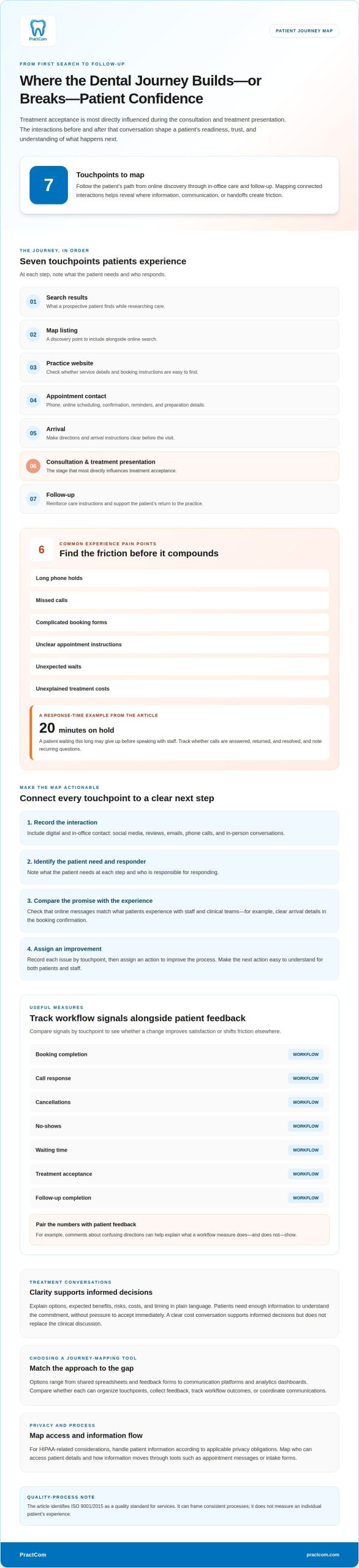
Patient touchpoints across the dental care journey
A touchpoint is any interaction that shapes a patient’s view of care, from a search result to a follow-up message. Mapping each one helps your team see how expectations, communication, and handoffs affect satisfaction.
Trace the patient experience in order: finding the practice, choosing a service, booking, receiving instructions, arriving, speaking with the clinical team, checking out, and receiving follow-up. At each step, note the channel, the patient’s likely need, the staff role, and the next action. For example, a website may explain a service, while a phone call answers a question the page leaves unresolved. The map should show both interactions, not just the website or appointment.
Different visit types call for different paths. An emergency journey should make urgent contact and immediate instructions easy to find, then explain what happens on arrival. A pediatric journey should account for the child and accompanying caregiver, with clear preparation and age-appropriate explanations. A routine visit can focus on booking, arrival details, the examination, and planning future care. The clinical team determines care; the map clarifies communication at each stage.
Make the map practical by pairing each touchpoint with a question: Can the patient find the right service? Does the confirmation explain what to expect? Does the checkout conversation clarify the next step? Include visual materials where they help explain a process, and note whether patients can access them easily. Compare what the practice intends to communicate with what patients actually experience.
Review feedback alongside operational signals. Online reviews, phone conversations, and patient surveys can highlight confusion or repeated questions. If several patients ask where to park, improve the arrival message. If patients report unclear next steps, revise the checkout conversation. Assign an owner to each change and revisit the map when new channels or services are introduced.
Use this touchpoint map to organize patient communications across the care journey. Start improving patient communication.
PractCom: Post-Treatment Instruction Library
PractCom’s Post-Treatment Instruction Library helps dental practices provide patients with clear guidance after care. It includes over 80 post-treatment templates that practices can deliver by email, text, or print in 15 languages. This supports a more organized handoff from the clinical visit to at-home care, with instructions patients can refer to after leaving the office.
For practices mapping communication touchpoints, the Post-Treatment Instruction Library supports the post-visit stage, while Digital Informed Consent Forms and the Patient Portal address other patient communication needs. Consider these tools when your team wants a more consistent way to share treatment information and organize patient interactions.
Contact PractCom to discuss how its communication tools can support your practice.
Make your next patient-journey improvement actionable
Choose a friction point your team can address, then define what a better interaction should look like. A brief review with front-desk staff, assistants, hygienists, and dentists can turn patient feedback into a practical adjustment, such as clarifying a message or improving a handoff. Record the change and revisit its effect using the feedback and workflow measures your practice already tracks.
Improving the dental patient journey map works best when the process stays practical: make one change, observe how patients respond, and refine the approach as new needs emerge. PractCom offers a Post-Treatment Instruction Library, Digital Informed Consent Forms, and a Referral Management System to support communication at distinct points in care. These tools help practices organize patient-facing information and referral workflows alongside broader journey improvements.
Contact PractCom to discuss improving patient journeys. Your next improvement can begin with one clear, manageable step.
Frequently Asked Questions
How can dental practices reduce friction during the scheduling process?
Reduce scheduling friction by making the next action obvious and keeping each booking step focused. Label appointment types in plain language, show available options clearly, and avoid asking for information staff can collect later. For example, someone seeking a cleaning shouldn’t have to guess which appointment category to select. Review abandoned inquiries and front-desk notes to identify confusing steps, then simplify the point causing the most difficulty.
What are the key stages of a dental patient journey map?
Key stages usually follow the patient’s goals: discovering a practice, evaluating care options, booking, preparing, attending, deciding on treatment, and continuing care afterward. The details vary by visit type. Someone comparing providers may need service and insurance information, while a returning patient may need a clear way to schedule ongoing care. Organize the map around these goals so teams can see what patients need at each transition.
How do you create a dental patient journey map step by step?
Start with a specific patient scenario, such as a parent arranging a child’s first visit. List the interactions in sequence, then record the patient’s questions, likely concerns, and staff handoffs at each point. Ask reception, assistants, hygienists, and dentists where information commonly gets delayed or lost. Compare their observations with patient feedback, select a friction point, assign responsibility, and revisit the map after making changes.
How can dental offices improve new-patient intake and online booking?
Make online booking easier with clear appointment labels and intake questions limited to information needed for the next step. Explain why sensitive details are requested and how patients can provide additional history. Make service descriptions easy to find, including information relevant to families, anxious patients, or people checking insurance. Before submission, show patients what happens next and what to prepare for their first visit.

Article by
Cary Ganz DDS
Dr. Cary H. Ganz is a dentist, prosthodontist, entrepreneur, lecturer, and author with more than 50 years of experience in clinical dentistry and dental technology. Throughout his career, he has combined hands-on patient care with a deep understanding of how technology can improve dental practice operations, communication, documentation, and patient outcomes.
In addition to his clinical background, Dr. Ganz has held significant leadership roles in the dental technology industry, including Past Owner and Vice President of Clinical Affairs at DEXIS Digital Radiography and Past Vice President of Clinical Affairs at Denticon Practice Management Software. His business experience includes product development, clinical strategy, dental software innovation, practice management solutions, and educating dental professionals on the effective use of technology in modern dentistry.
Today, Dr. Ganz continues to focus on creating practical technology solutions for dental practices, including PractCom, a comprehensive dental practice communication platform designed to improve patient communication, documentation, compliance support, referrals, and overall practice efficiency. His work reflects a career-long commitment to helping dentists deliver better care while making their practices more organized, efficient, and protected.
No responses yet