
Yes, digital consent forms can be legally valid in the United States. Under the federal ESIGN Act and the Uniform Electronic Transactions Act adopted by most states, an electronic signature or record generally can’t be denied legal effect solely because it’s electronic; intent, consent, and record retention still matter. The benefits of digital consent forms go beyond replacing paper: they can also support a clearer, more organized consent process.
It’s understandable to ask whether a digital signature will hold up. But the benefits of digital consent forms go beyond signing: patients need to understand the information, complete forms accurately, and trust that their details are handled responsibly. This article explains the legal basics, practical workflow advantages, and privacy safeguards to consider. Digital forms can improve the patient experience, but they do not replace a conversation about informed consent.
Key Takeaways
- Keep the signed form and the version the patient reviewed together in the patient chart for easier retrieval.
- Use required fields and clear routing to reduce incomplete submissions and manual data entry.
- Make consent easier to understand with plain language, defined terms, and accessible formats.
- Assess privacy safeguards alongside accessibility so digital consent works securely for more patients.
Are Digital Consent Forms Legally Valid?
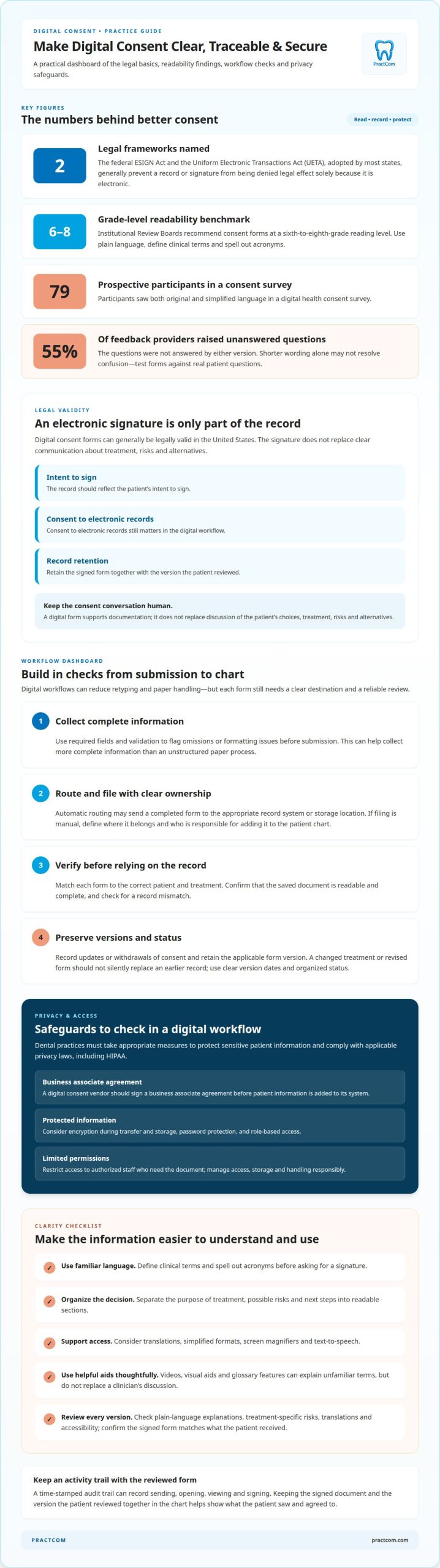
Generally, yes. In the United States, the federal ESIGN Act and the Uniform Electronic Transactions Act, adopted by most states, generally prevent an electronic signature or record from being denied legal effect solely because it is electronic. The patient’s intent to sign, consent to electronic records, and record retention still matter. A digital consent form supports documentation, but it does not replace clear communication about treatment, risks, and alternatives.
Keep the signed form and its version together in the patient’s chart. That way, the record shows what the patient reviewed and agreed to, rather than only the latest form template. A time-stamped audit trail can record actions such as sending, opening, viewing, and signing. For example, staff retrieving a consent record for an audit can locate the signed document and its recorded activity instead of searching paper files manually.
Digital intake can make arrival and check-in more efficient. Patients can complete a consent form before reaching the clinic, which may reduce lobby paperwork and give staff less to process at the front desk. Having the completed form in the patient chart also cuts down on paper handoffs. That can support a smoother visit without rushing the consent conversation.
Paper forms require printing, physical storage, and eventual disposal. Digital records can reduce those tasks and make retrieval easier when files are organized in the patient chart. Online completion also gives patients an alternative to signing only at the front desk. A digital workflow still needs a reliable process for matching each signed form to the correct patient and treatment.
Dental practices must take appropriate measures to protect sensitive patient information and ensure data entry complies with applicable privacy laws, including HIPAA. Digital consent workflows should limit access to authorized users and protect information as it is stored and shared. A record of form activity can support accountability, but privacy also depends on how the practice manages access, storage, and handling.
Workflow efficiency and reduced manual data entry
Digital forms can move patient information through a workflow without staff retyping every response. Required fields and validation can flag omissions or formatting issues before submission. This structure can help practices collect more complete information at intake than an unstructured paper process.
Routing is another potential efficiency gain. When a system supports automatic routing, a completed form can be sent to the appropriate record system or storage location, reducing manual handling. If the workflow requires a manual step, staff can save the completed document and add it to the patient chart. Either way, define where each signed form belongs and who is responsible for filing it.
Automation does not remove the need for verification. Staff should match each form to the correct patient and treatment, then confirm that the saved document is readable and complete. Required fields can flag missing information, while a final review can catch a record mismatch. Clear checks help maintain accurate records without recreating the entire paper process.
Security also depends on who can access the information. A digital consent vendor should sign a business associate agreement before patient information is added to its system. Encryption during transfer and storage, role-based access, and password protection can limit exposure. Restricting permissions to staff who need the document helps control third-party data access and keeps handling aligned with privacy practices.
Consent management continues after the first signature. Practices need a process for recording when a patient updates or withdraws consent and for retaining the applicable form version. A changed treatment or revised form should not silently replace the earlier record. Clear version dates and an organized status help staff identify which document applies before the next clinical action.
Clearer forms and guidance
A digital signature records agreement, but clear information helps patients understand what they are signing. Use plain language, define clinical terms, and spell out acronyms before asking for a signature. For example, describe a procedure in familiar words before introducing its clinical name. Institutional Review Boards recommend consent forms at a sixth-to-eighth-grade reading level, a useful benchmark when reviewing readability.
Digital formats make it easier to organize information into readable sections. Patients can review the purpose of treatment, possible risks, and next steps without facing a dense block of text. Videos, visual aids, and glossary features can help explain unfamiliar medical terms. These tools support consent, but they do not replace a clinician’s discussion of treatment choices and risks.
Research highlights why simplification needs careful review. In a digital health consent survey, 79 prospective participants saw original and simplified language; 55% of those who provided feedback raised questions neither version answered. The practical lesson for a practice is to test forms against real patient questions, not just shorten the document. A concise form still needs to explain the decision patients are being asked to make.
Language and accessibility also shape understanding. Write each form in a language the patient is comfortable using, or provide a translation. Consider simplified formats, screen magnifiers, and text-to-speech so patients can access information in ways that work for them. The FDA and the Department of Health and Human Services provide guidance on electronic systems for obtaining and documenting consent. Clearer guidance can reduce patient confusion and follow-up work for staff.
Before publishing a form version, review its plain-language explanations, treatment-specific risks, translations, and accessibility. Then confirm that the signed form matches the information the patient received. Digital storage can make updated versions easier to distribute, but effective consent still depends on accurate content and a meaningful discussion.
What are the privacy, security, and accessibility risks of digital consent forms?
Digital forms reduce paper handling, but they also store sensitive information in electronic systems. A misdirected form, such as one saved to the wrong patient chart, can expose private treatment details. Establish a clear process for matching each document to the patient before saving or sharing it. This verification helps prevent avoidable disclosure.
Data protection depends on safeguards throughout the document’s lifecycle. Consent information should be protected during transfer and storage, and access should be limited to staff who need it for their role. For example, a front-desk employee may need to confirm that a form is complete, but broader chart access may not be necessary for that task.
Third-party systems introduce another privacy consideration: patient information may be handled outside the clinic’s own environment. Practices should understand which users and systems can access consent records and how access is controlled. Map the form’s path from patient submission to chart storage to identify where information is viewed or transferred.
Digital-only access can create barriers. A patient using a screen reader may struggle with unlabeled fields, while someone on a small phone screen may miss instructions. Test forms with assistive technology and on mobile devices before relying on them for consent. Keep a paper option available for patients who cannot comfortably complete the electronic version.
Accessibility features should make the content usable without weakening privacy. Avoid displaying patient details on shared screens, and ask staff to close records after use. Review the form’s layout, field labels, and privacy controls together, since a secure form that patients can’t use still disrupts intake. Explore a digital consent workflow designed to support careful handling and patient access.
PractCom: Post-Treatment Instruction Library
PractCom’s Post-Treatment Instruction Library helps dental practices share consistent guidance after care, while its Digital Informed Consent Forms support the consent workflow. Turn to these tools when your team wants patient instructions and consent documents organized within its communication process. The library includes over 80 post-treatment templates, and documents can be delivered by email, text, or print in 15 languages. A Patient Portal and Referral Management System are also available for practices addressing related communication and referral needs.
These tools support specific patient communication tasks, but they are not a replacement for full practice management software. If your practice wants a more organized approach to consent and post-treatment guidance, PractCom brings these communication tools together in one platform.
Make consent part of a stronger patient communication process
The benefits of digital consent forms grow when your practice treats consent as an ongoing part of patient communication, not just a signature to collect. Use each workflow review to consider whether patients receive clear information, staff can manage documents consistently, and follow-up communication supports care beyond the appointment.
PractCom offers Digital Informed Consent Forms, a Post-Treatment Instruction Library, and a Referral Management System for dental practices. Its consent templates can be edited, downloaded, printed, or sent by email or text, with delivery logs showing what was sent and when. Explore PractCom to see how its tools can support the communication workflow your practice wants to improve.
Contact PractCom to discuss your forms and identify a practical next step for your practice. A clearer process can help your team move forward with confidence.
Frequently Asked Questions
What is electronic informed consent?
Electronic informed consent means giving a patient information digitally and recording their agreement electronically. In a dental practice, a patient might review a proposed procedure, acknowledge the information, and sign on a phone or computer. The digital record documents the patient’s response, while the clinician remains responsible for discussing treatment and answering questions.
How Do You Transition from Paper to Digital?
Start with one commonly used consent form, then review its content and digital layout before introducing it to patients. Train staff to send, receive, and file completed forms, and explain the process to patients at check-in. Keep paper forms available during the transition for patients who need another way to complete consent.
What are the main benefits of digital consent forms?
The main benefits of digital consent forms include simpler distribution, easier retrieval, and a more consistent patient experience. Patients can review information before an appointment, while staff spend less time handling paper. Digital forms can also make explanations easier to follow through organized sections and accessible formats. Their value depends on clear content and a workflow that fits the practice.
How do digital consent forms reduce paperwork, administrative time, and costs?
Digital forms reduce paper handling by letting patients submit responses electronically instead of printing, collecting, scanning, and filing each document. Staff can retrieve a completed record from the patient’s chart rather than search a physical folder. This can reduce printing and storage work, though the actual administrative savings depend on how the practice currently manages forms.
Do digital consent forms improve completion rates and reduce errors compared with paper forms?
Required fields and formatting checks can catch blank responses or incorrect entries before a digital form is submitted. Research figures in this article report incomplete-form errors below 1% for eSignature forms with mandatory fields, versus 5-10% for paper forms. These figures describe reported error rates, not a guarantee for every clinic. Clear questions and patient review still matter.
Are electronic signatures on consent forms legally valid in the United States?
Generally, yes. The federal ESIGN Act and the Uniform Electronic Transactions Act, adopted by most states, generally mean a record or signature cannot be denied legal effect solely because it is electronic. A practice should preserve evidence of the patient’s intent, consent to electronic records, and the signed document. The form should support meaningful understanding, not simply capture a signature.

Article by
Cary Ganz DDS
Dr. Cary H. Ganz is a dentist, prosthodontist, entrepreneur, lecturer, and author with more than 50 years of experience in clinical dentistry and dental technology. Throughout his career, he has combined hands-on patient care with a deep understanding of how technology can improve dental practice operations, communication, documentation, and patient outcomes.
In addition to his clinical background, Dr. Ganz has held significant leadership roles in the dental technology industry, including Past Owner and Vice President of Clinical Affairs at DEXIS Digital Radiography and Past Vice President of Clinical Affairs at Denticon Practice Management Software. His business experience includes product development, clinical strategy, dental software innovation, practice management solutions, and educating dental professionals on the effective use of technology in modern dentistry.
Today, Dr. Ganz continues to focus on creating practical technology solutions for dental practices, including PractCom, a comprehensive dental practice communication platform designed to improve patient communication, documentation, compliance support, referrals, and overall practice efficiency. His work reflects a career-long commitment to helping dentists deliver better care while making their practices more organized, efficient, and protected.
No responses yet