
A dental records release gives patients control over where their information goes. Under HIPAA, patients can ask a covered dental practice to send copies of their records to someone they designate. A consent for release of dental records form documents that request in writing and identifies the recipient and destination. HIPAA doesn’t require a consent form for every transfer between healthcare providers, though state law may require one in some situations.
That distinction matters in a busy practice. A signed form clarifies what the patient has authorized, which records are involved, and where to send them. It also helps your team handle requests consistently without treating every transfer alike.
This guide explains what a release form means for your practice, who can authorize a release, and what information the form should include. You’ll also learn how records can be transferred between practices and how a clear, standardized process supports accurate patient communication.
Key Takeaways
- Identify who has authority to approve a release, including when a guardian or legal representative signs on a patient’s behalf.
- Make the request specific by naming the records, recipient, and destination so your team can process it clearly.
- Choose a transfer format that fits the records and your practice’s secure handling process, from paper copies to electronic files.
- Use a consistent release process to document the patient’s direction and keep the authorization with the dental record.
- When you need a structured way to manage patient communications and digital consent, consider how a dedicated platform can support the workflow.
What Does a Release of Records Form Mean for Your Dental Practice?
A release form records a patient’s direction to share specified dental information with a named recipient. The Health Insurance Portability and Accountability Act of 1996 (HIPAA) gives patients the right to request that covered dental practices send copies of their records to another person designated by the patient, according to U.S. Congress.
Form details and requested records
A useful form identifies the patient, recipient, delivery destination, requested records, signature, and date. Specify whether the request covers radiographs, photographs, treatment notes, or the complete chart. A parent or guardian signing for someone else should provide written proof of authority. Clear selections help staff match the release to the patient’s request.
For email delivery, carefully identify the recipient’s address and follow your practice’s privacy procedures. Dental practices should inform patients of the risks before sending sensitive records to an unencrypted email address. Explain the risk, document the patient’s direction, and confirm the destination before sending files. Keep the signed authorization with the dental record to support consistent handling.
Record provision timing
How long a dental office has to provide records depends on applicable state law and the circumstances of the request. The response process also depends on locating the requested material, confirming the patient’s identity, and clarifying any incomplete or broad request. A defined scope, such as specified radiographs and treatment notes, helps staff identify what to gather and track the request through completion.
Copying and transfer charges
How much a dentist can charge for copying or transferring records depends on applicable state rules and the type of copies requested. Paper charts, printed films, and electronic files may involve different handling steps. Before processing a request, identify the format and delivery method, then apply the practice’s policy consistently with governing requirements. Don’t assume one charge applies to every request.
Finding a release form template
Start with a dental records release template used by your practice or provided by a relevant state dental or health agency. Before using it, confirm that it has fields for the patient, recipient, destination, record scope, signature, and date. Add space for a guardian’s authority when needed. A template supports orderly processing, but your team should align it with state requirements and practice procedures.
To revoke consent, the patient can send the practice a dated written notice identifying the authorization and intended recipient. Ask staff to record the notice and apply it to any disclosure still being processed. Including the patient’s name and the date of the original form can help the team locate the right authorization. A consent for release of dental records form works best when each instruction is connected to a specific request.
Sending records between dental practices
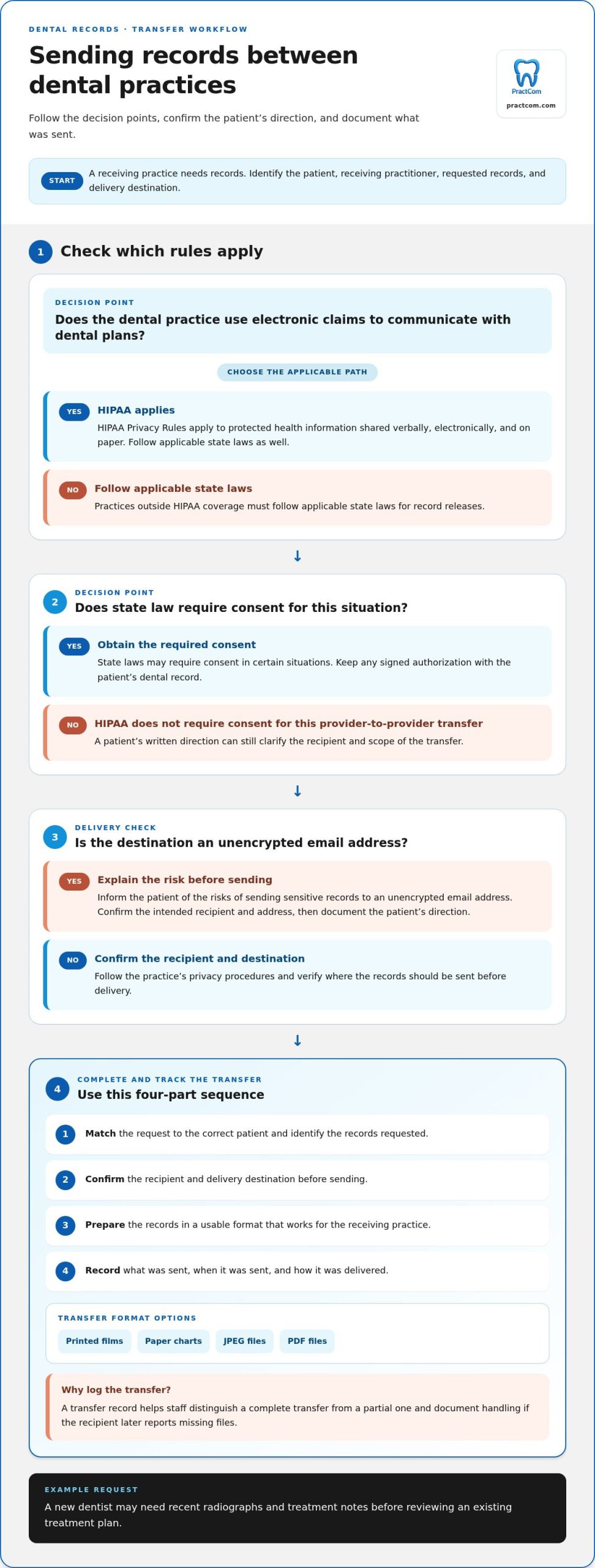
A transfer between dental practices gives the receiving team information needed for continuity of care. Start by identifying the patient, receiving practitioner, requested records, and delivery destination. Confirm that the request is clear, then route it to the staff member responsible for records. For example, a new dentist may need recent radiographs and treatment notes before reviewing an existing treatment plan.
When HIPAA applies to dental practices
A dental practice is covered by HIPAA if it uses electronic claims to communicate with dental plans. HIPAA Privacy Rules apply to protected health information shared verbally, electronically, and on paper. Staff should protect records at every stage, from discussing a transfer to sending a PDF or printing a chart. Practices outside HIPAA coverage must follow applicable state laws for record releases.
HIPAA doesn’t require a consent form to send dental records to another healthcare provider. However, state laws may require consent in certain situations, so a practice needs a process that accounts for the rules governing its records. A patient’s written direction can still clarify the recipient and scope of the transfer. Keep the authorization with the patient’s dental record when one is used.
Choose a format and track the transfer
Dental records can be transferred as printed films, paper charts, JPEG files, or PDFs. Choose a format that preserves the information and works for the receiving practice. A practical transfer sequence is:
- Match the request to the correct patient and identify the records requested.
- Confirm the recipient and the delivery destination before sending.
- Prepare the records in a usable format, such as printed films or PDF files.
- Record what was sent, when it was sent, and how it was delivered.
This sequence helps staff distinguish a complete transfer from a partial one. It also creates a record of the practice’s handling steps if the recipient later reports missing files.
State requirements and email precautions
Do dental records release requirements vary by state? Yes. State laws may set requirements for releasing records, including situations where consent is needed. Practices covered by HIPAA must also follow applicable state laws. The rules depend on the practice’s coverage and the records involved.
Email requires careful handling because a dental chart can contain sensitive health information. Before sending records to an unencrypted email address, inform the patient of the risks. Confirm the address and intended recipient, then document the patient’s direction and the transfer. A clear workflow helps staff avoid sending files to the wrong address or overlooking part of the request.
For practices aiming to make patient communication more orderly, explore a structured patient communication workflow as a next step.
Specifying the scope of a records request
A precise request tells the dental practice which patient’s information to locate, which records to provide, and who should receive them. Under HIPAA, a patient’s written request to send records to another person must be signed and clearly identify the recipient and destination. Listing the requested records separately helps staff distinguish a focused request from one for the complete chart.
Who can request access to dental records?
A competent adult or emancipated minor may generally authorize release of their own information under state law. A parent or legal guardian may generally authorize release for a minor or a patient who is incompetent, subject to state law. A representative signing for someone else should provide written proof of authority. For a deceased patient, an estate administrator or executor may generally authorize release.
Match each authorization to the person whose records are requested. A parent’s signature is usually sufficient for a minor’s dental records, while a previous practice may require separate signed authorizations for adult family members. One adult’s signature should not be treated as permission to release another adult’s chart. Confirm the signer’s authority before staff retrieve or disclose records.
Describe the records and recipient clearly
Use specific selections rather than a broad phrase such as “all information” when the patient wants only certain items. A request can identify x-rays, photographs, treatment records, or the complete dental chart. Include the receiving practitioner’s name and the destination for copies. The patient’s name, signature, and date connect the instructions to the correct request.
- Identify the patient and the person signing, including their relationship if applicable.
- Name the records requested, such as specified x-rays, photographs, or treatment notes.
- State the recipient and delivery destination clearly.
- Record the signature and date, and attach written proof of a representative’s authority.
A defined scope supports accurate retrieval. For example, “bitewing x-rays and treatment notes from the recent restorative visit” gives staff a clearer search than “dental records.” If the patient wants the entire chart, state that directly. Keep the signed authorization with the patient’s dental record to document what was approved.
Some information may need special attention. State laws may prohibit disclosure of HIV/AIDS records unless the authorization specifically refers to that information. Patients can also review their records, request corrections, keep personal copies, and ask for reports about why information was shared. A well-scoped request helps staff respond to the patient’s stated purpose without assuming every record category is included.
Purpose of a dental records release form
A dental records release form turns a patient’s instruction into a clear, documented request. It identifies whose information may be shared, which records are involved, and who should receive them. For your team, that written direction distinguishes an authorized disclosure from an assumption based on a phone call or family relationship.
HIPAA gives patients the right to request that copies be sent to a person they designate. HIPAA doesn’t require a consent form for every transfer between healthcare providers, though state law may require consent in certain situations. A written form can still clarify what the patient wants and help staff handle the request consistently.
Clarify the patient’s choice
The form lets patients direct a transfer rather than leaving staff to infer the recipient or scope. For example, a patient changing dentists may authorize the current practice to send specified radiographs and treatment notes to the new practitioner. Naming both the records and recipient helps prevent an unintended release of unrelated chart information.
A form also distinguishes the patient’s authorization from the practice’s internal processing steps. Staff can use it to confirm the patient’s identity, review the requested scope, and match the destination to the named recipient. If a guardian or legal representative signs, written proof of authority helps establish why that person may act for the patient.
Create a record of the disclosure decision
Keep the signed authorization with the patient’s dental record. The American Dental Association recommends retaining a patient’s signed consent form authorizing release to another healthcare provider as part of that record. This gives the practice a reference if staff need to clarify which information was approved or when the authorization was received.
Clear documentation can also help the practice respond to questions about information sharing. Patients can learn how their information is used or shared, review their records, request corrections, and ask for reports about why information was shared. An organized release record gives staff a practical starting point when answering those requests.
Support consistent handling across the practice
Use the same review steps for each request: check the patient and signer, read the scope, verify the recipient, and record the action taken. If a request names only photographs, for example, staff should not treat it as permission to release the entire chart.
These steps make the form a control point, not a substitute for privacy procedures. Staff should still use approved handling methods, document the transfer, and follow applicable state requirements. A consistent process helps respect patient choice while giving the dental team a reliable record of each disclosure decision.
Where can I download a dental records release form template?
Start with a records release template used by your dental practice, then compare it with applicable state requirements. A state dental or health agency may also provide forms or guidance for patient records. The right template should support the specific transfer, whether a patient requests radiographs for a new dentist or copies of a complete chart. Don’t assume a downloaded form is suitable for every request.
Review the template before using it
Check that the form has space for the patient’s name, recipient, destination, and requested records. It should also include the patient’s signature and date. For example, a request for photographs and treatment notes needs a way to identify those items separately. If a guardian or legal representative may sign, include room to document the signer’s relationship and attach written proof of authority.
Look for language patients can understand. They should be able to tell who will receive the information and what the practice may disclose. A form that says only “release records” may leave staff uncertain about whether the request covers x-rays, photographs, treatment notes, or the entire chart. Specific choices make the patient’s direction easier to follow.
Adapt it to your practice workflow
Before adding a template to your process, compare its fields with the steps your team uses to handle requests. Confirm that staff can record when the form arrived, what records were gathered, and how the transfer was completed. State laws may affect release requirements, so the template should fit the rules applicable to your practice. Practices should consult legal counsel about state laws and legally binding documents.
Keep the completed authorization with the patient’s dental record. The American Dental Association recommends keeping a patient’s signed consent form authorizing release to another healthcare provider as part of that record. According to the form information, a photocopy of a signed authorization is as valid as the original. For a practical workflow, retain the signed copy alongside transfer details, such as the date and format sent.
Make the form clear and usable
Test the template with a common example before using it across the practice. Have a staff member follow the form to transfer specified x-rays to a receiving dentist. If the recipient, destination, requested records, and signature are easy to identify, the form supports a clear handoff. If any field creates uncertainty, revise the form and explain the updated steps to staff.
Once the release form is ready, connect it to a consistent process for managing patient forms and communications. Explore a more organized digital patient forms workflow.
PractCom: Post-Treatment Instruction Library
PractCom’s Post-Treatment Instruction Library helps dental practices share clear care guidance after procedures. Its library includes over 80 post-treatment templates, while Digital Informed Consent Forms support consent workflows. These tools address patient communication and treatment documentation, not authorization to release dental records. Use a records release authorization for that separate purpose.
Turn to PractCom when your team wants a more consistent way to deliver post-treatment instructions and manage digital consent forms. Documents can be delivered by email, text, or print in 15 languages, helping practices communicate with patients in their preferred format.
Visit practcom.com to learn more about PractCom and its tools for dental patient communication.
Make your records process part of a dependable workflow
A clear consent for release of dental records form is one part of a reliable patient communication process. Next, make responsibilities clear: decide who receives requests, who reviews authorizations, and how completed actions are documented. That routine helps your team handle each request carefully, even during a busy clinic day.
PractCom supports related communication needs with its Dental Aftercare Notes, Digital Informed Consent Forms, and Referral Management System. These tools help organize patient instructions, consent workflows, and referrals alongside your practice’s records procedures. They don’t replace the specific authorization or privacy steps required for releasing dental records.
If you’re ready to explore a more organized communication workflow for your practice, contact PractCom about your practice. A thoughtful process can make the next patient request easier to manage.
Frequently Asked Questions
What information should a dental records release consent form include?
Include enough detail to connect the patient’s authorization to the right disclosure: patient identity, recipient, delivery destination, records covered, signature, and date. Add the signer’s relationship to the patient when someone else signs. For example, a patient authorizing a new dentist to receive a treatment plan can name the dentist and identify the plan rather than selecting the entire chart.
How do I request a copy of my dental records?
Send your dental practice a written request identifying you and the records you want. If you want copies sent elsewhere, name the recipient and provide the destination. For example, specify whether you need a treatment summary for your own files or radiographs sent to a new dentist. Keep a copy of your request and note when you submitted it so you can follow up clearly.
Can a patient authorize release of dental records to another dentist or person?
Yes. A patient can designate another person, including a new dentist, to receive copies of dental records. The written request should identify the recipient and where copies should be sent. If you want a family member to receive records, name that person rather than relying on the relationship alone. The practice can then match its disclosure to your documented instruction.
What are the HIPAA rules for releasing dental records?
HIPAA gives patients the right to request that a covered dental practice send copies to a person they designate. A request to send records to another person must be written, signed, and clearly identify the recipient and destination. HIPAA doesn’t require a consent form for every provider-to-provider transfer, though state law may require consent in some situations. Practices must also protect health information in paper, electronic, and verbal forms.
Does a parent or legal guardian need to sign a dental records release for a minor?
A parent or legal guardian may generally authorize release for a minor, subject to state law. A parent’s signature is usually sufficient for a minor’s dental records. If a guardian or legal representative signs, the practice should receive written proof of that person’s authority. For a family request involving adult relatives, each adult may need to provide a separate signed authorization for their own records.
What risks are involved in sending dental records by email or fax?
Email can expose sensitive records if an address is entered incorrectly, an account is accessed by someone else, or files are sent without encryption. A fax can reach the wrong number or remain visible to people near the receiving machine. Before sending records to an unencrypted email address, the practice should explain the risks. Confirm the destination and recipient, then document the patient’s direction and chosen delivery method.

Article by
Cary Ganz DDS
Dr. Cary H. Ganz is a dentist, prosthodontist, entrepreneur, lecturer, and author with more than 50 years of experience in clinical dentistry and dental technology. Throughout his career, he has combined hands-on patient care with a deep understanding of how technology can improve dental practice operations, communication, documentation, and patient outcomes.
In addition to his clinical background, Dr. Ganz has held significant leadership roles in the dental technology industry, including Past Owner and Vice President of Clinical Affairs at DEXIS Digital Radiography and Past Vice President of Clinical Affairs at Denticon Practice Management Software. His business experience includes product development, clinical strategy, dental software innovation, practice management solutions, and educating dental professionals on the effective use of technology in modern dentistry.
Today, Dr. Ganz continues to focus on creating practical technology solutions for dental practices, including PractCom, a comprehensive dental practice communication platform designed to improve patient communication, documentation, compliance support, referrals, and overall practice efficiency. His work reflects a career-long commitment to helping dentists deliver better care while making their practices more organized, efficient, and protected.
No responses yet