
What if a cancellation were treated as the start of a patient conversation, not just an empty slot? Knowing how to handle dental appointment cancellations means responding promptly, understanding why the patient needs to cancel, and giving them a clear next step. When notice is short, chair time can be difficult to recover, but a rushed or inconsistent response can also make it harder for the patient to return.
Your team shouldn’t have to improvise each time. A consistent process helps staff acknowledge the patient’s reason, explain the practice policy in calm, plain language, and offer a practical path to reschedule. This guide covers those steps, along with how to document follow-up and respond when cancellations repeat. It also leaves room for empathy when illness, work, caregiving, or other circumstances affect a patient’s plans. The goal is to manage schedule capacity while treating each patient fairly and consistently.
Key Takeaways
- Distinguish advance cancellations, short-notice cancellations, and no-shows so your team can respond appropriately.
- Review notice timing, stated reasons, appointment type, and rescheduling outcomes to spot patterns without blaming patients.
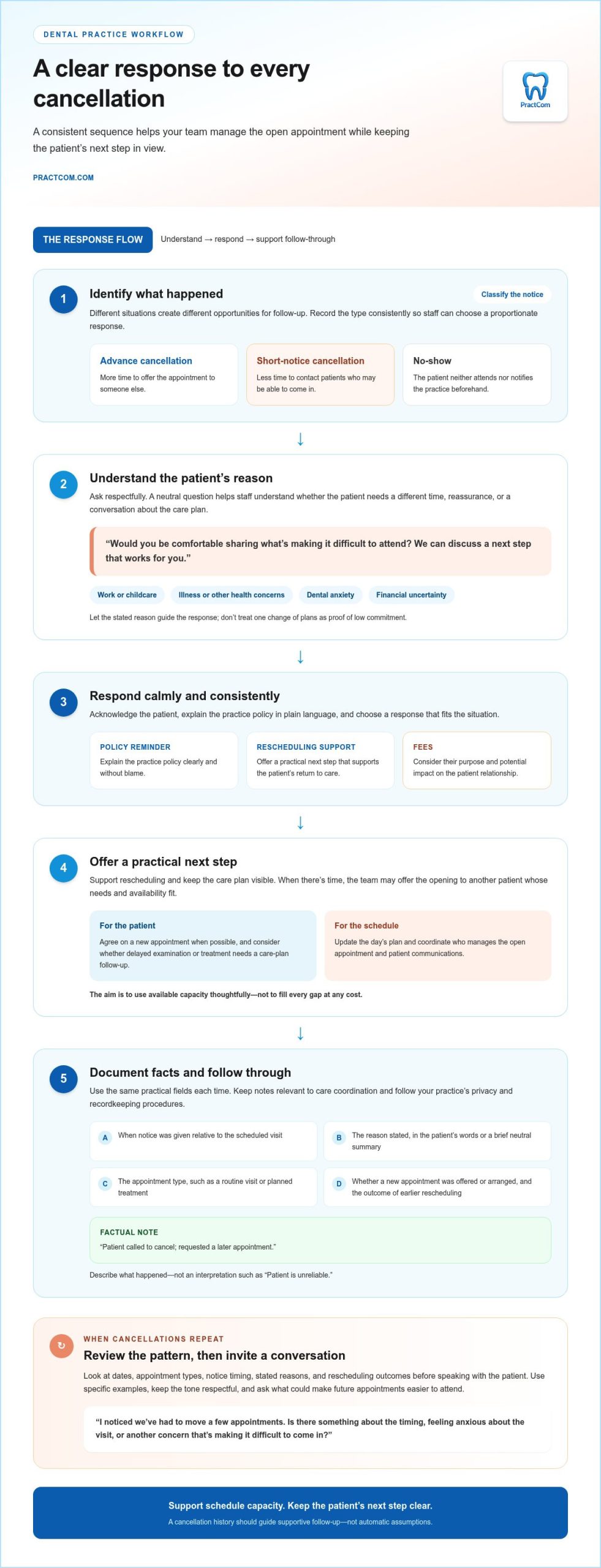
- Learn how to handle dental appointment cancellations with a consistent sequence for acknowledging the patient, applying policy, rescheduling, documenting, and following up.
- Choose between policy reminders, rescheduling support, and fees based on their purpose and potential impact on the patient relationship.
- Use clear communication and factual documentation to support follow-through. Communication tools can help record what was sent and when.
Why dental appointment cancellations disrupt care and practice flow
A cancellation can disrupt a carefully coordinated day, especially when it comes close to the appointment time. The team may need to adjust room preparation, clinical coverage, and patient communications, while another patient is waiting for an opening. Still, a cancellation isn’t automatically a sign of disregard. Patients may be dealing with real constraints, and the practice needs a response that protects care and capacity without assigning blame.
Timing affects what the team can do next. An advance cancellation gives the practice more time to offer the appointment to someone else. A short-notice cancellation leaves less time to contact patients who may be able to come in. A no-show occurs when the patient neither attends nor notifies the practice beforehand. These situations create different opportunities for follow-up, so recording them consistently helps staff choose a proportionate response.
A cancellation-response workflow is the practice’s repeatable set of next steps for understanding a cancellation, managing the open appointment, and supporting the patient’s return to care. That definition keeps the focus on both schedule capacity and continuity of care. If a patient delays an examination or planned treatment, the team may need to revisit when care should resume rather than simply close the appointment record.
Why patients cancel dental appointments
Reasons often fall into four broad groups: scheduling conflicts such as work or childcare; health concerns, including illness; anxiety about dental care; and financial uncertainty. A patient may not volunteer the reason unless staff ask respectfully. Try, “Would you be comfortable sharing what’s making it difficult to attend? We can discuss a next step that works for you.”
A neutral question can help staff understand whether the patient needs a different time, reassurance, or a conversation about their care plan. It also avoids treating a single change of plans as evidence of low commitment to oral health. Let the reason guide the response, while keeping the patient’s privacy and preferences central.
What a cancellation changes for the practice
An opening affects more than one chair. The team may need to update the day’s plan, coordinate clinical and front-desk responsibilities, and consider patients awaiting care. A cancellation received early may be recoverable if there’s time to offer the slot to someone whose needs and availability fit. At short notice, the same opening may remain unfilled because patients can’t rearrange their schedules quickly.
That distinction matters for operational coordination. A clear dental practice workflow helps staff know who updates the schedule, who contacts patients about the opening, and how the original patient’s next step is recorded. The aim isn’t to fill every gap at any cost. It’s to use available capacity thoughtfully while keeping the patient’s care plan visible and follow-through clear.
How to identify cancellation patterns without blaming patients
A cancellation history is useful when it helps your team understand what may be getting in the way of care. It becomes less useful when staff treat a pattern as proof of a patient’s motives. Review consistent, relevant details before deciding whether a conversation or a different follow-up step makes sense. A single change of plans calls for a different response than repeated difficulty attending, but neither tells the whole story on its own.
Cancellation patterns should guide supportive follow-up, not automatic assumptions about a patient’s priorities or intentions. This distinction helps staff respond to what they know, ask about what they don’t, and keep the patient relationship constructive.
Which details are useful to record
Use the same practical fields for each cancellation so the team can compare like with like. Depending on your recordkeeping procedures, note:
- When the patient gave notice relative to the scheduled visit.
- The reason the patient stated, using their words or a brief, neutral summary.
- The appointment type, such as a routine visit or planned treatment.
- Whether staff offered a new appointment, whether one was arranged, and the outcome of any earlier rescheduling.
Keep entries factual. “Patient called to cancel; requested a later appointment” describes what happened. “Patient is unreliable” adds an interpretation and doesn’t help the next team member decide what to do. Record only information relevant to care coordination and follow your practice’s privacy and recordkeeping procedures. Don’t add unrelated personal details or draw clinical conclusions from a scheduling change.
When a repeat-cancellation conversation may help
Before speaking with a patient about repeated cancellations, review the dates, appointment types, notice timing, stated reasons, and rescheduling outcomes. Specific examples make it easier to discuss the pattern calmly instead of relying on a general impression. Choose a respectful tone and invite the patient to explain what could make future appointments easier to attend.
For example: “I noticed we’ve had to move a few appointments. Is there something about the timing, feeling anxious about the visit, or another concern that’s making it difficult to come in?” The question is direct without being accusatory. If the patient shares a barrier, listen first and discuss a practical next step within the practice’s usual process. A more empathetic patient experience often begins with asking rather than assuming.
Use the information to distinguish a one-time disruption from a recurring scheduling challenge. A patient who repeatedly can’t attend early appointments may benefit from discussing a different time, while another may need space to talk through anxiety or uncertainty. Don’t apply the same response automatically to every history. Revisit the record after follow-up so the next staff member can see what was discussed and whether a new visit was arranged.
Learning how to handle dental appointment cancellations includes making useful notes without turning them into labels. PractCom’s communication and documentation tools can help teams keep patient-facing messages and records organized. See how PractCom supports patient communication.
Cancellation policies, reminders, or fees: which response fits?
Different responses solve different problems. A clear policy sets expectations, reminders can prompt patients to flag conflicts, rescheduling support keeps care moving, and a fee may address certain missed-appointment situations under a practice’s policy. None is a universal fix. To decide how to handle dental appointment cancellations, match the response to the circumstances and consider how it may affect the patient’s willingness to return.
| Approach | When it may help | Limitations | What staff should communicate |
|---|---|---|---|
| Clear policy | Set shared expectations before a cancellation occurs. | A policy alone doesn’t resolve a scheduling barrier. | Explain notice expectations and how the practice handles cancellations. |
| Reminder | Give patients a chance to notice a conflict and respond before the visit. | A reminder may not reach or resolve every patient’s issue. | Keep the message clear and give the patient a way to respond. |
| Rescheduling support | Help patients continue care when the original time no longer works. | A suitable alternative may not be available immediately. | Offer practical options and confirm the agreed next step. |
| Fee policy | Address situations covered by the practice’s clearly communicated policy. | Fees may strain trust and may be subject to applicable rules. | Explain the policy calmly and consistently, including any relevant exception process. |
When a clear cancellation policy is the right foundation
Put expectations in patient-facing materials and explain them before a problem arises, rather than introducing the policy during a stressful cancellation call. Use consistent wording across the team, and define how staff handle exceptions so patients aren’t given conflicting answers. If the practice is considering or enforcing a fee, check applicable rules first. A written policy and advance communication are important, but they don’t replace that review.
How reminders and flexibility differ from penalties
A reminder is a communication step, not a penalty. It gives patients an opportunity to spot a conflict early and contact the practice, leaving more time to discuss options. Rescheduling support addresses a different need: it helps the patient find another suitable time and maintain continuity of care. A fee, by contrast, applies a consequence under the practice’s policy and may be experienced as frustrating, especially when circumstances are difficult. Use it thoughtfully, not as the default.
These approaches can work together without being interchangeable. For example, a patient who responds to a reminder with a work conflict may simply need help finding another time. A patient with a pattern of short-notice changes may need a calm conversation about expectations and barriers, with the policy explained consistently. Illness or other circumstances may call for an exception under the practice’s process. Clear communication gives staff a dependable starting point while leaving room to respond to the person in front of them.
What staff should do when a dental appointment is cancelled
A consistent response helps the team handle the immediate schedule change and gives the patient a clear next step. Use the same sequence whether the notice comes by phone, email, or text, adapting the conversation to what the patient has shared. Staff should follow the practice’s scheduling process and policy, and avoid promising that a short-notice opening can be filled.
Use this order to keep the response complete without making it feel scripted:
- Acknowledge the notice. Thank the patient for letting the practice know, and respond with empathy if they mention illness or another difficulty.
- Clarify what they need. Ask whether they’d like to reschedule now, and confirm which appointment is being cancelled.
- Apply the policy. If relevant, explain the practice’s policy in plain language, using the wording the team has agreed on.
- Offer rescheduling. Present suitable options through the practice’s usual scheduling process, including a way to follow up if the patient can’t choose a time yet.
- Document the outcome. Record the notice, relevant patient response, policy information shared, and agreed next step according to practice procedures.
- Follow up and manage the opening. Complete any promised follow-up and use the existing process to offer the opening to patients who may want an earlier visit.
A practical response script for the front desk
Keep the language warm, direct, and consistent. For example: “Thanks for letting us know. I’m sorry that time won’t work for you. Would you like to look at another appointment now? Our cancellation policy is [brief policy wording]. If you’re not ready to choose a new time, we can agree on how you’d like us to follow up.” Use only the policy wording that applies to the patient’s situation.
For a patient with repeated cancellations, add a gentle invitation rather than a reprimand: “I noticed we’ve had to move a few visits. Is there a time that tends to work better, or anything making it difficult to attend?” This opens a practical conversation about timing or other barriers while preserving the patient’s dignity.
How to recover an opening and close the loop
If the patient can’t select a replacement appointment immediately, don’t leave the outcome vague. Ask whether they’d prefer to contact the practice later or receive follow-up, and record the agreed next step. Then follow the practice’s established process for identifying patients who may want an earlier visit. An opening may be filled, partially used, or remain open. Record what happened so the team can review its workflow without treating an unfilled slot as a staff failure.
Keep the cancellation outcome in the appropriate record rather than duplicating unrelated notes. If a message or follow-up is sent, document it according to practice procedures. Learning how to handle dental appointment cancellations includes closing the communication loop, not only updating the schedule. PractCom’s communication and documentation tools support patient messaging and records. Learn about PractCom’s communication tools.
How consistent communication supports better cancellation follow-through
A staff workflow is only as dependable as the messages and records that support it. If one team member explains the policy differently or a promised follow-up isn’t recorded, patients may receive mixed signals and colleagues may be unsure what happens next. Consistent communication gives patients a clearer experience and helps your team carry each cancellation through to an agreed outcome.
That doesn’t mean every response must sound identical. A patient who needs to cancel because of illness may need a different conversation from someone who has repeatedly struggled to attend. The useful standard is consistency in the essentials: respectful language, accurate policy information, a clear next step, and a factual record of communication.
Where communication tools fit into the process
Plain-language scripts help staff explain expectations without sounding abrupt, while customizable documents let a practice keep patient-facing information aligned with its current process. PractCom Communications lets practices edit, download, print, or email documents, with version history. Documents can also be sent by text, and PractCom provides print-ready handouts for patients who prefer paper. Clear, respectful language matters throughout the patient experience, including when a visit has to change.
PractCom Communications combines communication and documentation tools, including Dental Aftercare Notes, digital informed consent forms, referral management, and a patient portal. It supports patient communication, but it doesn’t automatically detect appointment cancellations. Staff still follow the practice’s existing scheduling workflow to update appointments, offer openings, and arrange rescheduling.
A low-friction next step for practice teams
Before standardizing scripts or records, write down what staff currently do from the first cancellation notice through follow-up. Identify where the process varies: how the policy is explained, what details are documented, and who completes any agreed follow-up. Then refine the workflow and prepare shared wording for common situations. This makes the change practical because the team can build on its actual process rather than an assumed one.
Documentation should make the next action clear without creating duplicate or unrelated notes. Record the relevant communication and outcome in line with the practice’s procedures. For messages sent through PractCom, tracked delivery logs show what was sent, how it was delivered, and when. These records can help the team review communication and follow-through; they aren’t a guarantee of legal protection.
- Keep policy explanations and rescheduling language consistent across staff.
- Record the agreed next step so a colleague can continue the conversation.
- Review sent communications and delivery records when refining the process.
These steps make it easier to put into practice how to handle dental appointment cancellations with both operational clarity and patient consideration. For teams looking to organize patient communication and documentation alongside their workflow, explore PractCom’s communication platform.
Make your next cancellation response more consistent
Choose one practical next step: write down the cancellation process your team wants to follow, then make the patient-facing wording easy for staff to use consistently. As you refine it, customizable PractCom documents can be sent by email, text, or print to help carry clear messages across channels. Tracked delivery logs record what was sent, how it was delivered, and when, giving your team a useful reference as it reviews communication and follow-through.
That’s a manageable way to put what you’ve learned about how to handle dental appointment cancellations into daily practice. Start with the points where handoffs or patient messages most often become inconsistent, then improve the workflow from there. You don’t need to solve every scheduling challenge at once; a clear, repeatable process gives your team a steadier foundation for responding with both care and confidence.
Explore PractCom’s patient communication platform and take the next step toward more organized, patient-centered communication.
Frequently Asked Questions
What should a dental office say when a patient cancels an appointment?
Thank the patient for letting you know, then ask whether they’d like help choosing another time. Explain any relevant policy calmly and avoid adding pressure to the conversation. For example: “Thanks for letting us know. Would you like to reschedule, or would you prefer to decide later?” Use consistent wording across the team, but keep your tone human. A prepared phrase should clarify next steps, not make the patient feel punished.
Is it appropriate to charge a fee for a cancelled dental appointment?
A practice may consider a fee policy, but it shouldn’t be treated as an automatic fix for lost chair time. A charge can affect patient trust, particularly if expectations weren’t clear or circumstances are difficult. Before adopting or applying a fee, check applicable rules and make sure the policy is communicated in advance. Keep a record of the policy information shared with the patient and apply the practice’s process consistently.
How much notice should patients give when cancelling a dental appointment?
Set notice expectations that fit your practice and explain them to patients before an appointment needs to change. The ADA gives 24- or 48-hour periods as examples, not universal requirements for every practice. Before adopting a specific timeframe, check applicable requirements. Use plain language in patient-facing materials, and make clear how patients can notify the office. That way, expectations are easier to understand before a last-minute change occurs.
What should a dental practice do when a patient cancels at the last minute?
Thank the patient for notifying you, check the policy that applies, and offer to discuss a replacement appointment. Then follow your usual process to see whether another patient may be able to use the opening. Record the outcome, including whether rescheduling was arranged or follow-up was agreed. A short-notice slot may be difficult to fill, so communicate next steps clearly without promising that the time will be recovered.
How should a practice handle a patient who repeatedly cancels appointments?
Review the relevant appointment history, then have a calm, prepared conversation rather than relying on assumptions. Ask whether timing, anxiety, or another barrier is making attendance difficult. For example: “Would a different time make it easier to keep your next appointment?” Restate the practice policy in the same neutral language used with other patients, and discuss a workable next visit. Focus on solving the scheduling problem, not labeling the patient.
Can appointment reminders reduce dental cancellations?
Reminders can give patients a chance to notice a scheduling conflict and contact the practice before the visit, but they can’t prevent every cancellation. Establish a consistent process for sending reminders and make it clear how patients can respond or request a change. For example, a reminder can invite the patient to call or reply if the appointment no longer works. Review whether the process supports timely communication, without treating attendance as guaranteed.
How can a dental practice document cancellation follow-up?
Keep a concise, factual record of when notice arrived, the reason if the patient volunteered one, whether rescheduling occurred, and any agreed next step. For example, note that the patient requested a call later to discuss available times. Keep the entry relevant, avoid staff judgments, and follow the practice’s recordkeeping procedures and applicable privacy requirements. Documentation supports continuity between team members, but it doesn’t guarantee legal protection.

Article by
Cary Ganz DDS
Dr. Cary H. Ganz is a dentist, prosthodontist, entrepreneur, lecturer, and author with more than 50 years of experience in clinical dentistry and dental technology. Throughout his career, he has combined hands-on patient care with a deep understanding of how technology can improve dental practice operations, communication, documentation, and patient outcomes.
In addition to his clinical background, Dr. Ganz has held significant leadership roles in the dental technology industry, including Past Owner and Vice President of Clinical Affairs at DEXIS Digital Radiography and Past Vice President of Clinical Affairs at Denticon Practice Management Software. His business experience includes product development, clinical strategy, dental software innovation, practice management solutions, and educating dental professionals on the effective use of technology in modern dentistry.
Today, Dr. Ganz continues to focus on creating practical technology solutions for dental practices, including PractCom, a comprehensive dental practice communication platform designed to improve patient communication, documentation, compliance support, referrals, and overall practice efficiency. His work reflects a career-long commitment to helping dentists deliver better care while making their practices more organized, efficient, and protected.
No responses yet