
What if a patient’s trust is shaped as much by the explanation and follow-up as by the treatment itself? Someone arriving anxious or skeptical may find it hard to feel confident when clinical details seem rushed or next steps are unclear. Building patient trust in a dental practice depends on the small, consistent ways your team communicates throughout the patient journey.
Patients want to feel respected, heard, and informed before making decisions about their care. But busy schedules can make it difficult to slow down, check understanding, and ensure each patient knows what happens next. Clear communication isn’t an extra step. It helps patients take part in decisions with greater confidence.
This practical guide covers ways to build trust before, during, and after appointments. Learn how to listen with empathy, explain recommendations in accessible language, discuss treatment and next steps transparently, and create reliable follow-up habits across your team. The goal is a more consistent patient experience, where people know their questions matter and their care doesn’t end when they leave the chair.
Key Takeaways
- Building patient trust in a dental practice depends on respectful, understandable communication repeated across the patient journey.
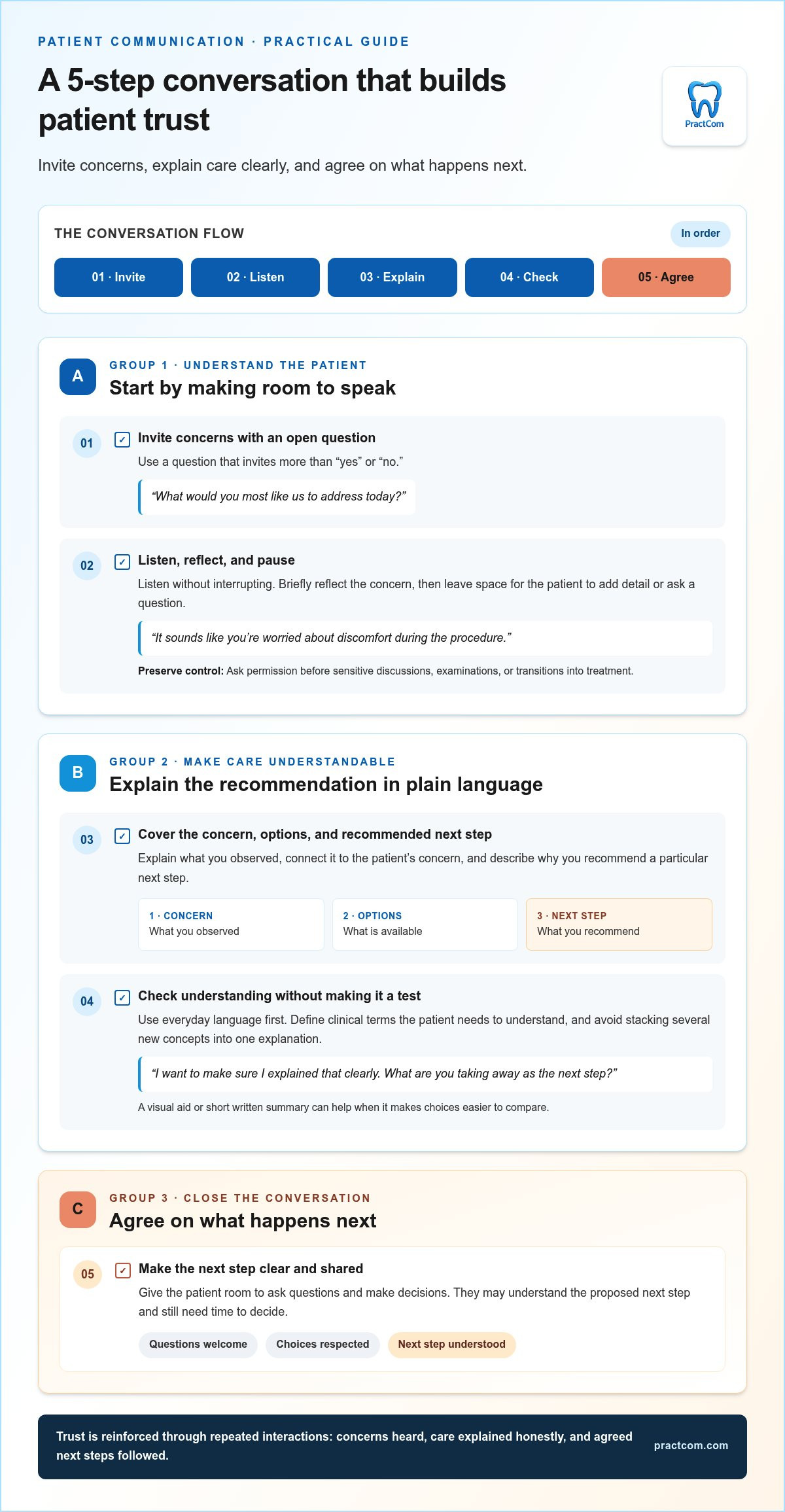
- Use a simple conversation sequence: invite concerns, listen, explain in plain language, check understanding, and agree on next steps.
- Discuss treatment benefits, limitations, alternatives, and uncertainty transparently so patients can make informed decisions without feeling pressured.
- Make communication more consistent by standardizing key moments before, during, and after appointments, then choosing one team behavior to improve first.
Why Building Patient Trust in a Dental Practice Starts With Everyday Experiences
Building patient trust in a dental practice isn’t achieved with one reassuring sentence. It grows through repeated interactions that show patients their concerns are heard, explanations are honest, and agreed next steps are followed. A calm welcome, an unhurried answer, and clear instructions after a visit can each reinforce confidence.
Patient trust is a patient’s confidence that the dental team listens, explains care honestly, respects their choices, and follows through. It includes confidence in the team’s clinical judgment and in how the patient is treated. Trust-building behaviors support a respectful process. They don’t guarantee a particular treatment outcome or require promising that care will be painless.
Patients may worry about pain, cost uncertainty, embarrassment about their teeth, or losing control during treatment. These concerns can affect what they ask, what they share, and how ready they feel to decide. Treat them as valid: ask what matters most, respond without judgment, and leave space for questions.
What does patient trust look like in a dental practice?
Look for observable signs rather than assuming that a quiet patient feels comfortable. Patients who feel respected are more likely to ask questions, share relevant concerns, and say when something is unclear. They should be able to describe the proposed next step in their own words, even if they still need time to decide. That reflects a shared conversation, not automatic agreement.
Trust in healthcare is closely connected to communication and shared decision-making. The broader physician-patient relationship offers useful context for principles that also apply to conversations between dental teams and patients.
Why can patients feel uncertain even in a clinically skilled practice?
Clinical skill doesn’t always prevent confusion. A rushed explanation, unfamiliar terminology, or an unanswered question can leave a patient unsure about what’s recommended and why. Expectations may also be shaped by dental anxiety or an earlier experience that felt uncomfortable or dismissive. Hesitation isn’t proof that someone is difficult, uninformed, or unwilling to receive care.
Respond with curiosity instead of judgment. Pause to ask, “What questions do you have?” or “What would help you feel clearer about the next step?” Then address the specific concern in plain language. This exchange helps patients retain agency and gives your team a clearer understanding of what they need to make an informed decision.
Build Dental Patient Trust With Listening, Empathy, and Clear Explanations
A useful conversation doesn’t require a long script. It needs a reliable sequence: invite concerns, listen without interrupting, explain the situation and options, check understanding, then agree on the next step. Repeating this pattern helps patients know what to expect and gives your team a chance to address uncertainty before it grows.
How can dental teams show patients they are being heard?
Start with open questions that invite more than a yes-or-no answer: “What would you most like us to address today?” or “Is there anything about dental visits that makes you uneasy?” Ask about relevant past experiences and practical constraints, too. Before offering a recommendation, reflect the concern briefly: “It sounds like you’re worried about discomfort during the procedure.” Then pause. A moment of silence gives the patient room to add detail or ask a question.
Ask permission before sensitive discussions, examinations, or transitions into treatment. A simple “Would it be okay if I explain what I’m seeing?” or “Are you ready for me to begin the examination?” helps preserve the patient’s sense of control. Listening doesn’t mean agreeing to every request. It means taking the concern seriously and responding respectfully.
How do you explain dental treatment without overwhelming patients?
Organize the explanation around three points: the concern, the available options, and the recommended next step. Use everyday language first, then introduce and define any clinical term the patient needs to understand. Explain what you’ve observed before naming the condition, and connect the recommendation to the patient’s stated priorities. Avoid stacking several new concepts into one explanation.
Visual aids or a short written summary can help clarify a discussion when they make choices easier to compare. They shouldn’t replace conversation or add more information than the patient can use. To check understanding, try: “I want to make sure I explained that clearly. What are you taking away as the next step?” This invites correction without turning the exchange into a test.
Listening closely and explaining care in plain language help patients feel informed, respected, and more confident about their next step. That’s a practical foundation for building patient trust in a dental practice, especially when each team member uses the same thoughtful approach.
Structured digital consent forms and patient communication resources can support clear conversations by giving patients information to review. Explore patient communication tools as one way to support consistency alongside attentive, person-to-person care.
Earn Trust Through Transparent Recommendations, Consent, and Respect
A recommendation is easier to consider when patients understand how it relates to their needs. Explain what you observed, how it connects to the concern they raised, and why you’re recommending a particular next step. Transparency means covering relevant benefits, limitations, alternatives, and uncertainty, not presenting one option as the only possible choice when other reasonable approaches exist.
How can dentists explain treatment recommendations transparently?
Keep the discussion neutral and specific. Explain what a proposed treatment is intended to address, what its limitations are, and what alternatives may involve. Clarify unfamiliar terms and distinguish what you know from what remains uncertain. Avoid guarantees about results and urgency that isn’t clinically justified. If timing matters, explain the clinical reason plainly so the patient can understand the recommendation without feeling pressured.
Give patients room to consider their options. They may need time to think, discuss the information with someone they trust, or return with questions. A recommendation is guidance, not pressure to make an immediate decision. That distinction helps patients retain control and supports an open conversation about their priorities.
How does respectful consent strengthen patient confidence?
Informed consent is an ongoing conversation, not simply a form completed before treatment. Before proceeding, invite questions and confirm the patient understands the proposed procedure, relevant choices, and what happens next. Ask whether they’d like anything clarified. Respect a request to pause, decline, or receive more information, and discuss an appropriate next step without judgment.
Written materials can reinforce what you’ve discussed, but they can’t replace the clinician’s explanation or the patient’s opportunity to ask questions. Digital informed consent forms can help present information in a structured way. The conversation makes space to address the patient’s specific circumstances and confirm understanding. For more on using consent documentation, see this digital dental informed consent guide.
These habits make building patient trust in a dental practice visible in the decision-making process: patients know why a recommendation was made, what choices they have, and that their questions and decisions will be respected. Clear documentation can support continuity, but it doesn’t guarantee trust or replace thoughtful communication. The clinician’s role is to explain, invite discussion, and make sure the patient has a genuine opportunity to participate.
Make Trust Consistent Before and After Every Dental Appointment
Patients shouldn’t have to guess what happens next. A repeatable communication routine helps each team member set clear expectations, provide useful instructions, and follow through. It also makes trust less reliant on one person remembering every detail during a busy day.
- Prepare: Review the appointment purpose and any relevant communication preferences so the team can give consistent information.
- Welcome: Explain what the visit is for, introduce team members, and invite the patient to raise concerns.
- Explain: Outline likely steps and describe transitions, such as moving from an examination to a discussion of findings.
- Confirm: Check that the patient understands the plan and knows what will happen next. Ask whether verbal information, written instructions, or both would be helpful.
- Follow up: Provide relevant aftercare information and any agreed next steps in an accessible format.
- Invite feedback: Ask whether the communication was clear and note recurring questions the team can address more consistently.
What should patients know before and during an appointment?
Before care begins, set expectations about the appointment’s purpose and likely steps without implying that every visit will follow an identical script. During the visit, narrate transitions and introduce anyone joining the conversation. A brief explanation such as “I’m going to take a closer look, then we’ll review what I found” can prevent a patient from wondering what’s happening. Ask about their preferred format for information and respect that preference where practical.
How can follow-up reinforce trust after treatment?
After treatment, give patients instructions relevant to the care they received, along with clear next steps. Keep follow-up relevant and appropriately timed, and use the patient’s communication preferences to guide how information is shared. If a patient raises a clinical concern, direct it through the practice’s established process rather than relying on a generic automated message to resolve it.
Consistent written guidance helps patients refer back to important information between visits. A well-organized post-treatment instruction library can support that routine, while the dental team remains responsible for making instructions appropriate to the patient’s care. For more detail, read this automated post-treatment instructions guide.
Use patient feedback as an improvement signal. If people repeatedly ask the same question after a certain procedure, clarify the instructions or adjust how the team explains next steps. This kind of follow-through supports building patient trust in a dental practice by making communication more predictable across visits. PractCom’s patient communication tools include a post-treatment instruction library and automated follow-ups to support consistent communication.
Turn Patient Trust Into a Repeatable Dental Practice Standard
Trust shouldn’t depend on which team member happens to be available. Make it a shared practice standard by identifying where patients commonly feel uncertain, assigning clear ownership, and reviewing whether communication is working. Start small: one consistent behavior, practiced across the team, is easier to maintain than a long list of new procedures.
How can a dental team put trust-building into practice?
Set aside a short team meeting to map the patient journey and identify moments when questions go unanswered or next steps are unclear. Choose one behavior to standardize first, such as explaining what happens after an examination or confirming a patient understands their instructions. Agree on who owns each communication step so preparation, welcome, explanation, documentation, and follow-up don’t fall between roles.
Use brief scripts as prompts, not rigid lines to recite. A reminder to explain the purpose of a procedure can help the team stay consistent while leaving room to adapt the conversation to each patient and clinical situation. Then review patient questions and feedback regularly. Look for recurring concerns and communication gaps, but don’t treat a single measure, such as fewer follow-up questions, as proof that patients trust the practice. Use it as a cue to listen and investigate further.
How can communication tools support, not replace, patient relationships?
Organized materials can help staff share instructions consistently and reduce reliance on memory during busy periods. PractCom offers a library of over 80 post-treatment instruction templates and digital consent forms, with documents available by email, text, or print in 15 languages. These resources can support follow-through, but a template can’t recognize a patient’s hesitation, respond to a personal concern, or replace a clinician’s explanation.
Keep the human conversation at the center. Team members should check that written instructions fit the patient’s care, invite questions, and direct clinical concerns through the practice’s established process. Communication tools work best as practical support for attentive care, not as a substitute for it.
To make progress manageable, choose one communication moment to improve, assign an owner, and bring the team back together to discuss what patients are asking. Building patient trust in a dental practice is ongoing work, strengthened when reliable systems support respectful interactions. PractCom’s communication tools can help your team organize patient instructions and follow-ups.
Make Consistent, Respectful Communication Your Next Step
Building patient trust in a dental practice takes more than one good conversation. It grows when patients are listened to, understand their options, feel respected in decisions, and receive reliable communication before and after appointments. A practical starting point is to choose one team behavior to standardize, then use patient questions and feedback to refine it.
Communication resources can help make follow-through more consistent while leaving personal care where it belongs: with your team. PractCom offers over 80 post-treatment instruction templates alongside digital consent forms, and documents can be delivered by email, text, or print in 15 languages. These tools support clear communication, but trust still depends on how your team listens, explains, and responds.
Explore PractCom’s patient communication tools to support a more consistent approach across the patient journey. Start with one small improvement, and build on it through steady attention and genuine respect.
Frequently Asked Questions
How do you build trust with dental patients?
Build trust through consistent actions: listen to concerns, explain recommendations in clear language, and follow through on agreed next steps. Invite questions without rushing the conversation, and check that the patient understands what will happen next. Be transparent about options and uncertainty, and respect a patient’s decision to pause or ask for more information. These habits make building patient trust in a dental practice part of everyday care rather than a one-time reassurance.
Why is patient trust important in a dental practice?
Patient trust helps people feel respected and informed as they consider their care. When patients can ask questions and share concerns, the dental team has a clearer understanding of what matters to them and can explain recommendations in context. Trust also supports more open conversations about preferences and uncertainty. It doesn’t guarantee treatment acceptance or a particular clinical outcome, but it helps create a respectful basis for shared decisions.
Can communication improve dental patient trust?
Yes. Clear, empathetic communication helps patients understand what the team recommends and why, while giving them room to express concerns. Use plain language before clinical terms, explain unfamiliar terms, and pause to check understanding. For example, ask, “What questions do you have about the next step?” rather than assuming silence means everything is clear. Consistent communication before, during, and after visits can reduce confusion and help patients feel heard.
How can a dentist help an anxious patient feel comfortable?
Ask what would help the patient feel more at ease, and listen without minimizing their concern. Explain what you’re about to do before an examination or treatment transition, ask permission to proceed, and agree on how the patient can signal that they need a pause. Offer information in manageable steps and leave time for questions. These actions can help the patient feel more informed and in control without promising that care will be pain-free.
What should a dentist explain before recommending treatment?
Explain the clinical concern, how it relates to the patient’s needs, and the reason for the recommendation. Discuss relevant benefits, limitations, alternatives, and uncertainty in accessible language. Clarify unfamiliar terms and explain any timing considerations without creating pressure that isn’t clinically justified. Give the patient time to ask questions and consider the information. A recommendation should guide an informed conversation, not imply a guaranteed result or remove the patient’s choice.
How can dental practices build trust after an appointment?
Close the visit by reviewing the agreed next step and providing relevant aftercare instructions in a format the patient can use. Follow up in a way that suits the patient’s communication preferences, and make clear how clinical concerns should be directed through the practice’s established process. Invite feedback about what was unclear. If the same questions come up repeatedly, use them to improve instructions and team communication for future visits.
Does using digital forms or follow-up software build patient trust?
Digital forms and follow-up tools can support consistent communication, but they don’t create trust on their own. Patients still need clear explanations, an opportunity to ask questions, and responses suited to their situation. PractCom offers over 80 post-treatment instruction templates and digital consent forms, with documents available by email, text, or print in 15 languages. These resources can help organize information and follow-through, while personal conversations remain essential.

Article by
Cary Ganz DDS
Dr. Cary H. Ganz is a dentist, prosthodontist, entrepreneur, lecturer, and author with more than 50 years of experience in clinical dentistry and dental technology. Throughout his career, he has combined hands-on patient care with a deep understanding of how technology can improve dental practice operations, communication, documentation, and patient outcomes.
In addition to his clinical background, Dr. Ganz has held significant leadership roles in the dental technology industry, including Past Owner and Vice President of Clinical Affairs at DEXIS Digital Radiography and Past Vice President of Clinical Affairs at Denticon Practice Management Software. His business experience includes product development, clinical strategy, dental software innovation, practice management solutions, and educating dental professionals on the effective use of technology in modern dentistry.
Today, Dr. Ganz continues to focus on creating practical technology solutions for dental practices, including PractCom, a comprehensive dental practice communication platform designed to improve patient communication, documentation, compliance support, referrals, and overall practice efficiency. His work reflects a career-long commitment to helping dentists deliver better care while making their practices more organized, efficient, and protected.
No responses yet