
A patient’s understanding of their care depends not only on the treatment, but also on what happens before they leave. A dependable dental patient discharge workflow helps patients leave with clear next steps instead of unanswered questions. When discharge tasks vary by clinician or team member, important guidance can be missed, explained inconsistently, or left undocumented.
Discharge involves more than handing over an instruction sheet. Patients need aftercare information they can understand and access, while your team needs a practical way to record what was shared and who is responsible for follow-up. The aim is to support both without adding unnecessary friction to a busy clinical routine.
This guide explains how to build a repeatable, patient-centered discharge process. You’ll learn how to define team responsibilities, match instructions to the procedure and patient, document the handoff, and assign follow-up. It also covers how standardized instruction resources and flexible delivery options can support the process while keeping clinical judgment at the center.
Key Takeaways
- A consistent dental patient discharge workflow connects the clinical handoff with clear aftercare, reliable documentation, and defined follow-up.
- Use a repeatable sequence for each discharge, while keeping the treating clinician responsible for approving instructions and patient-specific changes.
- Choose verbal, printed, or digital delivery based on the patient’s preferences, access needs, and your practice’s workflow.
- Review instructions for clinical accuracy, plain language, and accessibility, and revisit them when protocols change.
- Communication tools can help organize instruction delivery and planned follow-up, while leaving clinical decisions with your team.
Why a Consistent Dental Patient Discharge Workflow Matters
Dental treatment doesn’t end when the procedure is complete. Discharge is the transition from treatment to informed aftercare: the patient receives relevant guidance, understands what to do next, and knows how to ask questions. A patient discharge process connects communication and planning with continuity of care. In a dental setting, that means coordinating the clinician’s instructions with the handoff, documentation, and any planned follow-up.
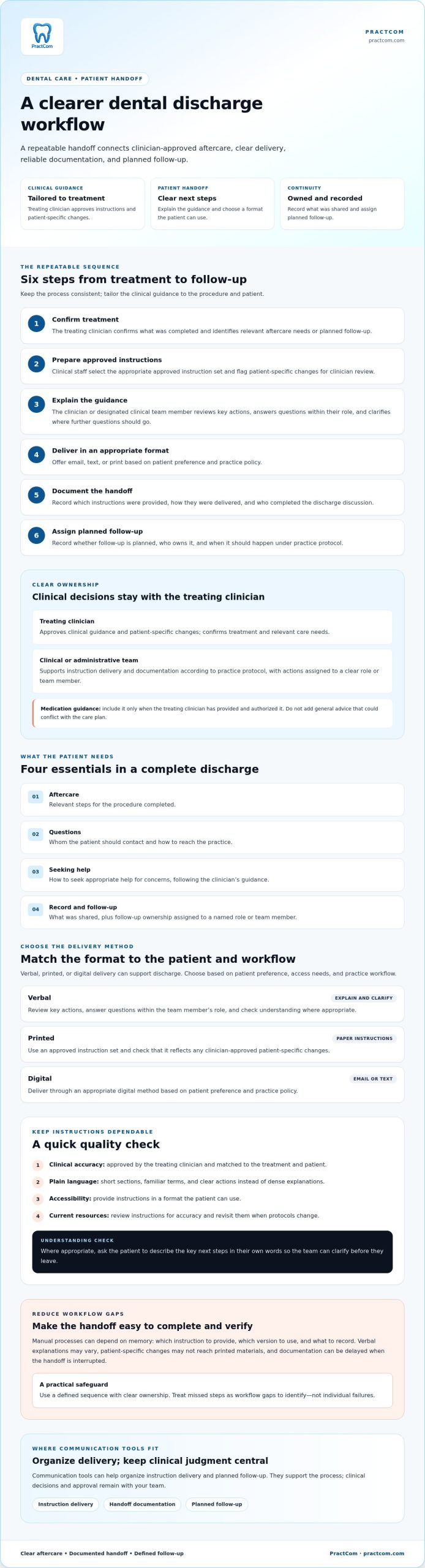
A standardized dental discharge workflow is a repeatable process for confirming care instructions, explaining and delivering them to the patient, documenting the handoff, and assigning planned follow-up. The steps remain consistent, while the clinical guidance is tailored to the procedure and individual patient.
Consistency gives the team a shared reference point. Without one, a patient may receive a detailed verbal explanation while another gets only a printed sheet. Staff may also be unsure whether instructions were delivered or follow-up was assigned. These are workflow gaps, not individual failures. A reliable process makes the handoff easier to complete and verify.
What Should Dental Discharge Include?
Discharge should give patients practical, clinician-approved guidance for their specific treatment. Explain it clearly, provide it in a format the patient can use, and check that the key points are understood. Include medication guidance only when the treating clinician has provided and authorized it. Don’t add general advice that could conflict with the patient’s care plan.
- Aftercare: Explain the relevant steps for the completed procedure.
- Questions: Clarify whom the patient should contact and how to reach the practice.
- Seeking help: Tell patients how to seek appropriate help if they have concerns, following the clinician’s guidance.
- Record and follow-up: Document what was shared and assign planned follow-up to a named role or team member.
Where Manual Discharge Processes Commonly Break Down
Manual processes depend on people remembering which instructions to provide, which version of a handout to use, and what details to record. Verbal explanations can vary by team member. Printed materials may not reflect a patient-specific change, and documentation can be delayed when the handoff is interrupted.
Interruptions are part of a busy workday. A clinician may be preparing for the next patient while front-desk staff handle check-out questions and scheduling. If no one owns the handoff, a step can be missed even when everyone is working carefully. A defined sequence and clear ownership help the team identify gaps without assigning blame.
How to Build a Dental Patient Discharge Workflow Step by Step
A dependable dental patient discharge workflow gives each team member a clear handoff. The treating clinician approves the clinical guidance and patient-specific changes. Clinical or administrative staff can support delivery and documentation according to practice protocol. Use this sequence as a starting point, then assign each action to a role on your team.
- Confirm treatment: The treating clinician confirms what was completed and identifies relevant aftercare needs or planned follow-up.
- Prepare instructions: Clinical staff select the appropriate approved instruction set and flag patient-specific changes for clinician review.
- Explain the guidance: The clinician or designated clinical team member reviews key actions, answers questions within their role, and clarifies where the patient should direct further questions.
- Deliver the instructions: Offer an appropriate method, such as email, text, or print, based on patient preference and practice policy.
- Document the handoff: The assigned team member records which instructions were provided, how they were delivered, and who completed the discharge discussion.
- Assign follow-up: Record whether follow-up is planned, who owns it, and when it should happen under practice protocol.
Prepare and Explain Patient-Specific Instructions
Match the approved instructions to the procedure performed, then have the treating clinician approve clinical content and patient-specific edits. Keep patient-facing language direct: use short sections, familiar terms, and clear actions instead of dense explanations. Where appropriate, ask the patient to describe the key next steps in their own words. This gives the team a chance to clarify the instructions before the patient leaves.
Deliver, Document, and Assign the Next Contact
Make delivery part of the handoff, not an assumption. Confirm that the patient received the chosen format, then document what was shared and which team member completed the step. If another contact is planned, assign an owner and timing under your practice protocol. This keeps responsibility visible instead of leaving follow-up to memory.
Routine aftercare is separate from a formal decision to end the provider-patient relationship. If that separate situation arises, the American Dental Association offers guidance on dismissing a patient. For everyday discharge, clear steps, defined roles, and a recorded handoff help the team follow a consistent process without turning clinical judgment into a checklist item.
Paper, Verbal, or Digital Discharge: Compare the Options
The right format depends on the patient and the practice, not on a universal preference. In a dental patient discharge workflow, verbal explanations, printed handouts, and digital delivery can each support the handoff. Whichever channel you choose, the treating clinician must approve the clinical content and any patient-specific changes.
| Format | Access and consistency | Workflow fit |
|---|---|---|
| Verbal | Allows patients to ask questions in the moment, but details may be harder to revisit later unless instructions are also recorded or provided in another format. | Fits naturally into the clinical conversation, but requires time and a clear handoff. |
| Printed | Provides a tangible reference to take home. The team should check that the handout matches the procedure and any approved changes. | Useful for patients who prefer paper or have limited access to digital communication. |
| Digital | Can make instructions easier to retrieve after the appointment. Access depends on the patient’s device, connection, language, and comfort with the channel. | May fit an established email or text process. The practice should confirm delivery and document the handoff. |
When Printed or Verbal Instructions Fit Best
A conversation gives the patient a chance to raise questions before leaving, while a printed handout provides a reference at home. Pairing the two connects the explanation with written guidance. For example, the team can review key points verbally, provide the matching handout, and note that it was given. Keep the explanation aligned with the clinician-approved instructions.
When Digital Instructions Add Practical Value
Email or text can make instructions available for later reference if the patient can access and use that channel. Check the patient’s preference, language needs, and comfort with the format. Offer print or a verbal explanation when digital delivery isn’t suitable. When selecting digital communication practices, consider guidance on automated dental post-op instructions. Digital delivery supports the handoff, but it doesn’t replace individualized clinical guidance.
Set a simple channel-selection rule: ask what works for the patient, check accessibility and practice policy, then document the chosen method. More than one format may be appropriate. Consistency comes from providing approved information and recording what was shared, not from requiring every patient to receive it the same way.
How to Make Discharge Instructions Clear, Accessible, and Accountable
A useful quality check covers both the information the patient receives and how the team handles the handoff. Apply it before making the dental patient discharge workflow routine, then revisit it whenever instructions or protocols change.
- Clinical approval: Confirm the treating clinician has approved the instructions and any patient-specific changes.
- Plain language: Use familiar words, clear headings, and one action per instruction where practical.
- Patient access: Ask about preferred language and delivery format rather than making assumptions.
- Delivery: Confirm the selected instructions were provided in the agreed format.
- Documentation: Record what was shared, who completed the handoff, and whether follow-up has an owner.
Clear communication is part of the patient experience, not an extra administrative step. Connect discharge guidance with your broader approach to dental patient experience and clinical communication. The clinical team should review instruction materials when protocols change, so standard wording stays aligned with current practice and clinician judgment.
Check Readability, Language, and Patient Access
Read each instruction from the patient’s perspective. Replace unfamiliar terminology with everyday language where appropriate, break dense text into short sections, and state actions directly. Ask which language and format the patient prefers, then confirm that the chosen option is accessible. A translated document or digital message is useful only if the patient can understand and access it.
Pilot the Workflow and Improve It Safely
Start with a defined team and a limited range of procedures. Observe where the handoff slows down or staff need clarification. Invite patient feedback on whether instructions were easy to follow and retrieve. Route proposed changes to the clinical team for approval before updating materials. A small pilot can surface process issues without treating missed steps as individual shortcomings.
Track process measures that show whether the workflow is being completed, such as whether delivery is documented and planned follow-up has an assigned owner. These measures can reveal where the process needs attention, but they don’t prove improved clinical outcomes. If you’re evaluating communication tools to support instruction delivery and follow-up, explore PractCom’s communication approach.
Where Patient Communication Tools Fit in a Dental Discharge Workflow
Communication tools can support the operational parts of a dental patient discharge workflow: sharing approved instructions, recording communication, and coordinating planned follow-up. They don’t determine what guidance is clinically appropriate. The treating clinician remains responsible for reviewing instructions and approving patient-specific changes.
PractCom provides a library of more than 80 post-treatment instruction templates that can serve as starting points for clinician review. Documents can be delivered by email, text, or print in 15 languages. Standardized templates give the team a consistent starting point, while clinical review keeps instructions relevant to the patient and procedure.
Evaluate Tools Against Your Discharge Process
Start with your handoffs, then assess whether a tool supports them. Check whether templates can be reviewed and adapted to practice protocols, which languages and delivery channels are available, and whether follow-up features fit your team’s process. Consider what staff need to document and how the tool works alongside existing systems. For a broader feature overview, visit PractCom’s communication platform overview.
- Instructions: Can the clinical team review and approve the content before use?
- Access: Can patients receive information through a channel and language they can use?
- Follow-up: Can planned communications be supported in a way that matches practice protocols?
- Documentation: Does the process help staff record what was delivered and who owns the next step?
Start with a Manageable Workflow Improvement
Choose one recurring discharge process and map its handoffs from completed treatment to patient communication. Identify who approves clinical content, who prepares and delivers instructions, and who records follow-up ownership. Ask patients about their preferred language and delivery format rather than assuming one channel works for everyone. A focused review helps show where a communication tool could fit before expanding its use.
PractCom is a patient communication and documentation platform for dental practices. It can complement existing practice management software, but it isn’t a replacement for a full PMS or clinician judgment. Explore PractCom’s platform to see how its communication tools may fit your discharge process.
Make Your Discharge Process Consistent, One Step at a Time
A dependable dental patient discharge workflow connects clinician-approved instructions with a clear handoff, accessible delivery, and documented follow-up ownership. Keep the steps repeatable, but tailor guidance to the patient and procedure. Clear roles help your team complete the process without relying on memory alone.
Start by reviewing one common discharge process. Confirm who approves instructions, how patients receive them, and who records delivery and any planned follow-up. Then use staff and patient feedback to identify practical adjustments. Small, reviewed changes can make the process easier to follow while keeping clinical judgment at the center.
Communication tools can support this work. PractCom offers more than 80 post-treatment instruction templates as starting points for clinician review, with document delivery by email, text, or print in 15 languages, and automated patient follow-ups. These tools support patient communication; they don’t replace your clinical team or a full practice management system.
To explore how PractCom’s communication tools could support your discharge process, visit PractCom. Choose a manageable first step, involve your team, and build a process patients can understand and staff can repeat with confidence.
Frequently Asked Questions
What should a dental patient discharge workflow include?
A dental patient discharge workflow should connect completed treatment with clear, clinician-approved aftercare. It should specify who explains the instructions, how the patient receives them, what the team documents, and who owns planned follow-up. Tailor guidance to the procedure and treating clinician’s directions. Templates can help the team work consistently, but the treating clinician must review clinical content and approve patient-specific changes.
How can a dental practice standardize post-treatment instructions?
Standardize instructions by reviewing guidance for common procedures with the clinical team and organizing approved materials so staff can find the right version. Use plain language and agree on how instructions are explained, delivered, and documented. Define responsibility for follow-up as well. Ask staff where handoffs become unclear or repetitive, and review materials whenever practice protocols change. A consistent process still allows clinician-approved adjustments for individual patients.
Should dental discharge instructions be printed or sent digitally?
Choose the format that fits the patient’s preference, access, and your practice’s process. Printed instructions provide a physical reference to take home; email or text may make information easier to retrieve later. You can offer more than one format where appropriate. Before discharge, confirm the patient can access the selected option and understands the guidance. Whatever the format, use clinician-approved instructions and document how they were provided.
How do you make dental aftercare instructions easier for patients to understand?
Use familiar words, clear headings, short sections, and practical actions tied to the treatment performed. Explain unfamiliar terms and give patients time to ask questions before leaving. When appropriate, ask them to describe the key next steps in their own words so you can clarify anything confusing. Ask about preferred language and accessible formats rather than assuming. Clinical staff should approve the instructions and any patient-specific changes.
Who is responsible for discharging a dental patient?
The treating clinician is responsible for clinical direction, including approving patient-specific aftercare guidance. Other team members may help explain, deliver, or document instructions when their roles and practice protocols allow. Make the handoff explicit by identifying who completes each step and confirming it’s done. Practices should define responsibilities to fit their procedures and applicable professional requirements, while keeping clinical decisions with the treating clinician.
Can dental practices automate patient discharge instructions?
Technology can support the workflow by organizing approved instruction templates, delivering documents, and helping coordinate planned follow-ups. It shouldn’t determine clinical advice or replace clinician review. PractCom offers more than 80 post-treatment instruction templates, document delivery by email, text, or print in 15 languages, and automated patient follow-ups. Ensure the team reviews instructions against practice protocols before use.
How should a dental practice measure its discharge workflow?
Track practical process measures, such as whether instructions were delivered, which method was used, and whether planned follow-up has an assigned owner. Staff feedback can identify delays, unclear responsibilities, or missed handoffs. Patient feedback can highlight confusing materials or access barriers. Review these measures periodically and adjust the process as needed. They show whether workflow steps are being completed, but operational measures alone don’t establish clinical outcomes.
Article by
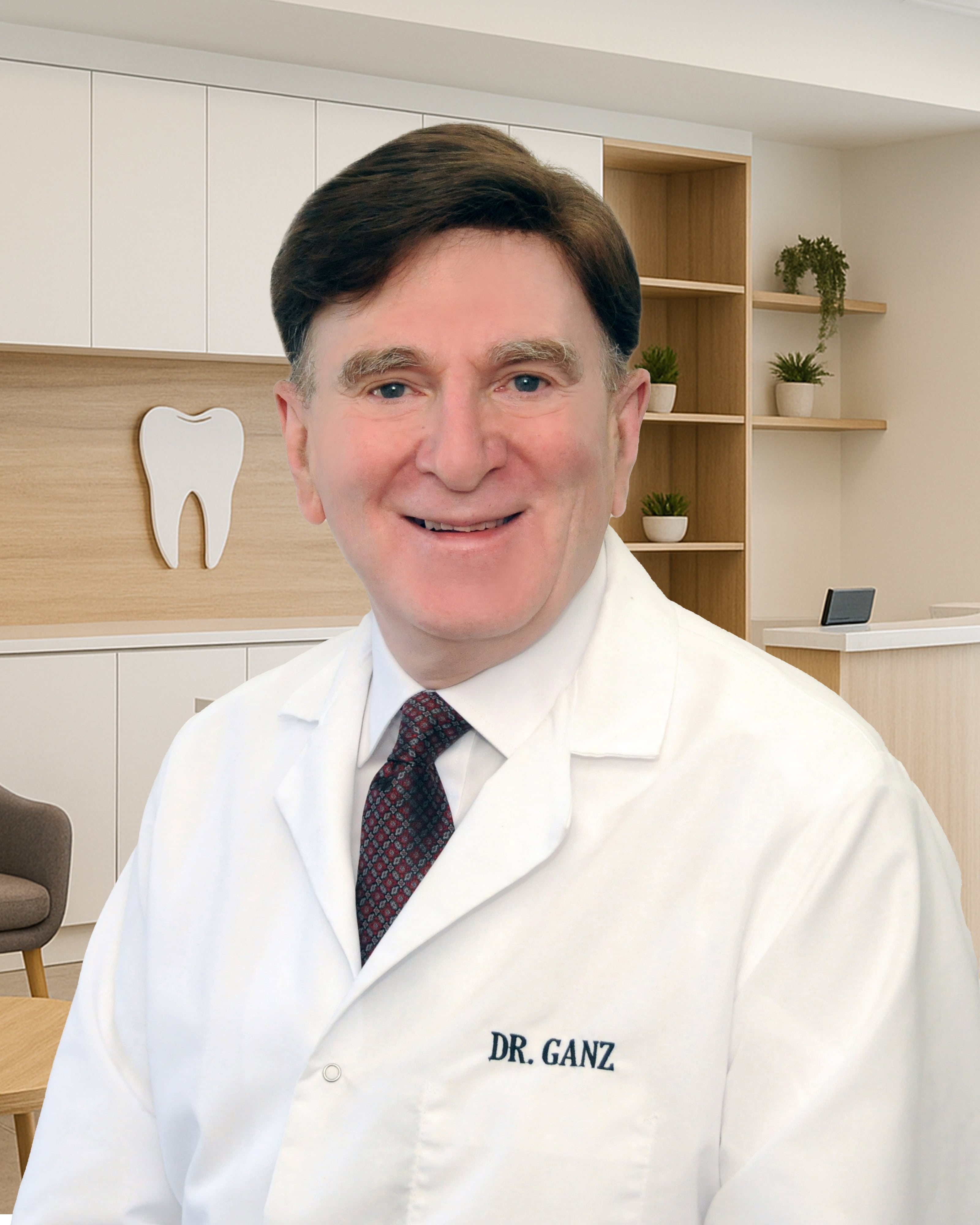
Cary Ganz DDS
Dr. Cary H. Ganz is a dentist, prosthodontist, entrepreneur, lecturer, and author with more than 50 years of experience in clinical dentistry and dental technology. Throughout his career, he has combined hands-on patient care with a deep understanding of how technology can improve dental practice operations, communication, documentation, and patient outcomes.
In addition to his clinical background, Dr. Ganz has held significant leadership roles in the dental technology industry, including Past Owner and Vice President of Clinical Affairs at DEXIS Digital Radiography and Past Vice President of Clinical Affairs at Denticon Practice Management Software. His business experience includes product development, clinical strategy, dental software innovation, practice management solutions, and educating dental professionals on the effective use of technology in modern dentistry.
Today, Dr. Ganz continues to focus on creating practical technology solutions for dental practices, including PractCom, a comprehensive dental practice communication platform designed to improve patient communication, documentation, compliance support, referrals, and overall practice efficiency. His work reflects a career-long commitment to helping dentists deliver better care while making their practices more organized, efficient, and protected.
No responses yet