
Patient communication isn’t just a “soft skill” or a matter of bedside manner; it’s a clinical lever that directly impacts your bottom line. If you’re still treating patient interactions as unquantifiable moments, you’re likely struggling with a high volume of post-op phone calls and low case acceptance from poor follow-up. Tracking specific dental patient communication metrics allows you to move from administrative guesswork to systematic control. It’s time to stop guessing how well your team communicates and start measuring it as a core component of your clinical success.
You likely feel the daily weight of documentation compliance and the frustration of referral loops that never seem to close. We understand that the manual burden on your staff is reaching a breaking point, often leading to missed opportunities and increased liability risks. This article will show you exactly how to transform these “soft” interactions into measurable clinical assets that drive production, compliance, and patient retention. We’ll explore how modern tools like performance dashboards and automated follow-up systems provide clear visibility into your practice’s health, ensuring no patient falls through the cracks while significantly reducing administrative friction.
Key Takeaways
- Shift from intuitive “soft skills” to systematic dental patient communication metrics to gain precise control over your practice’s operational performance.
- Identify the five essential KPIs, including referral loop closure and consent speed, that turn administrative tasks into high-value clinical assets.
- Reduce the daily volume of post-op phone calls by transitioning from manual follow-ups to a standardized digital library of post-treatment instructions.
- Secure your reputation and legal standing by closing documentation gaps that often lead to liability risks and poor patient compliance.
- Leverage a centralized communication dashboard to visualize patient engagement and eliminate the data silos that slow down your team’s productivity.
Moving Beyond “Good Chairside Manner”: Why Communication Metrics Matter in 2026
For decades, the success of a dental practice relied heavily on the charismatic “chairside manner” of the provider. While empathy remains vital, 2026 demands a shift toward dental patient communication metrics. These are quantifiable data points that track how, when, and how effectively your practice engages with a patient throughout their clinical journey. It’s the difference between hoping a patient understood their post-op care and knowing they accessed their digital instructions three times before dinner. This transition from intuitive soft skills to systematic operational data allows you to manage your practice with technical precision rather than administrative guesswork.
We’re seeing a fundamental change in how high-performing clinics operate. When you treat communication as a measurable clinical asset, you gain the ability to spot friction before it becomes a negative review or a lost case. This approach provides a stabilizing force in a high-pressure setting, alleviating the anxiety practitioners feel regarding what happens once a patient leaves the chair. High-performing practices now realize that communication clarity is the most effective tool for reducing non-clinical emergency phone calls. If your front desk is drowning in “is this normal?” queries, your communication data is signaling a breakdown in your instruction delivery system.
Standardization also protects your team from administrative and clinical burnout. Without a system, your staff repeats the same instructions dozens of times daily, often missing key details due to fatigue or the limitations of human memory. Data-driven communication ensures every patient receives the same high-standard information, protecting your reputation and your team’s mental bandwidth. It creates a professional ecosystem where no part of the patient process is left to chance.
The ROI of Measurable Patient Engagement
Tracking engagement leads directly to higher case acceptance rates. Patients don’t say “no” as often as they say “not right now” because they feel overwhelmed or under-informed. By measuring follow-up loops, you can identify exactly where patients stall in their decision-making process. Closing these loops prevents the high cost of “lost” patients who slip through the cracks of a manual system. This systematic approach significantly improves patient lifetime value (LTV) by fostering a sense of psychological security and professional reliability that keeps patients returning for years.
Standardization as the Foundation of Data
You can’t measure what you don’t standardize. Relying on verbal-only instructions is a liability because human memory is prone to error, especially under the stress of a clinical procedure. A digital post-treatment instruction library provides the baseline needed to collect meaningful dental patient communication metrics. Without this foundation, your data is just noise. In 2026, communication standardization is the automated synchronization of clinical instructions across all digital platforms to ensure 100% documentation accuracy and patient comprehension.
Core Dental Patient Communication Metrics Every Practice Should Track
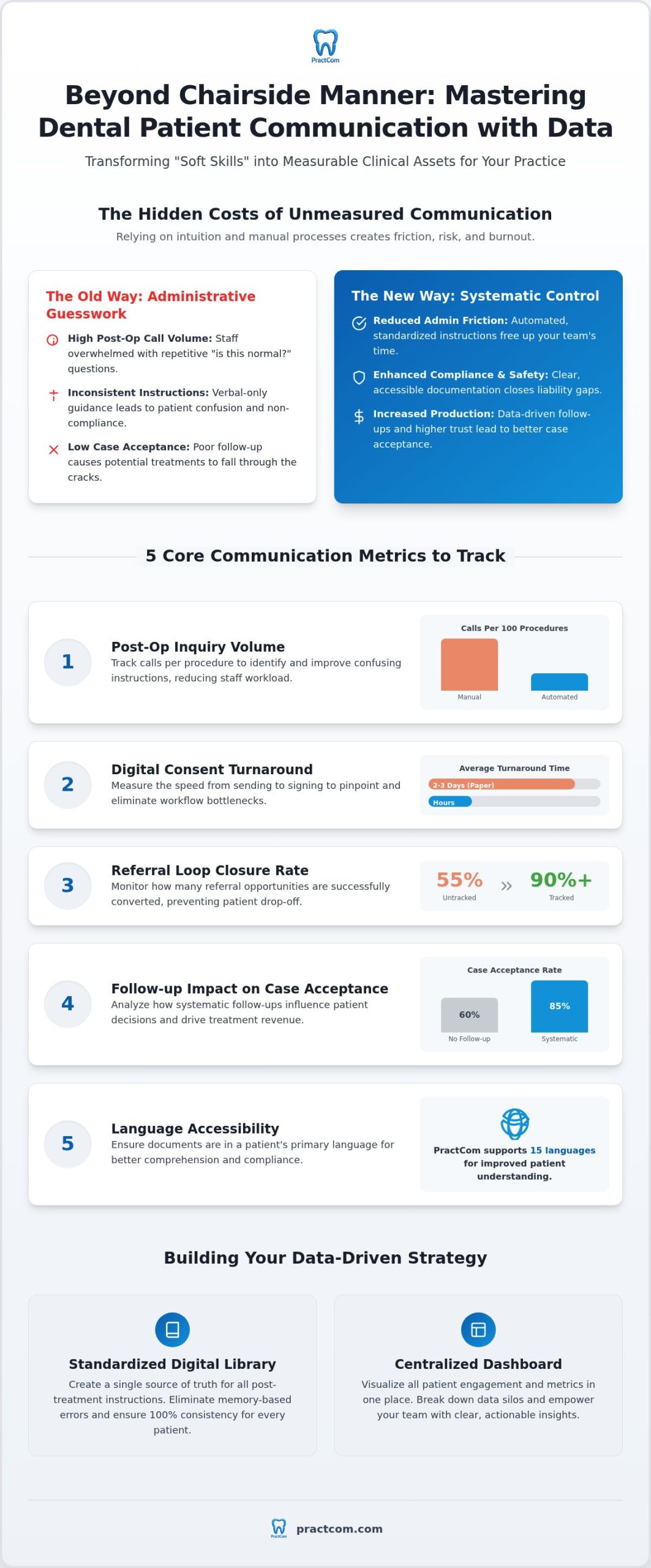
To move from administrative resistance to systematic control, you must prioritize specific dental patient communication metrics. These aren’t just numbers; they’re indicators of clinical safety and operational health. Tracking your Digital Consent Turnaround Time, for instance, tells you if your workflow is efficient or if patients are stalling due to confusion. Likewise, monitoring Post-Op Inquiry Volume per procedure type helps you identify which instructions need more clarity to prevent unnecessary phone traffic. By quantifying these touchpoints, you transform the patient experience from an unpredictable variable into a manageable clinical asset.
Language accessibility is another critical metric that often goes unmeasured. If you serve a diverse population, tracking the percentage of documents delivered in a patient’s primary language ensures higher compliance and reduced liability. Since PractCom supports 15 languages, you can easily measure how well you’re bridging the gap between complex procedures and patient understanding. This level of technical precision alleviates the anxiety of practitioners regarding documentation and regulatory reassurance.
Follow-Up and Instruction Compliance KPIs
Measuring whether patients actually read your digital post-op instructions is a game-changer for clinical outcomes. By tracking the “open” and “view” rates of your digital library, you gain visibility into patient engagement before a post-operative complication even has a chance to arise. Automated follow-ups often yield faster response times than manual calls, which can be verified by comparing your team’s manual outreach data against automated SMS delivery. Many practices find that SMS alerts result in higher immediate compliance rates compared to email; this makes it a vital delivery metric to monitor for practice efficiency. You can explore how automated follow-ups streamline this process to see the impact on your specific workflow.
Referral Performance and Loop Closure
The “Referral Loop Closure Rate” is calculated by dividing confirmed specialist appointments by the total referrals issued. This metric identifies “leakage” in your network where patients fail to follow through on necessary care. By measuring the time from referral issuance to specialist confirmation, you can pinpoint exactly where the loop breaks and which partners require better communication protocols. Identifying these gaps prevents the loss of production and ensures the continuity of care. For more on this, see our guide on mastering dental referral management software. High-performing practices use these insights to refine their specialist partnerships and ensure 100% loop closure, protecting both the patient’s health and the practice’s reputation.
The Clinical and Legal Risks of Unmeasured Patient Communication
Practitioners often view the tracking of dental patient communication metrics as a distraction from clinical work, yet this data is actually your strongest defense against malpractice. If you don’t measure how information is delivered, you can’t verify that it was understood. Unrecorded talk is a liability. Unmeasured interactions create documentation gaps that are impossible to defend in a regulatory audit or a liability claim. By moving from the resistance of manual, unlogged interactions to a standardized digital system, you gain the psychological security of knowing your reputation is protected by hard data.
One of the most overlooked risks in a high-pressure clinic is “Instruction Drift.” This occurs when staff members provide non-standardized verbal advice that deviates from your intent over time. Without a measurable delivery system, you have no way to ensure that every patient receives the same high-standard care instructions. Standardization eliminates this variance. It transforms communication from a liability into a verifiable clinical asset that supports your legal standing.
Informed Consent as a Measurable Risk Lever
A simple signature on a paper form isn’t enough to prove informed consent in 2026. You must be able to measure the process of understanding, which is why tracking engagement with digital dental informed consent forms is essential. For practices serving diverse populations, measuring the use of multi-language consent forms is a critical regulatory requirement. If a patient’s primary language is ignored, the validity of their consent is legally fragile. Digital systems provide the technical precision needed to ensure that language accessibility is a documented reality rather than a guess.
Reducing Malpractice Exposure with Audit Trails
Communication logs function as a digital guardian of your professional standing. While unrecorded phone calls leave your practice vulnerable to “he said, she said” scenarios, logged digital instructions provide a clear, chronological record of every touchpoint. This level of systematic oversight is a pre-emptive strike against administrative failure. Digital communication logs that include time-stamped delivery and recipient read-receipts provide a verifiable audit trail that establishes a robust defense by meeting the high burden of proof required in clinical negligence disputes. This moves your practice from a state of operational disorganization to one of systematic control, ensuring that no instruction or warning is ever left to chance.
Implementing a Data-Driven Communication Strategy: From Manual to Automated
Transitioning to a data-driven model requires a structured shift from manual habits to automated oversight, specifically focusing on dental patient communication metrics that highlight operational gaps. You can’t improve what you don’t track, and your team likely doesn’t have the bandwidth to track it manually. We recommend following these five steps to move from administrative resistance to systematic control:
- Step 1: Audit current touchpoints. Identify where data silos exist, such as unlogged post-op phone calls or paper-based consent forms that never make it into a searchable database.
- Step 2: Implement a digital library. Transition to a digital post-treatment instruction library to ensure every patient receives standardized, verifiable care instructions that eliminate verbal variance.
- Step 3: Automate follow-ups. Use automated SMS and email to ensure 100% reach for every procedure without increasing your staff’s daily workload.
- Step 4: Centralize data. Use a Practice Performance Dashboard to visualize your dental patient communication metrics in real time, moving away from fragmented spreadsheets.
- Step 5: Conduct monthly reviews. Analyze your data every 30 days to identify specific clinical or administrative bottlenecks that are slowing down your production or increasing liability.
This phased approach replaces the fragility of human memory with the reliability of a digital system. If you’re ready to modernize your approach, you can start automating your patient outreach today to see immediate results in your operational flow.
Eliminating Operational Resistance
Automation is the most effective tool for removing the human error factor that often leads to post-operative complications and patient confusion. By using automated SMS for follow-ups, you reduce the heavy administrative burden on your front-desk staff, allowing them to focus on high-value in-office patient care. This system balances technical precision with administrative warmth by providing clear, timely information that makes patients feel cared for and secure. It speaks to the patient with the voice of an experienced peer who understands their needs while maintaining the accuracy required for clinical safety.
Integrating Communication with Your Workflow
While many practitioners rely on basic Practice Management Software (PMS) tools, a dedicated communication suite offers the specialized depth needed for true clinical efficiency. A specialized platform provides the granular tracking and multi-language support (supporting 15 languages) that standard systems simply lack. For detailed workflow tips, you should read about optimizing dental practice workflow to see how these specialized tools fit into your daily routine. This integration ensures that your communication isn’t an isolated task but a seamless part of your practice’s professional ecosystem.
Optimizing Practice Performance with PractCom’s Communication Dashboard
The Practice Performance Dashboard functions as the central nervous system of your clinical communication strategy. It transforms raw data into actionable insights, allowing you to monitor dental patient communication metrics without the manual labor traditionally required for such oversight. By visualizing engagement levels in real time, you move from a state of operational disorganization to one of systematic control. This dashboard provides the regulatory reassurance you need to manage a high-pressure clinic with technical precision, ensuring that every patient interaction is logged, measured, and optimized for success.
This dashboard is fueled by our extensive library of 80+ post-treatment templates. These templates aren’t merely documents; they’re the engine of your data strategy. When your team utilizes standardized instructions, the system tracks delivery, open rates, and patient engagement automatically. This creates a professional ecosystem where you can identify which procedures trigger the most follow-up questions and adjust your protocols accordingly. It’s a pre-emptive strike against administrative failure that protects your reputation while reducing the daily burden on your clinical staff.
Beyond instructions and consent, the Smile Design tool acts as a measurable driver of cosmetic case acceptance. By showing patients their potential before-and-after cosmetic changes, you’re not just selling a procedure; you’re providing a visual roadmap that builds psychological security. This tool allows you to track how visual communication impacts your production numbers, turning a “soft” conversation into a quantifiable clinical asset. Coupled with our dedicated patient portal, which centralizes every interaction, you gain a comprehensive view of the patient journey that basic systems simply cannot provide.
Why PractCom is the Reliable Professional Ally
We position ourselves as a stabilizing force in modern clinical environments. We understand that the limitations of human memory and the stress of a busy schedule can lead to documentation gaps. Our 15-language support ensures that no patient is left unmeasured, regardless of their primary language. This level of technical oversight is an ethical necessity in 2026, protecting your legal standing and ensuring high patient compliance across diverse populations. We invite you to compare our communication tools to standard options to see how we provide the systematic oversight your practice deserves.
Getting Started with Data-Driven Communication
Moving from paper-based habits to digital documentation is a straightforward process that yields immediate administrative warmth and efficiency. You don’t have to overhaul your entire workflow to start seeing the benefits of measurable engagement. By implementing a standardized system, you alleviate the anxiety of practitioners regarding compliance and follow-up loops. You can start a trial today to see your practice metrics in real-time and experience the confidence of a standardized system. Start your journey toward a data-driven practice today and reclaim control over your professional communication.
Future-Proof Your Practice with Data-Driven Communication
Transitioning to a standardized communication system is no longer a luxury; it’s a clinical and legal necessity for the modern practice. We’ve explored how tracking dental patient communication metrics transforms unquantifiable interactions into measurable assets that drive case acceptance and long-term patient retention. By utilizing a specialized Practice Performance Dashboard, you eliminate the data silos that lead to administrative friction and documentation gaps. This move from manual tasks to a standardized system provides the psychological security your team needs in a high-pressure environment.
You can now protect your professional reputation with a library of 80+ post-treatment templates and digital informed consent available in 15 languages. This systematic approach ensures regulatory compliance while reducing the daily burden on your staff through automated oversight. It’s time to replace operational disorganization with the confidence of technical precision. Start your free trial and master your practice metrics to see how a reliable professional ally can stabilize your workflow. We’re ready to help you build a more resilient and protected practice today.
Frequently Asked Questions
What are the most important dental patient communication metrics to track?
The most critical dental patient communication metrics include Digital Consent Turnaround Time, Referral Loop Closure Rate, and Post-Op Inquiry Volume per procedure. These data points move communication from a subjective bedside manner to a quantifiable clinical lever. Tracking these allows you to identify administrative friction and clinical bottlenecks before they impact your production. By focusing on these KPIs, you transform patient interactions into measurable assets that drive compliance and retention.
Can patient communication metrics really improve my clinical outcomes?
Yes, measuring communication directly impacts outcomes by ensuring higher compliance with post-operative care. When you measure instruction delivery and view rates, you can verify that patients actually received and accessed their care protocols. This reduces the risk of post-op complications and non-clinical emergency calls. A standardized system provides the technical precision needed to ensure that every patient understands their recovery steps, which leads to fewer healing delays.
How does automated follow-up affect my practice metrics?
Automated follow-ups significantly improve your engagement data by ensuring 100% reach for every patient without increasing staff workload. By using SMS and email, you can track response times and delivery success in real time. This systematic oversight replaces the inconsistency of manual phone calls, which often go unlogged and unmeasured. Automation provides a stable foundation for your data, allowing you to move from administrative resistance to the confidence of a standardized system.
Is it difficult to set up a communication dashboard in a dental practice?
Setting up a dedicated Practice Performance Dashboard is straightforward because it integrates with your existing workflow rather than replacing your core systems. It centralizes your communication data into a single visual interface. This allows you to monitor your dental patient communication metrics in real time, moving from operational disorganization to systematic control. This level of technical oversight provides the psychological security needed to manage a high-pressure clinic with precision and accuracy.
How do communication metrics help with HIPAA and legal compliance?
Metrics provide a verifiable audit trail of every patient interaction, which is essential for regulatory reassurance. Tracking digital informed consent and instruction logs establishes a chronological record of delivery and understanding. This level of documentation acts as a guardian of your reputation, protecting you against liability risks and documentation gaps. Digital logs that include time-stamped delivery and recipient read-receipts provide a robust defense by meeting the high burden of proof required in clinical disputes.
Do I need a full Practice Management Software to track these metrics?
No, you don’t need a full Practice Management Software (PMS) to track these specific data points. In fact, most PMS tools lack the granular tracking required for deep communication analysis. PractCom is a specialized communication and documentation suite that works alongside your existing systems to provide high-utility data. This allows you to gain systematic control over your patient interactions without the complexity or expense of switching your entire management platform.
How does multi-language support impact patient engagement data?
Multi-language support in 15 languages ensures that your engagement data reflects your entire patient population. If you only track English communications in a diverse area, your data is incomplete and your liability risk increases. Measuring how often patients access instructions in their primary language provides clear visibility into actual comprehension. This level of technical precision ensures no patient is left unmeasured, which protects both the patient’s health and your professional standing.
What is the “Referral Loop Closure Rate” and why does it matter?
The Referral Loop Closure Rate measures the percentage of patients who actually attend a specialist appointment after you issue a referral. This metric identifies “leakage” in your professional network where patients drop out of the care cycle. Tracking this ensures continuity of care and prevents the loss of production due to poor follow-up. By closing these loops, you protect your patient’s health outcomes and strengthen the professional reliability of your practice’s referral network.

Article by
Cary Ganz DDS
Dr. Cary H. Ganz is a dentist, prosthodontist, entrepreneur, lecturer, and author with more than 50 years of experience in clinical dentistry and dental technology. Throughout his career, he has combined hands-on patient care with a deep understanding of how technology can improve dental practice operations, communication, documentation, and patient outcomes.
In addition to his clinical background, Dr. Ganz has held significant leadership roles in the dental technology industry, including Past Owner and Vice President of Clinical Affairs at DEXIS Digital Radiography and Past Vice President of Clinical Affairs at Denticon Practice Management Software. His business experience includes product development, clinical strategy, dental software innovation, practice management solutions, and educating dental professionals on the effective use of technology in modern dentistry.
Today, Dr. Ganz continues to focus on creating practical technology solutions for dental practices, including PractCom, a comprehensive dental practice communication platform designed to improve patient communication, documentation, compliance support, referrals, and overall practice efficiency. His work reflects a career-long commitment to helping dentists deliver better care while making their practices more organized, efficient, and protected.
No responses yet