
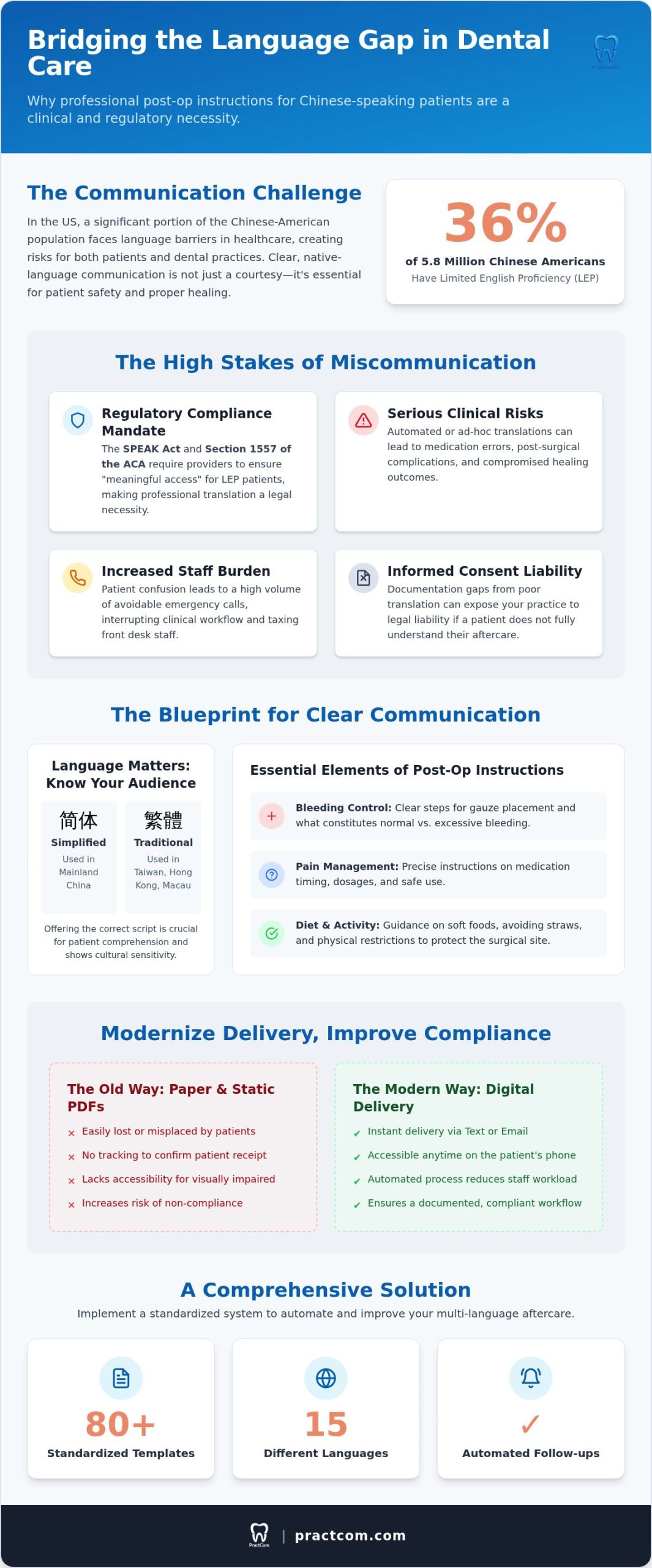
Did you know that as of 2026, nearly 36% of the 5.8 million Chinese Americans in the United States are classified as having limited English proficiency? This means that providing professional dental post-op instructions in Chinese isn’t just a courtesy; it’s a critical requirement for regulatory compliance under the SPEAK Act and Section 1557 of the Affordable Care Act. Relying on free, automated translation tools often creates dangerous clinical misunderstandings that lead to avoidable emergency calls and compromised healing outcomes.
You likely recognize the administrative strain caused by patient confusion and the constant cycle of follow-up calls that interrupt your clinical workflow. We’ll show you how to provide accurate, professionally translated aftercare that protects your patients and your practice reputation. This guide explores how to implement a standardized library of templates and digital delivery systems to ensure every patient receives clear, culturally sensitive instructions via text or email the moment they leave the chair. By the end of this article, you’ll have a blueprint for reducing follow-up volume while improving the standard of care for your Mandarin and Cantonese speaking patients.
Key Takeaways
- Learn how to meet 2026 federal language access standards while protecting your practice from informed consent liabilities.
- Identify the critical clinical elements that must be included in dental post-op instructions in Chinese to prevent post-surgical complications.
- Compare digital and physical delivery methods to determine which approach ensures the highest treatment compliance for your specific patient demographics.
- Simplify your administrative workflow by implementing a standardized library of over 80 templates that integrate with your existing communication systems.
- Reduce the burden on your front desk staff by automating patient follow-ups and aftercare delivery in 15 different languages.
The Critical Need for Chinese Dental Post-Op Instructions in Modern Practice
In high-pressure clinical settings, the post-surgical handoff is often the most vulnerable point in the patient journey. Your clinical responsibility continues after the patient leaves the chair, yet your direct oversight vanishes the moment they walk out the door. For the nearly 36% of Chinese Americans with limited English proficiency, a language barrier at this stage isn’t just a hurdle; it’s a clinical risk. Providing dental post-op instructions in Chinese ensures that essential steps for clot stabilization and pain management are understood perfectly. This clarity reduces the volume of unnecessary emergency calls that disrupt your front desk workflow and tax your staff’s time.
The regulatory environment reached a turning point in February 2026 with the signing of the SPEAK Act. This legislation, combined with existing Section 1557 requirements, demands that providers offer “meaningful access” to those with limited English skills. Ad-hoc translation methods or relying on family members to interpret often fail these clinical and legal standards. Such shortcuts leave your practice exposed to documentation gaps and potential liability. Standardizing your documentation isn’t just about safety; it’s about creating a predictable administrative environment where no patient is left to guess about their care.
Bridging the Language Gap in Oral Surgery
Effective care depends on a patient’s level of health literacy, or their ability to process and act on health information. When instructions aren’t in a native language, the risk of medication errors increases significantly. Patients may misunderstand antibiotic dosages or fail to recognize signs of a dry socket. Providing native-language support also offers psychological comfort during a high-stress recovery period. This level of care builds a stronger practice reputation within the Chinese-speaking community, leading to better reviews and higher referral rates without extra marketing spend.
Risk Management and Compliance for LEP Patients
Standardizing your dental post-op instructions in Chinese is a proactive strike against administrative failure. Many offices still use static PDFs, but these are becoming a liability because they lack the tracking and accessibility patients expect in 2026. A digital-first approach allows you to send standardized, professionally translated instructions directly to a patient’s phone. This system ensures your informed consent process flows seamlessly into aftercare, protecting your legal standing while improving healing outcomes across your entire patient base. Moving from manual tasks to a standardized system gives you the confidence that your practice is both compliant and clinically sound.
Key Clinical Elements of Effective Chinese Aftercare Documentation
Effective clinical communication requires more than just a literal translation of your office forms. To ensure patient safety, dental post-op instructions in Chinese must bridge the gap between complex dental terminology and actionable health steps. For instance, explaining “hemostasis” or “alveolar osteitis” requires simplified language that a layperson can follow while under the stress of post-surgical recovery. Integrating visual aids alongside the text provides a dual layer of communication that significantly improves compliance, as universal diagrams reinforce the translated instructions for gauze placement or ice application.
Precision in these documents prevents the “lost in translation” errors that lead to emergency weekend calls. When you provide clear guidance on bleeding control, pain management, and dietary restrictions, you’re not just offering a service; you’re protecting the clinical outcome of your work. You can explore how to standardize your clinical aftercare to ensure every patient receives the same high level of instruction regardless of their primary language.
Simplified vs. Traditional Chinese: Knowing Your Patient Base
One common pitfall in practice management is failing to distinguish between Simplified and Traditional Chinese. Patients from Mainland China typically use Simplified characters, while those from Taiwan, Hong Kong, or Macau utilize Traditional script. Offering the incorrect version can create a subtle barrier to understanding and may feel less personalized. Professional libraries like PractCom eliminate this guesswork by providing both variations, ensuring maximum accessibility for your specific demographic without requiring your staff to have linguistic expertise.
Procedural Specifics in Translation
Each procedure carries unique risks that must be addressed with linguistic accuracy. For post-extraction care, instructions must explicitly detail the “no spitting, no straws” rule to prevent dry socket, using terms that resonate with cultural dietary habits. Implant aftercare requires precise language regarding site protection and specific hygiene protocols to ensure long-term osseointegration. Finally, medication schedules must be unmistakable. Differentiating between “as needed” analgesics and “complete the course” antibiotics is vital for preventing post-operative infections and managing patient expectations during the first 48 hours of healing.
Digital Delivery vs. Paper: Optimizing Communication for Chinese-Speaking Patients
Providing high-quality dental post-op instructions in Chinese is only half the battle; the other half is ensuring the patient can actually access them when the anesthesia wears off. Physical handouts are notoriously unreliable in a clinical setting. Patients are often groggy, anxious, or overwhelmed, leading them to leave paper instructions in the car or lose them altogether. This creates a dangerous information gap that often results in panicked after-hours calls to your office. Digital delivery via SMS or email solves this by placing the information directly into a device the patient already uses and trusts.
Digital systems also allow you to reinforce the long-term value of the procedure. By including smile design visualizations that show the before and after cosmetic changes, you remind the patient why following the recovery protocol is essential. This visual proof of the final result motivates them to protect their investment, leading to higher compliance and better clinical outcomes. Moving from paper to a digital-first strategy isn’t just a technical upgrade; it’s a stabilizing force for your practice’s administrative workflow.
The Power of SMS Aftercare
Text messaging is the most effective way to reach your Chinese-speaking patient base, especially older demographics who may not interact with complex email portals regularly. SMS provides instant accessibility, ensuring the instructions are always in the patient’s pocket. From a practice management perspective, digital delivery allows you to track receipt status. You’ll know exactly when a patient opened their instructions, providing a clear audit trail that physical paper simply cannot offer. This reduces the “I forgot” barrier and creates a more accountable recovery process.
Automated Follow-Ups: The Second Line of Defense
Your communication shouldn’t end when the patient leaves the office. Automated follow-ups at the 24 and 48-hour marks act as a critical safety net for your most vulnerable patients. These messages reduce patient anxiety by checking in on their progress and asking targeted questions, such as whether their swelling is decreasing. If a patient reports an issue through these automated prompts, your team can intervene early. This allows you to escalate concerns before they become emergency appointments, keeping your daily schedule predictable and your patients safe.
Best Practices for Implementing Multi-Language Patient Communication
Transitioning from reactive translations to a proactive communication system requires a structured implementation plan. Your first step is to audit your patient demographics to identify the specific linguistic needs of your community. If your practice serves a growing number of Mandarin or Cantonese speakers, having a reliable source for dental post-op instructions in Chinese becomes an operational necessity. Once you’ve identified these needs, you should select a standardized library of over 80 templates. This prevents your clinical team from wasting time on manual note-taking or searching for outdated physical files.
Staff training is the next pillar of a successful rollout. Your chairside assistants must be proficient in digital delivery workflows to ensure that sending instructions is a “one-click” task rather than an administrative burden. Finally, you must integrate these instructions with your digital informed consent forms. This creates a cohesive legal and clinical record for every patient, protecting your reputation while ensuring patient safety remains the top priority.
Standardizing the Clinical Workflow
A standardized workflow eliminates the variability that often leads to human error in a busy practice. By creating a “one-click” system, you ensure that every patient receives the same high-quality information regardless of which assistant is in the operatory. You can leverage automated dental post-op instructions to maintain consistency across your entire office. This level of oversight removes the operational resistance that often prevents staff from following multi-language protocols during a high-volume day.
Measuring the ROI of Better Communication
Investing in a systematic approach to dental post-op instructions in Chinese yields measurable business results that go beyond simple compliance. You’ll likely see a sharp reduction in post-operative phone traffic, as patients have clear, translated answers available on their devices. Professional documentation also improves case acceptance; patients feel more secure and valued when they see a professional, organized system in their native language. You can use practice performance dashboards to monitor patient engagement and track receipt status, giving you the data needed to refine your communication strategy.
If you’re ready to protect your practice and improve patient compliance with a standardized system, you can get started with our multi-language library today.
PractCom: Your Comprehensive Solution for Multi-Language Post-Treatment Care
PractCom serves as the stabilizing force your practice needs to manage the complexities of modern patient communication. While many tools offer simple translation, our platform provides a professional library of over 80 templates in 15 different languages. This includes high-precision dental post-op instructions in Chinese, ensuring your clinical requirements are understood by every patient you treat. We’ve designed this system to bridge the gap between your existing Practice Management Software (PMS) and the patient, filling the communication void that often leads to administrative friction and clinical errors.
Efficiency in a high-pressure environment requires more than just aftercare instructions; it requires a standardized system for legal protection. PractCom integrates digital signatures for informed consent forms, creating a secure and traceable audit trail from the initial consultation to the final follow-up. This level of standardization is why DSOs and multi-location practices prefer our system. It ensures that every clinic in your network maintains the same high standard of documentation and regulatory compliance, regardless of the individual staff members on duty.
Beyond Translation: A Complete Communication Suite
Our platform functions as a comprehensive ecosystem designed to reduce operational resistance. Beyond providing dental post-op instructions in Chinese, PractCom offers robust referral management and dedicated patient portals to ensure seamless care transitions. We understand that some patients still value the physical touchpoint of a tangible document, so we’ve included professional printing capabilities for all translated materials. This flexibility allows you to meet the patient where they are, whether they prefer a digital text or a printed handout. You can start a free trial today to experience how our Chinese library can transform your post-surgical workflow.
Why PractCom is the Stable Choice for 2026
PractCom isn’t just a software service; it’s a tool built by dental professionals who understand the daily stresses of the operatory. We serve as a guardian of your practice’s reputation by providing continuous updates to our clinical and regulatory templates. This ensures your office remains compliant with the latest 2026 standards, such as the SPEAK Act and Section 1557 requirements. Our problem-solver persona anticipates administrative failures before they happen, giving you the psychological security to focus on clinical excellence. Visit the PractCom comparison page to see how our specialized communication platform provides the technical precision your practice deserves.
Securing Your Practice’s Clinical Future
Standardizing your aftercare protocol is no longer an optional upgrade; it’s a fundamental requirement for clinical safety and regulatory compliance in 2026. By moving away from manual, ad-hoc translations and adopting a digital-first strategy, you eliminate the administrative friction that leads to patient confusion and staff burnout. Providing professionally translated dental post-op instructions in Chinese ensures your Mandarin and Cantonese speaking patients receive the technical precision they need for a successful recovery. This proactive approach protects your practice’s legal standing while significantly reducing the volume of avoidable emergency calls.
PractCom offers a specialized ecosystem designed by dental professionals who understand your daily operational stresses. With a library of over 80 templates supporting 15 languages, we act as a guardian of your reputation and a stabilizing force for your clinical workflow. It’s time to replace operational resistance with the confidence of a standardized communication system. Start your free trial of PractCom’s multi-language library today and experience the psychological security of a truly organized practice. Your patients deserve the clarity, and your team deserves the efficiency.
Frequently Asked Questions
Why shouldn’t I use Google Translate for dental post-op instructions?
Free automated tools often fail to capture the technical precision required for clinical safety. These systems can produce literal translations that lose the original medical intent, leading to dangerous misunderstandings regarding medication dosages or surgical site care. Using a professional library for dental post-op instructions in Chinese ensures that your office remains compliant with 2026 federal standards while protecting your patients from avoidable post-surgical complications caused by linguistic errors.
Do I need to provide both Simplified and Traditional Chinese instructions?
Providing both scripts is a best practice for maximizing accessibility across your entire patient base. Simplified Chinese is the standard for patients from Mainland China, while Traditional Chinese is utilized by those from Taiwan, Hong Kong, and Macau. By offering both versions, you remove a subtle but significant barrier to care. This demonstrates a high level of professional empathy and ensures that your technical instructions are readable for every demographic you serve.
How do digital post-op instructions improve patient compliance?
Digital delivery places critical information directly into a device the patient already uses and trusts. Unlike physical paper, which is often lost or forgotten during a high-stress recovery, digital instructions stay in the patient’s pocket for instant reference. This accessibility reduces the “I forgot” barrier and allows for the integration of visual aids. When patients have clear, native-language guidance on their phones, they’re more likely to follow recovery protocols accurately, leading to better clinical outcomes.
Is it HIPAA compliant to text dental instructions to patients?
Texting clinical instructions is compliant when handled through a secure, encrypted communication platform designed for healthcare. You must ensure your system tracks delivery and maintains a clear audit trail for your practice records. PractCom functions as a guardian of your legal standing by providing a secure environment for sending dental post-op instructions in Chinese. This systematic approach ensures that you meet modern documentation standards while respecting patient privacy and federal communication regulations.
Can PractCom integrate with my existing Practice Management Software?
PractCom is designed as a specialized communication and documentation suite that bridges the gap between your PMS and the patient. While it isn’t a full Practice Management Software itself, it acts as a stabilizing force that enhances your current clinical workflow. The platform allows your team to send standardized instructions and digital consent forms with minimal administrative friction, ensuring that your documentation remains organized and professional across all of your office locations.
What procedures are covered in the PractCom Chinese instruction library?
Our comprehensive library features over 80 templates that cover a wide range of clinical scenarios. This includes detailed aftercare for routine extractions, dental implants, root canals, and cosmetic smile designs. Each template is professionally translated into 15 languages, including Mandarin and Cantonese. This variety ensures that your chairside assistants can provide high-quality, procedure-specific information to every patient with just a few clicks, regardless of the complexity of the treatment provided.
How do automated follow-ups help with Chinese-speaking patients?
Automated follow-ups act as a critical second line of defense for patients who may have limited English proficiency. By sending a check-in message at 24 and 48 hours, you can ask targeted questions about pain levels or swelling in the patient’s native language. This allows your clinical team to identify potential issues early and intervene before they escalate into emergency appointments. It’s a proactive strike against patient anxiety that improves the standard of care for your entire community.
What is the best way to handle dental referrals for non-English speakers?
The most effective way to manage referrals is through a standardized system that carries the patient’s language preferences through the entire care journey. Using a digital referral management system ensures that the specialist receives accurate clinical data while the patient receives clear instructions in their native language. This creates a seamless transition of care that builds trust and reduces the likelihood of the patient failing to follow through with the necessary specialist appointments.

Article by
Cary Ganz DDS
Dr. Cary H. Ganz is a dentist, prosthodontist, entrepreneur, lecturer, and author with more than 50 years of experience in clinical dentistry and dental technology. Throughout his career, he has combined hands-on patient care with a deep understanding of how technology can improve dental practice operations, communication, documentation, and patient outcomes.
In addition to his clinical background, Dr. Ganz has held significant leadership roles in the dental technology industry, including Past Owner and Vice President of Clinical Affairs at DEXIS Digital Radiography and Past Vice President of Clinical Affairs at Denticon Practice Management Software. His business experience includes product development, clinical strategy, dental software innovation, practice management solutions, and educating dental professionals on the effective use of technology in modern dentistry.
Today, Dr. Ganz continues to focus on creating practical technology solutions for dental practices, including PractCom, a comprehensive dental practice communication platform designed to improve patient communication, documentation, compliance support, referrals, and overall practice efficiency. His work reflects a career-long commitment to helping dentists deliver better care while making their practices more organized, efficient, and protected.
No responses yet