
It is 2:00 AM on a Tuesday, and your emergency line is ringing because a post-op patient misunderstood their recovery instructions. For many practitioners, this isn’t just a hypothetical scenario; it’s a recurring operational stress that highlights the hidden risks in a modern practice. You likely agree that providing high-quality care is difficult when language barriers create gaps in understanding and increase the chance of malpractice due to poor informed consent. Effectively communicating with multilingual dental patients is no longer a niche skill but a clinical necessity for protecting your reputation and your sanity.
This 2026 clinical excellence guide promises to show you how to eliminate these barriers and improve clinical outcomes using standardized, automated communication protocols. You’ll learn how to move away from the inefficiency of manual translation and toward a systematic approach that ensures every patient receives clear, accurate information in their preferred language. We will examine how to streamline your workflows, secure legally sound documentation, and leverage digital tools to provide a professional experience that bridges the gap between complex procedures and patient understanding.
Key Takeaways
- Identify how Limited English Proficiency (LEP) correlates with higher post-operative complications and explore the regulatory risks of insufficient documentation.
- Uncover the psychological reasons why verbal translation fails in high-stress clinical environments, leading to a significant “Information Retention Gap” for patients.
- Master a standardized protocol for communicating with multilingual dental patients that replaces unreliable ad-hoc methods with professional, multi-channel digital systems.
- Compare the clinical accuracy and cost-benefit of automated communication platforms against human interpreters and non-compliant tools like Google Translate.
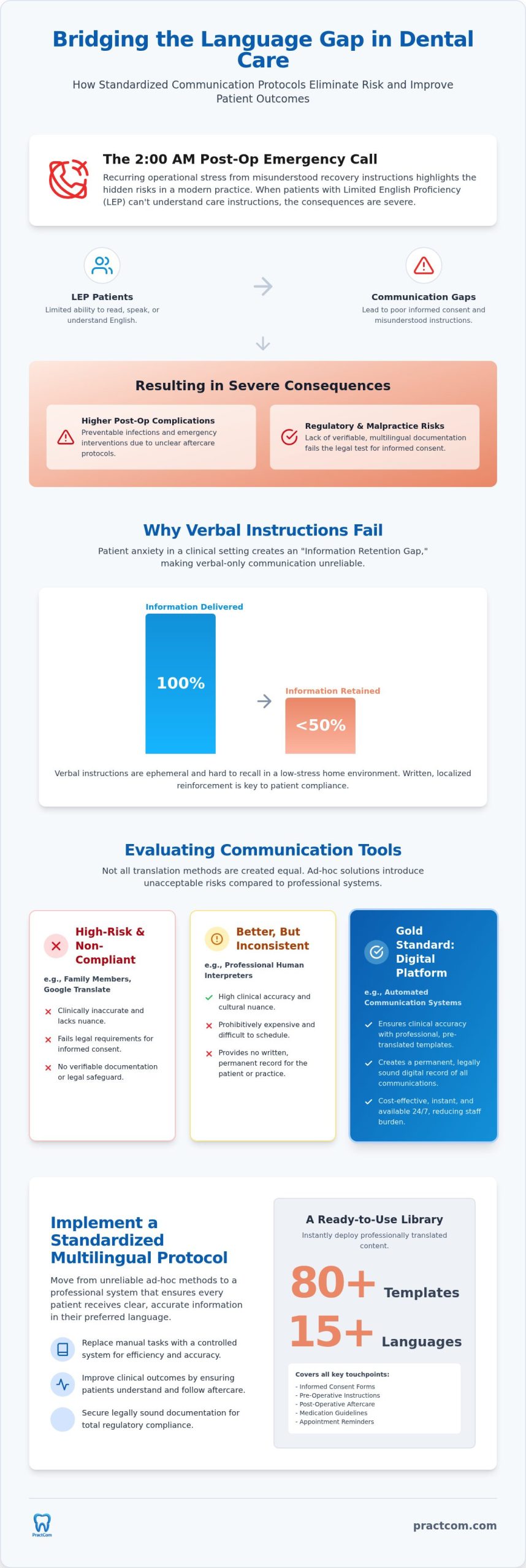
- Learn how to implement a library of 80+ professional templates in 15 languages to ensure informed consent while reducing the burden on your clinical staff.
The Impact of Language Barriers on Clinical Outcomes and Liability
Limited English Proficiency (LEP) describes patients who don’t speak English as their primary language and have a limited ability to read, speak, or understand the language effectively. In your practice, this translates to a significant clinical risk. When you are communicating with multilingual dental patients, the nuance of a complex procedure can easily be lost in translation. This isn’t just a matter of hospitality; it’s a matter of patient safety. Research indicates that language barriers correlate directly with higher post-operative complication rates because patients often struggle to follow specific aftercare protocols without clear guidance.
Effective care relies on sound health communication principles to ensure every instruction is absorbed. Without a standardized system, your clinical outcomes are left to chance. Misunderstandings regarding medication dosages or activity restrictions after oral surgery can lead to preventable infections and emergency interventions. These incidents don’t just hurt the patient; they create administrative chaos and strain your team’s resources.
Informed Consent and Regulatory Compliance
Relying on verbal summaries or ad-hoc translation from a patient’s family member is a major liability. It often fails the legal test for informed consent because you cannot verify the accuracy of the information relayed. In a high-pressure clinical environment, human memory is fallible. Standardized documentation protects your practice by ensuring that every risk, benefit, and alternative was presented clearly. Multilingual documentation serves as a legal safeguard in 2026 by providing a verifiable, permanent record of the clinical information provided in the patient’s native tongue. Integrating a professional suite like PractCom allows you to move from the anxiety of “did they understand?” to the confidence of total regulatory compliance.
The Hidden Cost of Miscommunication
Miscommunication has a direct impact on your bottom line. You’ve likely experienced the “silent patient” phenomenon, where a patient nods along but leaves the chair without a true grasp of their responsibilities. This lack of questions rarely signals understanding. Instead, it often leads to operational friction points that drain your profit margins:
- Increased chair time: Repetitive, circular explanations eat into your production schedule and frustrate your staff.
- Unbillable follow-ups: Poor aftercare compliance results in emergency calls and “look-see” visits that you cannot charge for.
- Missed appointments: Confusion over scheduling or pre-operative requirements leads to expensive gaps in your calendar.
By standardizing your communication, you eliminate these administrative failures. Moving away from disorganized, manual tasks toward a controlled system ensures your practice remains efficient. You gain the ability to provide a protective, forward-thinking environment that values both time and accuracy.
The Psychology of Comprehension: Why Verbal Translation Often Fails
Patients in a dental chair often experience heightened anxiety. This stress triggers a physiological response that significantly impairs the brain’s ability to process and retain new information. This phenomenon is known as the ‘Information Retention Gap.’ When you are communicating with multilingual dental patients, this gap widens further. Even if a patient seems to understand your verbal explanation, the nuances of clinical aftercare often vanish the moment they leave your office. Verbal instructions are ephemeral, but your liability is permanent.
Literal translation is rarely enough for clinical success. Clinical localization involves adapting medical concepts into culturally relevant terms that drive specific actions. For example, a direct translation of “localized swelling” might not convey the urgency of a potential infection in every dialect. You need more than just words; you need a system that reinforces verbal communication with written, localized documentation. Providing written reinforcement allows patients to review instructions in a low-stress environment at home, which is the key to long-term compliance.
The Pitfalls of ‘Ad-Hoc’ Interpreters
Using a bilingual staff member or a family member as a translator is a common but risky practice. It creates a ‘broken telephone’ effect where clinical accuracy is sacrificed for speed or comfort. Family members often feel immense psychological pressure to filter sensitive health data. This can lead to the patient withholding critical history or symptoms to avoid worrying their relatives. You can’t guarantee that a relative is explaining the risks of a procedure with the same precision as a professional template. Standardizing your message ensures that every patient receives the same high-quality clinical instruction regardless of their native tongue.
Visual Learning and the Smile Design Tool
Visual aids serve as a universal language that bypasses cognitive barriers. In cosmetic dentistry, explaining complex aesthetic changes through an interpreter is notoriously difficult and prone to error. This is where the smile design tool becomes essential to your workflow. By showing ‘before and after’ representations, you remove the guesswork from the consultation. These visual representations decrease patient anxiety by providing a tangible outcome they can see and approve.
Integrating these visuals into your consultation workflow increases case acceptance and builds trust. It moves the conversation from abstract linguistic concepts to concrete clinical realities. If you’re ready to see how standardized visuals can transform your practice, you can explore our clinical communication suite to bridge the gap today. Combining visual clarity with written reinforcement ensures your instructions live on long after the appointment ends.
Evaluating Communication Tools: Interpreters vs. Automated Systems
Selecting the right method for communicating with multilingual dental patients is a choice between manual effort and systematic efficiency. On-call human interpreters offer high accuracy but come with a prohibitive price tag and scheduling delays that disrupt clinical workflows. Conversely, free tools like Google Translate are enticing but represent a significant risk to your reputation. They are not HIPAA-compliant, and their algorithmic translations often fail to capture specific dental terminology, leading to dangerous clinical errors that compromise patient safety.
The rise of digital instruction libraries in 15+ languages offers a professional middle ground that prioritizes both precision and profitability. By using pre-translated, professionally vetted clinical templates, you ensure that the technical nuances of a procedure are preserved without the hourly expense of a live linguist. This approach allows your practice to scale rapidly. You can serve diverse demographics with the same level of care provided to English speakers, turning a potential liability into a competitive advantage for your business.
Digital Templates vs. Manual Translation
Manual translation is a major operational bottleneck. When a patient needs immediate post-operative guidance, waiting for a staff member to draft a custom message is inefficient and prone to errors. Digital templates allow you to send SMS or email instructions in seconds, ensuring the patient has the information before they even leave the parking lot. This consistency removes human error from the aftercare process, as every patient receives the exact same vetted protocol. Maintaining this level of documentation is just as critical as Mastering Dental Referral Management Software in 2026 to keep your practice running smoothly.
The ROI of Communication Automation
Automating your multilingual outreach yields a high return on investment by protecting your most valuable resource: your team. Repetitive explanations in multiple languages contribute to staff burnout and administrative fatigue. When you automate these touchpoints, your staff can focus on high-value clinical tasks instead of translating the same aftercare steps ten times a day. It’s a proactive strike against the disorganization that often plagues high-volume clinics.
This systematic control also improves your public reputation. Patients who receive clear, professional instructions in their native tongue are more likely to leave positive Google reviews, citing your practice’s accessibility and care. You can monitor these improvements and track patient engagement through a performance dashboard. This data-driven approach transforms communication from a vague administrative burden into a measurable driver of practice growth and psychological security for your patients.
Implementing a Standardized Multilingual Protocol in Your Practice
Transitioning from ad-hoc translation to a systematic protocol requires a structured approach. You can’t rely on the linguistic skills of whoever happens to be on shift that day. Communicating with multilingual dental patients effectively depends on having a pre-set framework that removes the guesswork from every interaction. This five-step implementation plan moves your practice from operational disorganization to systematic control.
- Step 1: Audit your local demographics. Review your patient records or local census data to identify the primary language needs in your area. This ensures you prioritize the right resources from the start.
- Step 2: Select a centralized library. Deploy a comprehensive library of post-treatment instructions. Having these ready in 15 languages eliminates the need for manual drafting.
- Step 3: Train your team. Move your staff toward a ‘Digital-First’ workflow. Focus on how to access and send documents rather than how to translate them.
- Step 4: Automate your follow-ups. Set up automated triggers to send comprehension checks post-appointment. This confirms the patient is recovering safely without requiring additional staff time.
- Step 5: Document every touchpoint. Ensure your system automatically logs when and in which language a document was sent. This creates a bulletproof audit trail for regulatory compliance.
Creating the ‘Frictionless’ Multilingual Journey
A language-agnostic patient path starts the moment a patient schedules their first visit. By using digital intake and Digital Dental Informed Consent Forms: The 2026 Guide to Clinical Compliance, you establish a professional standard before they even reach the chair. This continuity is especially vital during referrals. When sending a patient to a specialist, providing their clinical history and instructions in their native language ensures the transition is seamless and the care plan remains intact. It protects the patient’s psychological security and your professional reputation.
Staff Training and Buy-In
Resistance often stems from the “we’ve always done it this way” mentality. To overcome this, show your team how automation reduces their administrative load. Give them simple scripts like: “I’m sending your recovery guide to your phone in your preferred language right now so you have it for reference.” The one-click multilingual delivery method allows clinical staff to provide complex instructions in seconds without leaving the operatory or interrupting their workflow. If you want to see this efficiency in action, you can schedule a demo of the PractCom platform to see how it fits your specific practice needs.
Leveraging PractCom to Bridge the Language Gap with 15+ Dialects
PractCom functions as a professional ally that transforms the complex task of communicating with multilingual dental patients into a standardized, low-resistance workflow. It isn’t a full Practice Management Software (PMS), which means it integrates seamlessly into your existing setup without the friction of a total system overhaul. By focusing specifically on clinical documentation and referral management, it acts as a stabilizing force in high-pressure environments. You gain access to over 80 clinical templates that cover the full spectrum of dental procedures, ensuring that no patient is left behind due to a language barrier.
These templates are translated by dental professionals, not generic AI algorithms. This distinction is critical for clinical accuracy. AI often misses the specific technical nuances required for digital informed consent forms, potentially exposing your practice to regulatory risks. PractCom removes this anxiety by providing vetted materials that you can deliver via SMS, email, or physical print in seconds. It allows you to maintain technical precision while offering administrative warmth to every patient who walks through your door.
Comprehensive Language Support
The platform provides support for 15 languages, allowing you to reach your entire community without the overhead of hiring additional bilingual staff. This professional translation ensures that technical instructions, such as dry socket prevention or implant care, are culturally localized and clinically precise. When patients receive high-quality materials in their native tongue, it builds an immediate bond of trust. It signals that your practice values their safety and psychological security, which is a powerful driver for long-term patient loyalty and positive reviews.
Getting Started with Multilingual Automation
Transitioning from a disorganized, paper-based system to a modern digital workflow doesn’t have to be a multi-week project. Most practices can implement the PractCom protocol in a single day, moving quickly from operational resistance to systematic control. While the focus is on digital delivery, the platform remains grounded in the logistical realities of the profession. This includes the ability to print physical documents for elderly multilingual patients who may prefer paper over digital notifications, ensuring no demographic is excluded from high-quality care.
You can eliminate administrative failures and secure your practice’s legal standing by standardizing your communication today. Providing clear, professional documentation is an ethical necessity that protects both the patient and your reputation. To see how these tools can fit into your daily routine, you can Start your free trial and see the 15-language library in action. Moving to a standardized system is the most effective way to ensure clinical excellence for every patient you serve in 2026.
Securing Your Clinical Legacy in 2026
The clinical landscape of 2026 demands more than just technical skill; it requires a protective framework that eliminates operational friction. You’ve seen how relying on ad-hoc translation or family members creates an “Information Retention Gap” that puts your patients and your reputation at risk. Standardizing your approach ensures that every patient, regardless of their native tongue, receives the technical precision and care they deserve. By moving from manual tasks to a controlled digital system, you bridge the language gap and secure your practice against avoidable complications.
Effectively communicating with multilingual dental patients is a professional necessity that shouldn’t drain your staff’s energy. PractCom offers a library of 80+ post-op templates and informed consent forms in 15 languages, all designed by dental professionals to ensure clinical accuracy. It is time to replace the anxiety of misunderstood instructions with the confidence of a standardized protocol. You can protect your practice and improve patient outcomes with a single click. Streamline your multilingual communication and start your PractCom free trial today to lead your community with clinical excellence.
Frequently Asked Questions
Is it legal to use Google Translate for dental informed consent?
Using Google Translate for dental informed consent is a high-risk practice that rarely meets legal or clinical standards. These tools often fail to capture complex dental terminology and are not HIPAA-compliant, which exposes your practice to significant liability. For a valid consent process, you need professionally translated documents that ensure the patient fully understands the risks and benefits. Relying on an algorithm can lead to misunderstandings that invalidate the consent entirely.
What are the most common languages needed in US dental practices in 2026?
In 2026, the most common languages needed in US practices include Spanish, Mandarin, Vietnamese, Arabic, and Tagalog. These reflect the shifting demographics across the country. Effectively communicating with multilingual dental patients requires a system that supports these dialects as a standard part of the workflow. PractCom addresses this by providing a library of clinical materials in 15 languages, ensuring you can serve the vast majority of your local community without hiring specialized staff.
How do I handle a patient who speaks a language not covered by my software?
If a patient speaks a language not currently supported by your communication suite, you should engage a certified medical interpreter. It’s critical to avoid using the patient’s family members as translators, as this creates a clinical risk and a privacy liability. Always document the name of the interpreter and the method used in the patient’s chart. This ensures you maintain a high standard of care and fulfill your regulatory obligations even in rare linguistic scenarios.
Does HIPAA require me to provide a professional interpreter?
HIPAA primarily focuses on the privacy and security of health information, but other federal regulations like Section 1557 of the Affordable Care Act require “meaningful access” for patients with Limited English Proficiency. This often necessitates the use of qualified interpreters or professionally translated materials to ensure equal care. While you don’t always need a live person on-site, you must provide a reliable way for the patient to understand their treatment plan and give informed consent safely.
How can I improve compliance for post-extraction instructions with non-English speakers?
Improving post-extraction compliance starts with providing written, professionally translated instructions that the patient can reference at home. Verbal instructions are easily forgotten, especially in high-stress clinical settings. By delivering these protocols via SMS or email in the patient’s native tongue, you provide a clear roadmap for recovery. This systematic approach reduces the risk of dry sockets and infections while also decreasing the volume of emergency follow-up calls to your office.
Can I print multilingual instructions for patients who aren’t tech-savvy?
Yes, providing physical printouts is an essential part of a comprehensive communication strategy. Many elderly or non-tech-savvy patients prefer a hard copy of their post-treatment instructions to keep on their refrigerator or nightstand. PractCom allows you to print any of the 80 plus clinical templates in all 15 supported languages with a single click. This flexibility ensures that every patient receives the same high-quality information, regardless of their comfort level with digital devices.
What is the difference between a PMS and a communication platform like PractCom?
A Practice Management Software (PMS) focuses on administrative tasks like billing, scheduling, and insurance processing. PractCom is a specialized communication suite that bridges the gap between your clinical procedures and patient understanding. It handles the specific task of communicating with multilingual dental patients through automated follow-ups, digital consent, and a library of localized instructions. It works alongside your PMS to enhance clinical documentation without replacing the core administrative functions of your practice.
How does automated follow-up help with multilingual patient retention?
Automated follow-ups improve retention by demonstrating a higher level of care and personalized attention. When a patient receives a message in their primary language asking about their recovery, it builds trust and reduces post-operative anxiety. This proactive approach identifies potential issues before they become emergencies, which keeps patients satisfied and loyal to your practice. It transforms a routine procedure into a supportive experience that encourages patients to return for future care and recommend your services.

Article by
Cary Ganz DDS
Dr. Cary H. Ganz is a dentist, prosthodontist, entrepreneur, lecturer, and author with more than 50 years of experience in clinical dentistry and dental technology. Throughout his career, he has combined hands-on patient care with a deep understanding of how technology can improve dental practice operations, communication, documentation, and patient outcomes.
In addition to his clinical background, Dr. Ganz has held significant leadership roles in the dental technology industry, including Past Owner and Vice President of Clinical Affairs at DEXIS Digital Radiography and Past Vice President of Clinical Affairs at Denticon Practice Management Software. His business experience includes product development, clinical strategy, dental software innovation, practice management solutions, and educating dental professionals on the effective use of technology in modern dentistry.
Today, Dr. Ganz continues to focus on creating practical technology solutions for dental practices, including PractCom, a comprehensive dental practice communication platform designed to improve patient communication, documentation, compliance support, referrals, and overall practice efficiency. His work reflects a career-long commitment to helping dentists deliver better care while making their practices more organized, efficient, and protected.
No responses yet