
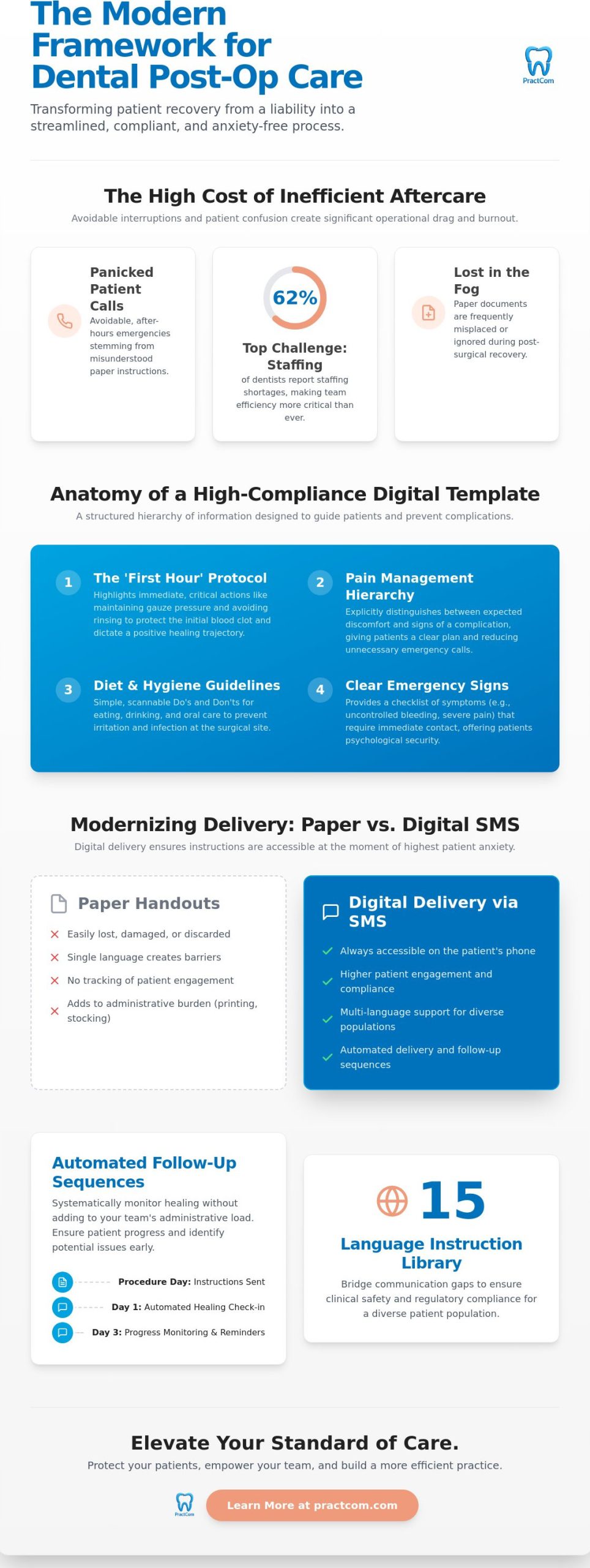
It’s 9:00 PM on a Friday when your phone rings with another “emergency” call from a panicked patient who can’t remember if they should be icing the area or starting their warm rinses. You’ve provided the handouts, but in the fog of post-surgical recovery, paper documents are frequently misplaced or misunderstood. You likely agree that these avoidable interruptions are a major source of burnout for a team already facing the staffing shortages that 62% of dentists report as their top challenge in 2026. Utilizing a standardized dental post operative instructions template is no longer just an administrative task; it’s a professional necessity that protects your reputation and your patient’s health.
This guide will show you how to implement a digital, multi-language framework that reduces after-hours calls and ensures total clinical compliance. You’ll learn how to align your protocols with 2026 CDT updates while providing patients with the psychological security they need during recovery. We will preview the essential elements of a high-utility template and demonstrate how automated, 15-language delivery can bridge communication gaps, reduce liability, and create a more predictable recovery process for every patient in your chair.
Key Takeaways
- Learn how a standardized dental post operative instructions template acts as a clinical safety net, reducing staff repetition and minimizing operational resistance.
- Identify the critical components of high-compliance templates, including immediate “First Hour” protocols and clear pain management hierarchies to prevent emergency calls.
- Discover why digital delivery via SMS leads to higher patient engagement than paper, ensuring recovery protocols are accessible at the moment of highest anxiety.
- Implement automated follow-up sequences for day one and day three to monitor healing progress systematically without adding to your team’s administrative burden.
- Explore the benefits of a 15-language instruction library to ensure clinical safety and regulatory compliance for a diverse patient population.
The Strategic Importance of Standardized Dental Post-Operative Instructions
A dental post operative instructions template is much more than a simple handout; it’s a standardized clinical protocol that bridges the critical gap between the surgical chair and the patient’s home environment. During the postoperative period, patients often feel overwhelmed by the technical complexities of their recovery. By implementing a consistent system, you transform aftercare from a variable administrative burden into a predictable clinical safeguard. This standardization effectively reduces “Operational Resistance” within your practice. When every staff member follows the same pre-vetted script, you eliminate the need for clinical assistants to repeatedly explain basic care steps. This preserves their energy for high-value patient interactions and reduces the cognitive load on your team.
Clear instructions also serve as a vital extension of your digital dental informed consent forms. Documentation that proves a patient received and understood their recovery protocols provides a powerful layer of legal protection. It ensures your practice remains compliant while significantly reducing the volume of uncompensated, after-hours emergency calls that often stem from simple misunderstandings. Efficiency builds trust. By providing a clear roadmap, you ensure that the standard of care doesn’t drop the moment the patient walks out your door.
Reducing Patient Anxiety and Improving Outcomes
Patients frequently enter a “Post-Treatment Panic” window as the local anesthesia wears off and the physical reality of their recovery begins. This is the specific timeframe where they are most likely to misinterpret normal postoperative swelling or minor oozing as a sign of surgical failure. Providing clear, written documentation offers essential psychological security during the first 24 hours. It grounds the patient in clinical facts rather than emotional fear. A standardized dental post operative instructions template serves as a silent guardian of your practice’s reputation by ensuring your standard of care remains high even when you aren’t physically present.
The Financial Impact of Efficient Aftercare
The administrative cost of poorly managed aftercare is often overlooked but substantial. Contrast the labor cost of a 15-minute emergency phone call with the near-zero cost of an automated, digital template delivery. When instructions are clear and accessible, patient compliance increases. This leads to better healing outcomes and fewer revision appointments that eat into your production time. These positive experiences directly translate into higher patient retention and more frequent positive online reviews. Integrating these templates into your broader dental practice workflow creates a comprehensive ecosystem of efficiency that protects your bottom line while elevating your professional standing.
Anatomy of a High-Compliance Dental Post-Op Template
A high-compliance dental post operative instructions template isn’t just a list of “don’ts”; it’s a structured hierarchy of information designed to protect your patient when they’re most vulnerable. You need to ensure the most critical data is impossible to miss, especially during the first few hours after a procedure. Your template should act as a clinical roadmap that guides the patient from the moment they leave your chair until their follow-up appointment.
The ‘First Hour’ Protocol must be the anchor of any professional template. This section highlights immediate actions such as maintaining firm gauze pressure for 30 minutes and strictly avoiding spitting or rinsing to protect the initial clot. Professional organizations like the AAOMS emphasize these basics in their Wisdom Tooth Extraction Postoperative Instructions, noting that immediate compliance often dictates the entire healing trajectory. Beyond the first hour, your template should establish a clear Pain Management Hierarchy. Patients don’t always know what’s normal, so you must explicitly distinguish between expected post-surgical soreness and “red flag” symptoms like uncontrolled bleeding, high fever, or worsening swelling after the third day.
Dietary and activity restrictions are most effective when presented as clear, bulleted lists. This format reduces cognitive load and makes the information easy to reference at home. Key points to include are:
- No Straws or Smoking: Avoid suction for at least 72 hours to prevent dry socket.
- Soft Food Diet: Stick to lukewarm soups, yogurt, or smoothies; avoid crunchy or spicy foods.
- Restricted Activity: No vigorous exercise for 48 hours to keep blood pressure stable at the surgical site.
Finally, your dental post operative instructions template must define explicit emergency contact triggers. If a patient experiences a symptom at midnight, they shouldn’t have to guess if it’s an emergency. Clearly state when they should call your office versus when they should simply continue their prescribed home care.
Visual Hierarchy and Readability
Patients who’ve undergone sedation or are managing pain have limited cognitive bandwidth. Your template requires bold headers and simplified language to remain effective. While digital delivery is the modern standard, Physical Document Printing remains a necessary backup for those who prefer a tactile reference. You should also use icons or diagrams to illustrate complex tasks, such as the proper use of an irrigation syringe, to ensure the instructions are understood regardless of the patient’s state of mind.
Multi-Language Accessibility in Aftercare
Non-compliance risks skyrocket when patients receive instructions in a language they don’t fully master. Providing templates in 15+ languages isn’t just a courtesy; it’s a form of “Regulatory Reassurance.” It ensures that every demographic in your community receives the same high standard of care and reduces your liability. You can explore our automated multi-language library to see how easily this can be integrated into your existing workflow.
Procedure-Specific Template Requirements: From Extractions to Implants
Generic instructions often fail because they don’t address the specific biological mechanics of different procedures. A high-utility dental post operative instructions template must be granular to be effective. For routine extractions, your primary clinical goal is clot preservation. You must explain that avoiding suction isn’t just a suggestion; it’s the only way to prevent the excruciating pain of a dry socket. In contrast, dental implant instructions shift the focus toward long-term site protection. You aren’t just managing immediate bleeding here; you’re safeguarding the osseointegration process that determines the functional success of the restoration.
Procedures involving the maxillary sinus require even more specialized warnings. Your template must explicitly forbid nose-blowing or sneezing with a closed mouth for several weeks following a sinus lift or bone graft. These sudden pressure changes can displace grafting material and lead to total surgical failure. Similarly, soft tissue biopsies require specific guidance on localized irrigation and managing swelling to ensure the diagnostic site heals without secondary infection. By providing these specific details, you reduce the “Operational Resistance” of patients who might otherwise call your office with basic questions about what’s normal for their specific surgery.
Customizing Templates for Surgical Complexity
Standardization becomes a critical legal shield as surgical complexity increases. A “one-size-fits-all” post-op form fails to protect the practice legally because it lacks the procedure-specific warnings necessary for true informed consent. For larger organizations, achieving “DSO-level” consistency across multiple locations is essential for maintaining a unified standard of care. Integrating these specialized templates into your dental referral management software ensures that when a specialist completes a case, the referring GP and the patient are immediately aligned on the recovery protocol. This systematic approach eliminates the risk of human memory failure in high-pressure clinical settings.
The Role of Smile Design in Aesthetic Aftercare
Aesthetic cases present a unique psychological challenge. You should use Smile Design visualizations to show patients their “final look” before they even leave the chair. This reinforces the value of following every step of the recovery protocol during cosmetic cases. When a patient can see the promised “after” result, they’re more likely to invest the necessary “recovery work” required for complex veneer or full-mouth reconstruction cases. This emotional connection improves patient buy-in for lengthy or uncomfortable healing processes, turning a difficult recovery into a shared journey toward a better smile.
Modernizing Delivery: Moving from Paper to Digital Templates
Relying on a physical handout as your only method of communication is a clinical risk you can’t afford in 2026. While paper still has its place as a backup, the “SMS Advantage” is undeniable. Texting your dental post operative instructions template leads to open rates three times higher than traditional email. This immediate accessibility ensures that your recovery protocols aren’t buried in a spam folder or left behind in the operatory. By meeting patients on their mobile devices, you provide the psychological security of having professional guidance literally in their pocket at the moment of highest anxiety.
Automation transforms your follow-up process from a series of manual chores into a systematic clinical protocol. You can set Automated Patient Follow-ups for “Day 1” and “Day 3” to monitor healing progress without requiring a single minute of manual labor from your team. These proactive touchpoints allow you to identify potential issues before they escalate into after-hours emergencies. If a patient has a question at 2 AM, they can simply log into the Patient Portal. This 24/7 digital hub serves as a reliable reference point, allowing them to re-read their specific instructions whenever they need reassurance. PractCom acts as the communication layer for your practice, integrating with your clinical documentation to ensure no patient is left without a clear roadmap for recovery.
Eliminating Operational Resistance with Automation
Old-school offices often struggle with the “manual repetition” of calling every surgical patient to check on their progress. Moving to a system of systematic control allows your team to focus on in-office production while the software handles the routine check-ins. Digital timestamps on every sent message provide a robust audit trail for clinical compliance. These logs act as a “digital witness,” proving exactly when the patient received and accessed their instructions, which is a powerful defense in any potential liability dispute.
Ensuring HIPAA Compliance in Digital Messaging
Texting is efficient, but it must be secure. You should never send full clinical details in an open SMS; instead, use secure links that lead to a protected environment. Maintaining 10DLC registration is also essential for practice-to-patient texting reliability to ensure your messages aren’t flagged as spam by mobile carriers. Legally, having timestamped documentation of all patient communications is a professional necessity for modern risk management. To see how these automated systems can protect your practice, you can start your 15-day free trial of PractCom.
Implementing a Professional Instruction Library with PractCom
Accessing a pre-vetted library of aftercare protocols is the ultimate pre-emptive strike against administrative chaos. PractCom provides your team with over 80 procedure-specific templates that cover every dental specialty, from routine hygiene to complex oral surgery. This ensures that your dental post operative instructions template is clinically sound, legally robust, and ready for immediate delivery. You don’t have to spend hours drafting documents or worrying about whether a staff member forgot a critical warning; the system provides a stabilized foundation for every recovery scenario.
The power of 15-language support cannot be overstated in a modern clinical environment. With a single click, you can serve every patient in their primary language, removing the communication barriers that frequently lead to non-compliance and emergency complications. This level of technical precision directly elevates the dental patient experience by fostering a deep sense of trust and psychological security. Your next step should be to audit your current aftercare process. Identify the gaps where verbal instructions might be forgotten or where paper handouts are likely to be lost, as these are your primary liability risks.
Why Standardization Wins for DSOs and Private Practices
Clinical consistency is the hallmark of a professional brand. For DSOs, maintaining a unified voice across multiple locations is a significant operational challenge that requires systematic control. Using a centralized dental post operative instructions template ensures that every provider in your organization delivers the same high standard of care. This also slashes the training burden for new staff; they don’t need to learn a new way of explaining aftercare because the platform handles the heavy lifting for them. You can Start a Free Trial today to explore how a standardized library can protect your operations.
Protecting Your Practice Reputation
Most negative online reviews aren’t a reflection of the dentist’s clinical skill; they are a reaction to the confusion and fear a patient feels during a difficult recovery. Professionalized aftercare eliminates this uncertainty gap by providing clear, accessible answers at any hour. By utilizing the Practice Performance Dashboard, you can track patient engagement with your instructions in real time. This data allows you to confirm that your recovery protocols are being accessed and understood, providing an extra layer of regulatory reassurance. Excellent dentistry doesn’t end when the patient leaves the chair; it ends with a successful, complication-free healing process that you have managed with technical precision.
While this guide focuses on dental clinical efficiency, other high-touch service industries use similar logic to manage client expectations; for instance, those in the beauty sector can check out SalonIQ for specialized booking and marketing systems that elevate the brand experience.
Securing Your Practice’s Clinical Future
Moving from manual aftercare explanations to a systematic digital framework is the most effective way to eliminate operational resistance and protect your clinical reputation. You’ve seen how a high-utility dental post operative instructions template acts as a safety net, bridging the gap between the surgical chair and the patient’s home. By automating your follow-up protocols and providing instructions in the patient’s primary language, you ensure that recovery is predictable rather than reactive. This transition doesn’t just reduce after-hours interruptions; it establishes a superior standard of care that patients recognize and value.
Modernizing your workflow ensures that no detail is lost to human memory failure or administrative oversight. With a library of 80+ expert-vetted templates, support for 15+ languages, and a fully automated SMS and email delivery system, you can provide the psychological security your patients need during their most vulnerable hours. Ready to professionalize your aftercare? Get access to 80+ dental post-op templates with PractCom; Start Your Free Trial. It’s time to trade the stress of uncompensated panic calls for the confidence of a standardized, compliant recovery system.
Frequently Asked Questions
What are the most important things to include in a dental post-op template?
Every effective template must prioritize the “First Hour” protocol, which includes critical immediate actions like firm gauze pressure and the avoidance of spitting. You should also include a clear pain management hierarchy that distinguishes between normal soreness and “red flag” symptoms like high fever or uncontrolled bleeding. Bulleted lists for dietary restrictions and activity limits ensure the patient knows exactly how to protect the surgical site during the initial healing phase.
How can I ensure patients actually read the post-operative instructions?
Moving to a digital delivery system is the most effective way to increase engagement and ensure your dental post operative instructions template is actually reviewed. Digital templates sent via SMS have three times higher open rates than email, placing the information directly on the patient’s mobile device. Using simplified language and bold headers also helps patients who may still be experiencing the lingering effects of sedation or local anesthesia.
Is it better to provide paper or digital post-op instructions?
A hybrid approach is often the safest clinical choice, though digital delivery offers superior tracking and accessibility. Digital instructions provide a “witness factor” through timestamped logs that prove the patient received the information, which is vital for legal protection. However, providing a physical printout at the office remains a helpful backup for patients who prefer a tactile reference or those who are less tech-savvy.
How do I handle post-op instructions for patients who don’t speak English?
You should utilize a professional instruction library that supports multi-language delivery to ensure clinical safety for every demographic. Providing a dental post operative instructions template in the patient’s primary language reduces the risk of non-compliance and localized complications. This approach offers regulatory reassurance and proves that your practice is committed to an inclusive and safe standard of care for your entire community.
Should I charge for post-operative follow-up appointments?
Most practices include post-operative check-ups as part of the initial surgical fee to encourage compliance and monitor healing. Charging separately for these visits can create a barrier to care, leading patients to skip appointments and potentially miss early signs of infection. Bundling these follow-ups into the total cost improves patient retention and ensures you maintain clinical oversight until the recovery is complete.
What is the legal importance of documenting that post-op instructions were given?
Documenting the delivery of aftercare protocols is a fundamental component of informed consent and risk management. If a liability dispute arises, having a digital audit trail that proves when and how the instructions were sent provides a robust defense for your practice. This systematic documentation shows that you fulfilled your professional duty to guide the patient through a safe and predictable recovery process.
How often should I update my dental post-operative templates?
You should review and update your templates at least once a year or whenever clinical standards change. For example, the 2026 CDT updates included 31 new codes that may require adjustments to your specific recovery protocols for procedures like implant maintenance or photobiomodulation therapy. Regular audits ensure your instructions remain aligned with the latest evidence-based practices and current regulatory requirements.
Can automated SMS reminders replace the traditional post-op phone call?
Automated reminders are excellent for handling routine “Day 1” and “Day 3” check-ins, which significantly reduces the administrative burden on your team. This systematic control allows your staff to focus on in-office production while the software monitors general healing progress. While automation handles the majority of cases, you should still reserve manual phone calls for high-risk patients or complex multi-site surgeries that require a more personal clinical touch.

Article by
Cary Ganz DDS
Dr. Cary H. Ganz is a dentist, prosthodontist, entrepreneur, lecturer, and author with more than 50 years of experience in clinical dentistry and dental technology. Throughout his career, he has combined hands-on patient care with a deep understanding of how technology can improve dental practice operations, communication, documentation, and patient outcomes.
In addition to his clinical background, Dr. Ganz has held significant leadership roles in the dental technology industry, including Past Owner and Vice President of Clinical Affairs at DEXIS Digital Radiography and Past Vice President of Clinical Affairs at Denticon Practice Management Software. His business experience includes product development, clinical strategy, dental software innovation, practice management solutions, and educating dental professionals on the effective use of technology in modern dentistry.
Today, Dr. Ganz continues to focus on creating practical technology solutions for dental practices, including PractCom, a comprehensive dental practice communication platform designed to improve patient communication, documentation, compliance support, referrals, and overall practice efficiency. His work reflects a career-long commitment to helping dentists deliver better care while making their practices more organized, efficient, and protected.
No responses yet