
Manual patient communication isn’t just an administrative chore; it’s a clinical liability that’s quietly eroding your practice’s efficiency and legal protection. You likely feel the daily pressure of a front desk team buried under repetitive tasks while no-shows cost your practice up to $70,000 in lost revenue annually. By automating dental patient communication, you can eliminate these operational bottlenecks and focus on high-value clinical care. It’s a common struggle to balance immediate patient needs with the heavy burden of manual documentation, but it shouldn’t be the standard for a modern office.
We’ll show you how to move from the resistance of manual tasks to the confidence of a standardized system that improves patient compliance and reduces administrative overhead. This guide outlines a 2026 clinical strategy that covers everything from digital informed consent to automated follow-up workflows, ensuring your clinical documentation is consistent across all providers. You’ll learn how to transform your practice into a streamlined clinical ecosystem that protects your professional reputation and provides the psychological security of a fully compliant, high-utility communication framework.
Key Takeaways
- Identify the structural shift from operational disorganization to a systematic control model that eliminates the front-desk bottleneck.
- Master the strategy for automating dental patient communication through predictive recall and automated clinical follow-up sequences.
- Secure your practice against liability by standardizing the delivery of digital informed consent and post-treatment instruction libraries.
- Improve patient compliance and safety across diverse populations by utilizing multi-channel communication supported in 15 languages.
- Learn to implement a dedicated communication suite that streamlines referral management and performance tracking without disrupting your current PMS.
The Shift from Manual to Automated Dental Communication in 2026
Modern dental practices have moved past simple text reminders. In 2026, automating dental patient communication refers to a comprehensive clinical ecosystem where every touchpoint is intentional, secure, and standardized. Many practitioners view the “front desk bottleneck” as a staffing issue, but it’s actually a failure of the manual infrastructure. When your team spends hours on repetitive post-op calls or manual recall, they’re trapped in a reactive “firefighting” mode. This drains mental energy and leaves little room for the high-value patient interaction that drives practice growth. Transitioning to a proactive guidance model ensures that technology handles the logistical logic while your staff provides the clinical warmth that builds patient trust. You can explore why this systematic shift is essential for modern practice survival.
The High Cost of Administrative Friction
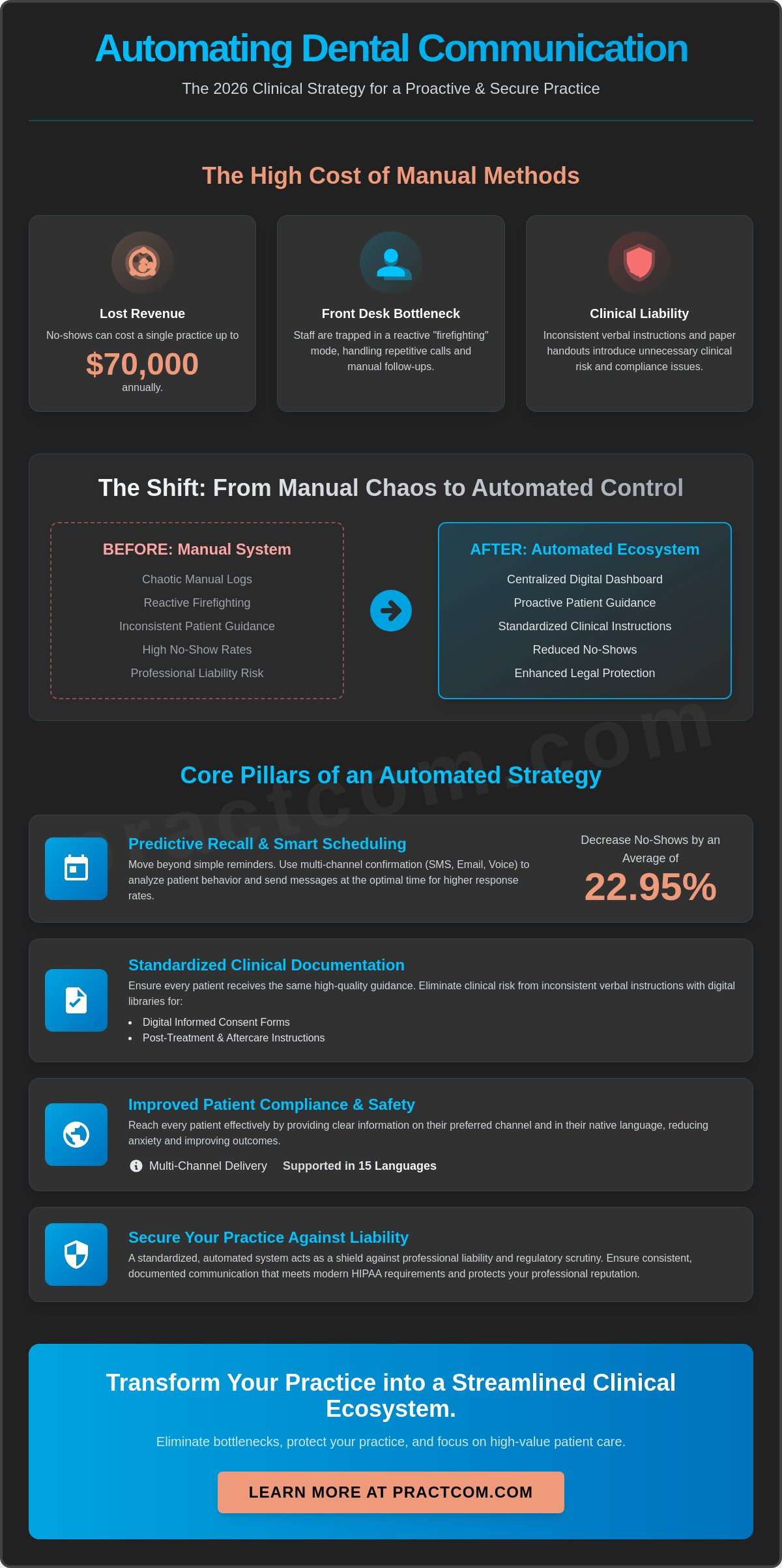
Manual follow-ups and unconfirmed referrals represent a massive leak in your practice’s revenue bucket. Verified data shows that just one no-show per day can cost a practice between $20,000 and $70,000 annually. Beyond the direct financial loss, communication gaps spike patient anxiety and lower treatment acceptance rates because patients feel unsupported once they leave the chair. Effective Health communication strategies bridge this gap by providing clear, timely information that reduces the cognitive load on both the patient and the provider. Communication friction is the primary barrier to practice scaling in 2026 because it forces human talent to perform machine-level repetition.
The Clinical Necessity of Standardization
Relying on verbal instructions or paper handouts leads to inconsistent patient outcomes. If three different assistants explain a post-extraction protocol in three different ways, you’ve introduced unnecessary clinical risk. Automating dental patient communication through a standardized Post-Treatment Instruction Library ensures every patient receives the same high-quality guidance regardless of who is on the schedule. This systematic approach acts as a shield against professional liability and regulatory scrutiny. With HIPAA updates in 2026 requiring stricter documentation and 72-hour breach notifications, using a secure, automated platform is no longer optional; it’s an ethical and professional necessity for protecting your reputation and your patients’ safety.
- Order: Move from chaotic manual logs to a centralized digital dashboard.
- Speed: Deliver critical post-op instructions instantly via the patient’s preferred channel.
- Control: Monitor referral status and follow-up completion in real-time.
Core Pillars of an Automated Patient Communication Strategy
Effective practice management requires more than just filling a calendar. It demands a clinical ecosystem that anticipates patient needs before they become administrative crises. By automating dental patient communication, you bridge the gap between treatment and long-term recovery. This strategy ensures no patient feels abandoned after they leave your chair. It moves your practice from a state of operational disorganization to one of systematic control, where every touchpoint is tracked and every follow-up is guaranteed.
Predictive Recall and Smart Scheduling
Modern systems have evolved beyond basic blast texts. Research on Modern Communication in Dental Care highlights how digital tools and AI are reshaping patient engagement by tailoring interactions to individual needs. Predictive recall analyzes patient behavior to determine the optimal timing for messages, ensuring higher response rates. This isn’t just about sending an SMS. It’s about multi-channel confirmation across email, text, and voice to guarantee visibility. Verified data shows that automated reminders can decrease no-shows by an average of 22.95%. These tools must integrate directly with your dental practice workflow to ensure real-time data synchronization without manual entry.
Referral Tracking and Specialist Coordination
Manual referrals often fall into a “black hole.” Patients frequently fail to schedule with the specialist, and the general practitioner loses visibility on the case. Automation closes this loop by providing real-time tracking of patient progress between offices. Specialists receive digital documentation instantly, and the referring doctor gets notified the moment the consultation occurs. This systematized loop protects your professional reputation and ensures clinical continuity. For a deeper look at these workflows, see our guide on Mastering Dental Referral Management Software.
Automated follow-ups ensure recovery stays on track without your staff spending hours on the phone. If a patient reports unexpected symptoms via an automated post-op survey, your team receives an immediate alert. Practice performance dashboards then aggregate this data to identify communication gaps. They show you exactly where patients are dropping off, allowing you to refine your strategy based on evidence rather than intuition. If you’re ready to see how these systems work in tandem, you can explore our integrated platform features. You’ll move from the resistance of manual logs to the confidence of a standardized, high-utility communication framework.
Beyond Reminders: Automating Clinical Documentation and Aftercare
If you view appointment reminders as the finish line, you’re missing the most critical 80% of the communication puzzle. While reminders protect your schedule, clinical documentation protects your license and your patients’ health. By automating dental patient communication beyond the front desk, you ensure that high-quality care continues long after the patient leaves the operatory. This proactive approach reduces the volume of post-op phone calls and alleviates the burden on your clinical staff. It’s about creating a comprehensive ecosystem where instructions and legal protections are integrated into the patient’s digital journey. When your clinical team isn’t bogged down by repeating the same post-extraction instructions ten times a day, they can focus on the patient currently in the chair.
Standardizing Post-Op Instruction Delivery
Verbal instructions are often forgotten the moment a patient exits the building. Paper handouts are frequently lost in the car or discarded. Utilizing a library with 80+ pre-vetted clinical templates allows your team to deliver precise instructions via text or email instantly. This ensures the patient has a permanent, searchable record of their aftercare, which significantly improves compliance. Some industry professionals report that practices can reduce emergency phone calls by up to 40% simply by providing this level of hyper-clear automated guidance. For detailed strategies on implementation and template best practices, you can explore our guide on Automated Dental Post-Op Instructions.
Digital Informed Consent as a Compliance Tool
Paper-based consent processes are prone to human error, physical clutter, and incomplete data. Transitioning to an automated digital system eliminates these vulnerabilities by ensuring every form is completed and stored correctly before the procedure begins. Modern solutions for Adopting Conversational AI and digital workflows help practices maintain strict regulatory standards without slowing down the clinical day. Specifically, digital dental informed consent forms provide a timestamped audit trail that serves as a robust defense during regulatory audits. This level of systematic control transforms risk management from a manual headache into a background clinical process. It provides the psychological security of knowing your documentation is standardized across every provider in your office.
This shift toward automation provides the administrative warmth that modern patients expect. It signals that your practice is organized, protective, and forward-thinking. By integrating these systems, you’re not just saving time; you’re building a guardian for your practice’s reputation and legal standing. Automating dental patient communication through these clinical tools is no longer a luxury for large DSOs; it’s a fundamental requirement for any practice aiming to scale efficiently in 2026.
Addressing Diversity: Multi-Language and Multi-Channel Delivery
A modern dental practice serves a diverse community, yet many communication systems remain stubbornly monolingual. When you’re automating dental patient communication, you must account for the reality that a “one-size-fits-all” approach creates clinical risks. If a patient doesn’t fully grasp their post-operative instructions due to a language barrier, the likelihood of complications and emergency calls increases. Relying on a digital-only, English-only system is a barrier to inclusive care that leaves both the patient and the practice vulnerable. By 2026, providing high-utility guidance in a patient’s primary language is an ethical and professional necessity that signals your practice’s commitment to safety and respect.
Bridging the Language Gap in Clinical Care
Automated translation for clinical documents reduces chairside time and eliminates the recurring costs of on-call translators for routine procedures. Supporting 15 languages ensures that Non-English Speaking Patients (NESP) receive the same high standard of care as everyone else. This systematic approach improves compliance because patients can review digital informed consent and aftercare instructions in the language they understand best. It alleviates the anxiety of practitioners who worry about the legal implications of inadequate communication. When you provide instructions in a patient’s native tongue, you’re not just offering a service; you’re functioning as a guardian of their health and your practice’s reputation.
The Role of Physical Document Printing
While the industry is moving toward a digital-first workflow, “digital-only” can be a mistake for certain demographics. Elderly patients or those recovering from heavy sedation often require a physical document they can keep at their bedside. A hybrid delivery model ensures that instructions aren’t just “in the cloud” but are physically present during the critical first 24 hours of recovery. Automating dental patient communication should include the ability to print standardized, professional documents that mirror your digital touchpoints. This maintains brand consistency and ensures that your guidance is accessible regardless of the patient’s tech-savviness or immediate physical state.
Inclusive care requires meeting patients where they are, both linguistically and logistically. This level of organized, forward-thinking communication reduces operational resistance and builds immediate bonds of shared professional experience. It moves your practice away from the disorganization of manual translation attempts toward a state of systematic control. If you’re ready to provide truly accessible care to every patient in your community, start your free trial of our multi-language patient communication platform and experience the confidence of a standardized, inclusive system.
Implementing PractCom for a Frictionless Clinical Workflow
Implementing a new system often feels like adding more weight to an already overloaded schedule. PractCom is designed to do the opposite by functioning as a dedicated clinical communication suite that works alongside your existing software. It’s important to understand that PractCom isn’t a PMS replacement; it’s a precision tool that fills the gaps in clinical documentation and patient engagement. By automating dental patient communication through a specialized platform, you ensure that high-level clinical guidance isn’t lost in the administrative noise of billing and scheduling. This creates a stabilizing force in your office, moving your team from the resistance of manual logs to the confidence of a standardized system.
Why a Dedicated Communication Suite Trumps Basic PMS Tools
Standard Practice Management Software modules are often built for logistics, not clinical depth. They handle the “when” of an appointment but often fail at the “what” and “how” of patient care. PractCom focuses on the technical precision required for informed consent and detailed aftercare, which most general modules lack. You can see how this specialized approach compares to general tools in our PractCom vs. Modento comparison. This distinction is critical for practitioners who value regulatory reassurance and want to alleviate the anxiety surrounding documentation and compliance. A dedicated suite ensures that your professional reputation is protected by an ecosystem designed specifically for clinical communication.
Beyond the basics, specialized tools like Smile Design allow you to visualize cosmetic changes instantly. This provides immediate patient buy-in by showing the “before and after” results before the first procedure even begins. Once these workflows are active, the Practice Performance Dashboard monitors your success in real-time. It allows you to identify communication gaps and track referral progress without manual dialing. This level of systematic control ensures that no part of the professional communication process is left to chance, providing the psychological security that every patient is being guided correctly.
Getting Started: From Setup to Smile Design
Transitioning to an automated ecosystem shouldn’t take weeks of staff training or complex IT overhauls. PractCom allows you to set up automated follow-ups and referral tracking in minutes, creating an immediate culture of documentation excellence with minimal staff effort. By leveraging visual tools and standardized templates, you bridge the gap between complex professional procedures and general patient understanding. This personality of a reliable professional ally is what sets a modern practice apart. It’s time to move toward a state of systematic control and high-utility workflows. Start your free trial of PractCom today to experience the stability of a truly frictionless clinical environment.
Securing Your Practice’s Future with Clinical Precision
Transitioning your office to a modern clinical ecosystem isn’t just about saving time; it’s about securing your reputation and ensuring every patient receives a standardized high quality of care. By automating dental patient communication, you eliminate the manual bottlenecks that lead to staff burnout and significant revenue loss. We’ve explored how integrating specialized tools, such as a library of 80+ standardized post-treatment templates and a dedicated Referral Management System, can bridge the gap between administrative scheduling and clinical excellence. This shift moves your practice away from operational disorganization and toward a state of systematic control.
Providing digital consent and instructions in 15 languages ensures your practice remains inclusive and legally protected in an increasingly diverse environment. This high-utility approach transforms your office from a reactive “firefighting” setting into a proactive environment where no part of the patient journey is left to chance. It’s time to move toward the confidence of a fully optimized workflow that supports both your team and your patients. Streamline your practice with PractCom’s specialized communication suite today. You have the tools to build a more resilient, efficient, and protective practice for the future.
Frequently Asked Questions
Is automated dental patient communication HIPAA compliant?
Yes, the process of automating dental patient communication is fully HIPAA compliant when utilizing platforms that prioritize mandatory encryption and multi-factor authentication. Any third-party vendor handling patient data must sign a Business Associate Agreement (BAA) with your practice. This ensures that electronic protected health information (ePHI) remains secure during transit and at rest, protecting your clinical reputation and meeting strict 2026 regulatory standards.
Can I use automated post-op instructions for complex surgeries like implants?
You absolutely can and should use automation for complex surgical aftercare. Standardizing instructions for procedures like implants ensures that every patient receives the exact same high-utility guidance, which reduces the risk of post-op complications. Automated delivery via text or email prevents instructions from being lost, allowing patients to review critical recovery steps at their bedside. This systematic oversight provides a stabilizing force during the high-pressure recovery period.
Does PractCom replace my current Practice Management Software (PMS)?
No, PractCom is designed as a dedicated clinical communication suite, not a full PMS replacement. It functions as a precision tool that integrates with your existing software to handle the complex documentation and aftercare tasks that basic systems often ignore. This focus on clinical depth ensures that your professional communication remains standardized and secure without requiring you to overhaul your entire administrative infrastructure or change your primary scheduling platform.
How does multi-language support work for consent forms?
Multi-language support allows patients to review and sign digital informed consent forms in their primary language. Our platform supports 15 different languages, ensuring that non-English speaking patients fully comprehend the risks and requirements of their treatment. This feature eliminates the operational resistance caused by language barriers and provides a timestamped audit trail of the patient’s understanding, which serves as an essential professional necessity for modern practices.
What happens if a patient doesn’t have a smartphone or email?
For patients who lack digital access, your practice should utilize a hybrid delivery model. PractCom includes physical document printing capabilities that allow you to generate standardized, professional handouts directly from the digital library. This ensures that every patient, regardless of their technology usage, leaves the office with the exact same high standard of care and instructions. It maintains your practice’s brand consistency across both physical and digital touchpoints.
Can I customize the post-treatment templates to my specific clinical style?
Yes, every template in our library of 80+ clinical documents is fully customizable. You can adjust the language to match your specific clinical style or procedure protocols while maintaining the core legal protections. This flexibility allows you to provide a personal touch without sacrificing the efficiency of a standardized system. Customization ensures that the instructions feel like a direct extension of your professional voice, building immediate trust with your patients.
How does automated referral management improve specialist relationships?
Automated referral management eliminates the “black hole” of manual coordination by providing real-time tracking of patient progress. Specialists receive digital documentation instantly, and referring doctors get notified the moment a consultation occurs. This systematized loop ensures clinical continuity and protects your professional reputation. By removing the administrative friction of phone tag, you strengthen your specialist network and ensure that patient care remains the primary focus.
What is the ROI of switching from paper to digital informed consent?
The ROI of automating dental patient communication through digital consent is found in reduced administrative overhead and improved risk management. Digital forms eliminate the costs of physical storage and the labor required for manual filing. More importantly, they provide a secure, searchable audit trail that reduces professional liability. By standardizing this process, you gain the psychological security of knowing every patient’s documentation is complete and easily retrievable during an audit.

Article by
Cary Ganz DDS
Dr. Cary H. Ganz is a dentist, prosthodontist, entrepreneur, lecturer, and author with more than 50 years of experience in clinical dentistry and dental technology. Throughout his career, he has combined hands-on patient care with a deep understanding of how technology can improve dental practice operations, communication, documentation, and patient outcomes.
In addition to his clinical background, Dr. Ganz has held significant leadership roles in the dental technology industry, including Past Owner and Vice President of Clinical Affairs at DEXIS Digital Radiography and Past Vice President of Clinical Affairs at Denticon Practice Management Software. His business experience includes product development, clinical strategy, dental software innovation, practice management solutions, and educating dental professionals on the effective use of technology in modern dentistry.
Today, Dr. Ganz continues to focus on creating practical technology solutions for dental practices, including PractCom, a comprehensive dental practice communication platform designed to improve patient communication, documentation, compliance support, referrals, and overall practice efficiency. His work reflects a career-long commitment to helping dentists deliver better care while making their practices more organized, efficient, and protected.
No responses yet