
How many hours of clinical productivity are lost every week to the administrative fallout of misunderstood post-operative instructions? You know the stress of a phone that won’t stop ringing with avoidable emergency questions or the anxiety of a manual referral system where patient cases simply disappear. It’s clear that relying on human memory for follow-ups is no longer sustainable. By mastering a standardized dental patient communication workflow, you move from the chaos of manual tasks to the confidence of a system that protects your time and your license.
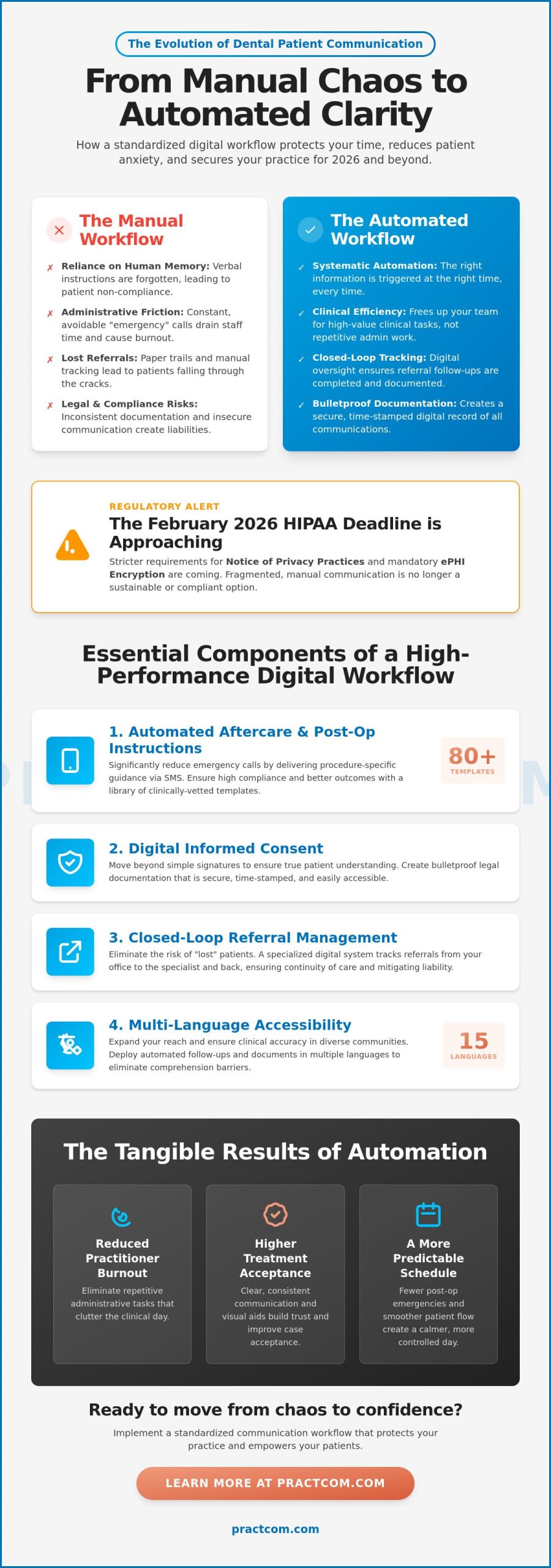
You’re likely already aware that as of February 2026, HIPAA requirements for Notice of Privacy Practices and ePHI encryption have become more stringent. This article provides a blueprint to bridge the gap between your practice management software and clinical excellence using automated tools. You’ll learn how to implement a system that provides multi-language support and digital informed consent to ensure bulletproof legal documentation. We will examine how a unified digital workflow leads to fewer post-treatment calls, higher treatment acceptance, and a more predictable daily schedule.
Key Takeaways
- Transition from manual paper trails to a standardized dental patient communication workflow to increase clinical efficiency and eliminate administrative friction.
- Implement a digital post-treatment instruction library to reduce the volume of emergency calls and improve patient compliance after they leave the chair.
- Secure your practice with digital informed consent forms that move beyond simple signatures to ensure true patient understanding and bulletproof legal documentation.
- Expand your reach and clinical accuracy in diverse markets by deploying automated follow-ups and documents in 15 different languages.
- Identify why specialized communication tools outperform basic practice management software modules when managing complex referral tracking and patient cases.
The Evolution of the Dental Patient Communication Workflow
The modern dental patient communication workflow is no longer just a professional courtesy; it’s a clinical requirement. For years, communication was viewed as a “soft skill” performed at the chair-side. However, in a high-pressure 2026 clinical environment, relying solely on verbal instructions is a liability. This workflow serves as the essential bridge between the procedure you perform and the compliance the patient maintains at home. Without a standardized system, your clinical excellence is at the mercy of human memory, which frequently fails under the stress of post-operative recovery.
Standardizing this process moves your practice from a reactive state to a proactive stance. While most offices have transitioned to basic Dental practice management software to store records, simple storage doesn’t solve the problem of human error. Automated clinical intelligence replaces the manual paper slips of the past with a digital ecosystem. This ensures every patient receives the same high standard of guidance, regardless of how busy the front desk becomes. This systematic oversight reduces practitioner burnout by eliminating the repetitive administrative tasks that clutter a clinical day.
From Paperless to Automated Clinical Intelligence
In 2026, being “paperless” is the baseline, not the final goal. True efficiency requires active automation. A standardized dental patient communication workflow uses clinical intelligence to trigger the right information at the right time. When a patient receives automated, clear instructions immediately after a procedure, their post-operative anxiety drops significantly. This consistency doesn’t just improve the patient experience. It builds a protective wall around your practice reputation. You’re providing a reliable, professional resource that patients can access 24/7, ensuring they feel supported long after they leave your chair.
Why 2026 Practices Are Facing a Documentation Crisis
The regulatory landscape has shifted significantly. With the February 2026 HIPAA updates regarding Notice of Privacy Practices and mandatory ePHI encryption, the stakes for documentation have never been higher. Fragmented communication leads to “lost” patients, especially in the referral loop where manual tracking often fails. If a patient doesn’t follow through with a specialist, it’s not just a lost case; it’s a potential legal risk. The rising cost of administrative time makes manual follow-ups a financial drain. Practices that fail to automate these touchpoints find themselves buried in manual tasks that add no clinical value but consume significant overhead.
Essential Components of a High-Performance Digital Workflow
While many practitioners understand the core principles behind dentist-patient communication strategies, the challenge lies in scaling those efforts without increasing administrative overhead. A high-performance dental patient communication workflow relies on five core pillars: standardized aftercare, digital consent, referral oversight, multi-channel delivery, and visual treatment planning. These elements work together to ensure that no patient falls through the cracks, regardless of the procedure’s complexity. By moving these tasks into a digital ecosystem, you remove the operational resistance that typically leads to human error.
Standardization is the key to psychological security for both the staff and the patient. When every team member follows the same digital blueprint, the quality of care remains consistent. This consistency is what builds trust and protects your reputation. It ensures that the clinical intelligence you’ve developed is applied to every single interaction, every time.
Automating Aftercare with Procedure-Specific Templates
Relying on verbal instructions or generic photocopies is a recipe for avoidable post-operative phone calls. To significantly reduce emergency calls, your workflow must include a library of 80+ pre-built, clinically vetted templates. These automated dental post-op instructions provide patients with immediate, procedure-specific guidance delivered directly to their smartphones. SMS delivery is particularly effective because patients are far more likely to read a text message than to keep a physical piece of paper. This ensures high compliance and better clinical outcomes while freeing your staff from the burden of answering the same questions repeatedly.
Digital Consent as a Risk Management Strategy
Consent is about more than just a signature on a screen; it’s about verified understanding and regulatory reassurance. Digital consent forms allow you to standardize the “informed” portion of the process by including visual aids and simplified explanations that bridge the gap between clinical jargon and patient comprehension. This approach protects your practice from legal risks while ensuring HIPAA compliance through secure, encrypted digital signatures. You can explore more about digital dental informed consent forms to see how they function as a preemptive strike against documentation failures.
Beyond consent and aftercare, a robust workflow must handle the logistics of referrals and visual engagement. Automated referral management closes the loop between general practitioners and specialists, preventing lost cases. Additionally, using tools like smile design to show before-and-after cosmetic changes significantly boosts treatment acceptance rates. By meeting patients where they are through SMS, email, or physical printouts, you ensure your message is received and understood. If you’re ready to see how these components fit into your daily routine, you can view our all-in-one platform features to begin your transition.
The PMS Gap: Why Specialized Tools Outperform Generalist Software
Many practices fall into the “Jack of All Trades” trap. They assume that because their Practice Management Software (PMS) includes a text module, their communication needs are met. In reality, these built-in features are often an afterthought, designed for administrative convenience rather than clinical excellence. A high-performance dental patient communication workflow requires technical depth that generalist software simply can’t provide. While a PMS excels at billing and scheduling, it often lacks the specialized logic needed to manage complex patient cases or post-operative care.
The primary limitation of generalist software is its lack of clinical specificity. A billing-centric system isn’t built to understand the nuance of a surgical follow-up versus a routine cleaning. Implementing a specialized communication layer allows you to maintain your current PMS for back-office tasks while upgrading your clinical interactions. This approach is significantly faster than a full PMS migration, providing immediate relief to your staff without the trauma of a complete data overhaul.
Specialized Suites vs. PMS “Lite” Features
Built-in modules usually offer basic SMS reminders but fail when it comes to procedure-specific instructions. Specialized tools provide 80+ clinically vetted templates that go far beyond a generic follow-up message. This depth is critical because it ensures patients understand their recovery steps, reducing the burden on your clinical staff. Referral tracking in a standard PMS is also notoriously leaky. Cases often disappear because the software isn’t designed to close the communication loop between general practitioners and specialists. You can see how these differences impact your daily operations by reviewing this comparison of specialized dental tools.
Effective care also requires high health literacy. Utilizing effective oral health communication techniques is essential for patient compliance. Generalist software rarely supports the multi-language documentation or visual aids necessary to bridge this gap. Specialized layers allow you to deliver complex information in a way that is accessible and actionable, which is a core requirement for any 2026 practice aiming for clinical precision.
The ROI of a Best-in-Breed Communication Stack
The financial justification for a specialized communication layer is clear. By automating follow-ups and consent, you save hours of administrative time every week. Chair-side assistants can focus on the patient instead of managing paper trails. This efficiency isn’t just about speed; it’s about accuracy. Standardized documentation in 15 languages reduces legal liability and ensures regulatory reassurance. Ultimately, optimizing dental practice workflow through a best-in-breed stack leads to measurable growth in treatment acceptance and patient retention. Tracking patient compliance through clinical analytics provides a much clearer picture of practice health than billing data alone.
Bridging the Language and Accessibility Gap
In a diverse clinical environment, language barriers can undermine the most precise surgical work. Your dental patient communication workflow must account for the reality that many patients don’t speak English as their primary language. Providing professional documentation in 15 different languages isn’t just a courtesy; it’s a risk management strategy. It ensures that clinical instructions are understood across all demographics, reducing the likelihood of post-operative complications caused by simple misunderstandings. This systematic approach provides the psychological security that patients need when recovering from complex procedures.
Standardizing your documentation across different languages also protects your practice’s legal standing. When a patient signs a consent form they cannot fully read, the “informed” part of informed consent is technically absent. By utilizing professionally translated materials, you provide a preemptive strike against administrative failures and regulatory scrutiny. This level of organization signals to your patients that you’re a reliable professional ally who values their safety and comprehension.
Clinical Accuracy in Every Language
Generic translation tools are insufficient for complex clinical instructions. Using them risks providing inaccurate or dangerous medical advice that could lead to patient harm. A standardized workflow uses professionally vetted translations for consent forms and aftercare instructions. This ensures you meet ethical requirements while protecting your practice from liability. When patients receive information they can fully comprehend, it significantly enhances the dental patient experience. This clarity builds an immediate bond of trust, as patients feel seen and respected by their provider. It positions your brand as a stabilizing force that values patient safety above all else.
Accessibility Beyond the Smartphone
Digital adoption is high, but it’s not universal. A hybrid approach that includes physical document printing remains a necessity for certain patient segments, such as older demographics who may prefer tangible instructions. Centralizing these formats within a single patient portal allows your staff to choose the best delivery method for each individual. For digital delivery, ensuring 10DLC registration is critical for reliable SMS delivery. Without this compliance, your messages may be flagged as spam, breaking the communication chain and leaving the patient without guidance. This comprehensive ecosystem ensures no part of the professional communication process is left to chance.
Professional documentation serves as a guardian of your reputation. It moves the practice from operational disorganization to systematic control. If you’re ready to implement these high-utility tools, you can start your free trial of our multi-language platform today.
Implementing Your Modern Workflow with PractCom
Transitioning to a high-performance dental patient communication workflow doesn’t require a disruptive overhaul of your entire office. Unlike general practice management systems that demand total data migration, a specialized clinical layer integrates seamlessly into your existing routine. This approach allows you to address specific administrative failures without the operational resistance associated with changing your core billing software. Implementation is a structured process designed to move your practice from manual chaos to systematic control in five logical steps.
- Step 1: Audit friction points. Identify exactly where your current process fails, such as high volumes of post-op calls or “leaky” referral revenue.
- Step 2: Integrate the specialized layer. Deploy PractCom as your dedicated clinical communication tool to bridge the gap between your PMS and patient compliance.
- Step 3: Staff training. Equip your chair-side assistants with 80+ pre-built, clinically vetted templates to eliminate the need for repetitive verbal instructions.
- Step 4: Launch referral management. Activate the automated tracking system to ensure every referred case is documented and closed, reclaiming lost revenue.
- Step 5: Performance monitoring. Use the dedicated dashboard to track patient compliance and documentation accuracy, ensuring regulatory reassurance.
Designed by Dentists for Clinical Reality
PractCom was built by clinicians who understand that human memory is a poor substitute for a standardized system. We focus specifically on the clinical gaps that traditional software leaves behind. Because we function as a specialized layer, you can begin starting a free trial today without the trauma of moving your patient records or billing data. This flexibility is particularly valuable for DSOs and multi-location practices that need to standardize communication across dozens of providers. It ensures that every location maintains the same high standard of clinical precision and legal documentation.
Ready to Transform Your Practice Workflow?
Modern dental practices are moving away from fragmented, manual tasks toward a comprehensive ecosystem where no part of the patient journey is left to chance. By prioritizing patient safety and compliance through automation, you position yourself as a reliable professional ally. The long-term benefits include higher treatment acceptance, fewer emergency calls, and a significant reduction in administrative stress. You don’t have to wait for a full software migration to upgrade your clinical standards. Start your free trial of PractCom’s clinical suite today and experience the confidence that comes with a bulletproof digital workflow.
Securing Your Practice with Clinical Precision
Mastering a modern dental patient communication workflow is the most effective way to eliminate the administrative friction that often leads to clinician burnout and lost cases. By bridging the gap between your practice management software and clinical reality, you ensure every patient receives consistent, high-quality guidance. You’ve seen how specialized tools provide the technical depth and regulatory reassurance your office requires to thrive in a competitive 2026 market.
PractCom functions as a professional ally, offering a library of 80+ procedure-specific templates and support for 15 languages across all clinical documents. With standardized digital informed consent and referral tracking, you can finally move from the resistance of manual tasks to the confidence of a standardized system. It’s time to protect your reputation and your clinical time with a solution built for the physical realities of the profession.
Start your free trial of PractCom’s clinical communication suite today to transform your patient interactions. Your practice deserves the stability and security of a professional, automated ecosystem.
Frequently Asked Questions
What is the difference between a PMS and a dental patient communication workflow tool?
A Practice Management Software (PMS) functions as your practice’s back-office engine for billing and scheduling, while a specialized communication tool manages the clinical interaction layer. While a PMS stores records, a dental patient communication workflow tool automates the delivery of complex instructions and consent forms. This distinction is critical because specialized tools offer deeper clinical logic that generalist software often treats as an afterthought.
How do automated post-op instructions reduce emergency phone calls?
Automated post-op instructions reduce emergency calls by providing immediate, procedure-specific guidance delivered directly to a patient’s smartphone. Patients often lose paper slips or forget verbal advice under the stress of recovery. Digital delivery ensures they have 24/7 access to clear instructions; this preempts common questions. This systematic approach decreases administrative pressure on your front desk and improves patient compliance.
Can digital consent forms be used if we still use paper charts?
You can absolutely use digital consent forms even if your practice still relies on physical paper charts. Many platforms allow you to print a signed, time-stamped PDF of the consent form to include in a physical file. This hybrid approach provides the legal protection of secure digital signatures while maintaining your existing organizational habits. It serves as a practical bridge toward a fully digital ecosystem.
How many languages should a modern dental practice support for instructions?
A modern practice should ideally support at least 15 languages to ensure clinical accuracy across a diverse patient base. Providing instructions in a patient’s primary language is an ethical necessity that builds immediate trust. It ensures that complex post-operative steps are fully understood, which is a key component of a high-performance dental patient communication workflow. This level of accessibility protects your reputation and your patients’ health.
Is specialized dental communication software HIPAA compliant?
Specialized dental communication software is designed specifically to be HIPAA compliant by using high-level encryption for all data at rest and in transit. As of the 2026 updates, these tools must also provide signed Business Associate Agreements (BAAs) to ensure legal accountability. Choosing a dedicated platform provides regulatory reassurance that generic text or email services simply cannot offer for protected health information.
Will implementing new workflow tools slow down my clinical staff?
Implementing these tools actually speeds up your clinical staff by replacing manual explanations with 80+ pre-built, procedure-specific templates. Chair-side assistants no longer need to spend valuable minutes writing out care steps or finding the right photocopies. One-click delivery allows the team to focus on the patient instead of administrative tasks. This efficiency reduces operational resistance and prevents staff burnout in high-volume environments.
How does a digital referral management system prevent lost cases?
A digital referral management system prevents lost cases by closing the communication loop between general practitioners and specialists. Instead of relying on the patient to carry a paper slip, the system tracks the referral status and alerts your team if a follow-up doesn’t occur. This oversight reclaims revenue that would otherwise disappear and ensures the patient receives the necessary specialized care without administrative delays.
Can I print physical instructions from a digital communication platform?
Yes, you can print physical instructions directly from a digital communication platform to accommodate patients who prefer paper. While digital delivery is the standard, a hybrid model ensures total accessibility for all demographics. This flexibility allows your staff to provide a tangible resource while still benefiting from the standardized, clinically vetted content stored within your digital library.

Article by
Cary Ganz DDS
Dr. Cary H. Ganz is a dentist, prosthodontist, entrepreneur, lecturer, and author with more than 50 years of experience in clinical dentistry and dental technology. Throughout his career, he has combined hands-on patient care with a deep understanding of how technology can improve dental practice operations, communication, documentation, and patient outcomes.
In addition to his clinical background, Dr. Ganz has held significant leadership roles in the dental technology industry, including Past Owner and Vice President of Clinical Affairs at DEXIS Digital Radiography and Past Vice President of Clinical Affairs at Denticon Practice Management Software. His business experience includes product development, clinical strategy, dental software innovation, practice management solutions, and educating dental professionals on the effective use of technology in modern dentistry.
Today, Dr. Ganz continues to focus on creating practical technology solutions for dental practices, including PractCom, a comprehensive dental practice communication platform designed to improve patient communication, documentation, compliance support, referrals, and overall practice efficiency. His work reflects a career-long commitment to helping dentists deliver better care while making their practices more organized, efficient, and protected.
No responses yet