
Have you ever gagged on a mouthful of impression putty during a dental visit? You’re not alone—and you may never have to experience that again.
Digital dental scans are transforming how dentists capture the exact shape of your teeth and gums. Whether you need a crown, bridge, dentures, or orthodontic treatment, the way we take impressions has evolved dramatically. Here in the local area, more practices are adopting this technology to make your visits faster, more comfortable, and more accurate.
Let’s walk through what digital dental scans are, how they compare to traditional impressions, and what you can expect during your next appointment.
What Are Digital Dental Scans?
Digital dental scans use a handheld wand—called an intraoral scanner—to capture thousands of images of your teeth and soft tissue in just minutes. The scanner projects light onto your teeth and records the reflections to build a highly detailed 3D model on a computer screen.
Unlike the goopy trays you might remember, digital scans require no messy materials. The wand is about the size of an electric toothbrush, and your dentist simply glides it around your mouth while you sit comfortably in the chair. Within seconds, you can see a full-color digital model of your smile displayed on a monitor.
This technology has become the standard in modern dentistry for procedures like crowns, veneers, Invisalign, implant planning, and even routine checkups. According to the American Dental Association, digital impressions improve both accuracy and patient comfort compared to conventional methods.
How Traditional Impressions Work
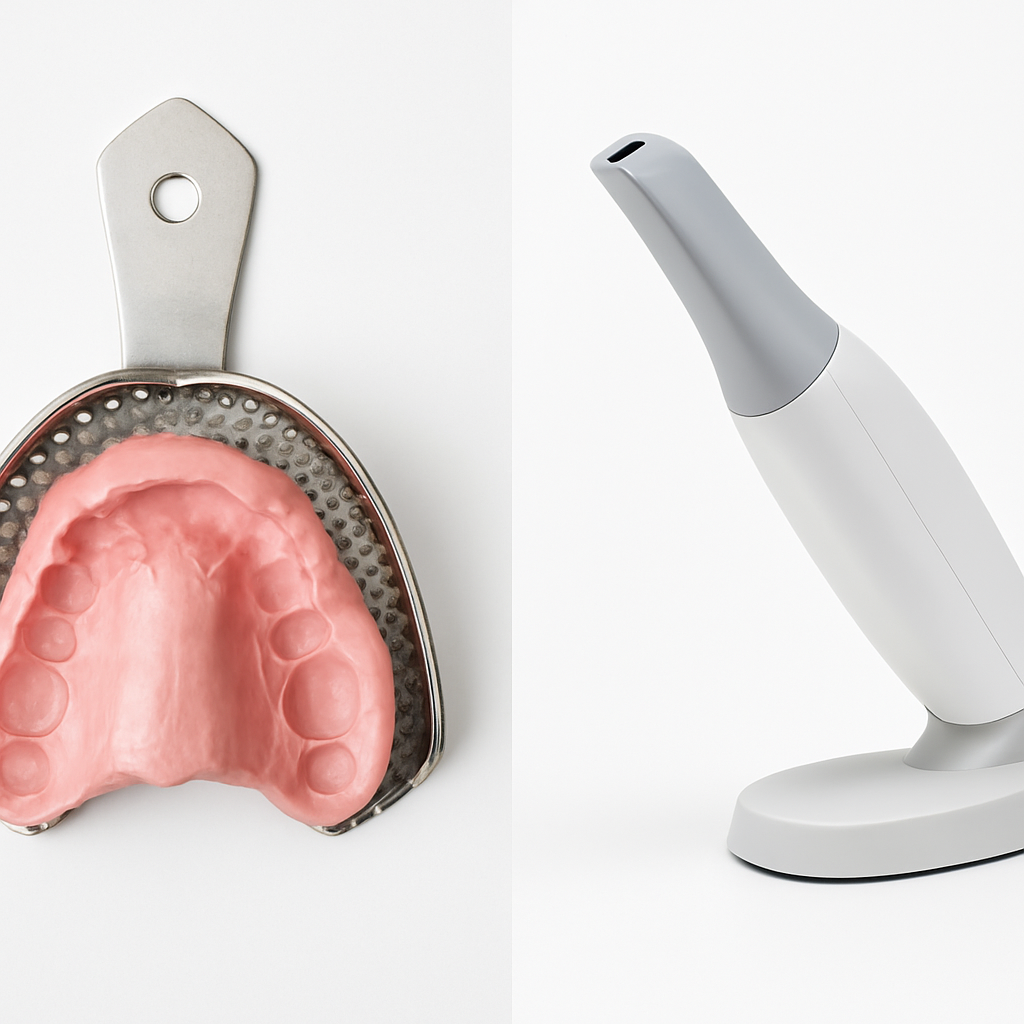
Traditional impressions rely on a putty-like material placed in a U-shaped tray that fits over your upper or lower teeth. You bite down and hold still for several minutes while the material sets. The process can trigger a gag reflex, especially if the tray reaches the back of your mouth or excess material flows toward your throat.
Once the putty hardens, the dentist removes the tray, creating a physical mold of your teeth. That mold is then shipped to a dental lab, where technicians pour plaster into it to create a stone model. The lab uses that model to fabricate your crown, denture, or other restoration.
While effective, this method has limitations:
- Discomfort: Many patients find the texture, taste, and gag reflex unpleasant.
- Timing: Molds must be shipped, which adds days to turnaround time.
- Accuracy issues: Air bubbles, distortions during removal, or shrinkage of the material can lead to impressions that don’t fit perfectly.
- Retakes: If the impression is flawed, you’ll need to repeat the process at another appointment.
Key Benefits of Digital Dental Scans
Switching from traditional impressions to digital dental scans offers several meaningful advantages for patients:
Comfort: No more gagging, drooling, or waiting with a tray in your mouth. The scanner is non-invasive and works quickly.
Speed: Most scans take less than five minutes. The digital file is available immediately, so there’s no waiting for a mold to set or cure.
Precision: Digital scans can capture details down to the micron level, which means restorations often fit better on the first try. Research published on PubMed shows that intraoral scanners provide accuracy comparable to or better than traditional methods for most applications.
Instant feedback: You and your dentist can review the 3D model together on-screen, making it easier to understand your treatment plan and ask questions.
Better communication with labs: Digital files are sent electronically to the lab within seconds, reducing shipping time and the risk of damage or loss in transit.
Environmentally friendly: No disposable trays, no impression material waste, and no shipping materials needed.
What to Expect During a Digital Scan Appointment
If your dentist uses digital dental scans, here’s how your appointment will typically unfold:
- Preparation: Your dentist may ask you to rinse your mouth or lightly dry your teeth. There’s no anesthesia needed for the scan itself.
- Scanning process: The dentist or hygienist will gently guide the scanner wand along your teeth, starting at one side of your mouth and moving to the other. You’ll feel a slight pressure as the wand touches your teeth, but no discomfort. The whole process usually takes three to five minutes.
- Review: Once the scan is complete, your dentist will show you the 3D model on a screen. You can see your teeth from all angles, and your dentist can zoom in to highlight areas that need treatment.
- Next steps: The digital file is sent to the lab or, in some cases, used immediately if your practice has same-day milling technology. Your custom restoration can often be ready much faster than with traditional impressions.
Most patients report that digital scans feel easier and less stressful than they expected, especially if they’ve had negative experiences with traditional molds in the past.
Are There Any Downsides to Digital Scans?
While digital dental scans offer many benefits, it’s worth noting a few considerations:
Learning curve: Dentists and staff need training to use the technology effectively, though most adapt quickly.
Cost: The equipment is expensive, which is why not every practice has adopted it yet. However, the investment often pays off in time saved and fewer remakes.
Saliva and moisture: Excessive saliva can interfere with scan accuracy, so your dentist may use suction or ask you to swallow occasionally during the process.
Limited use for certain cases: In rare situations—like extremely deep margins below the gumline—a traditional impression may still be necessary.
Overall, the advantages far outweigh these minor limitations for the vast majority of patients.
Which Method Is Right for You?
If your dental practice offers digital dental scans, it’s usually the preferred option for comfort, speed, and accuracy. Traditional impressions are still effective and remain a reliable choice when digital technology isn’t available or appropriate for a specific clinical situation.
Your dentist will recommend the best approach based on your individual needs, the type of restoration you require, and the equipment available. Don’t hesitate to ask questions about the process during your consultation—understanding what to expect can ease any anxiety and help you feel more confident about your care.
Here in the local area, the practice is committed to offering the latest technology to make your dental experience as comfortable and efficient as possible. If you’re due for a crown, bridge, or other restorative work, ask our team about digital scanning at your next appointment. We’re always happy to walk you through the process and answer any questions. Give us a call or book online today to experience the difference modern dentistry can make.
Comments are closed