
Last Tuesday, your front desk coordinator spent four minutes apologizing to a patient while frantically scrolling through a cluttered database to find a single record. It is a common scene that creates unnecessary friction and risks data confusion through duplicate profiles. When you transition to a system that prioritizes speed, the dental patient portal benefits become clear immediately. You aren’t just saving seconds. You are protecting your practice’s clinical integrity by ensuring the right data reaches the right person every time.
You likely already feel the weight of administrative noise and the stress of keeping up with 2026 HIPAA requirements, including mandatory MFA and encrypted ePHI. We understand that your time is better spent on clinical care than on manual documentation tasks. This article will show you how an efficient search-by-name function within a digital portal reduces operational resistance and enhances your team’s communication. We’ll explore how instant access to patient history eliminates data silos and creates a more personalized, secure experience for every person who walks through your door.
Key Takeaways
- Learn why a fast, name-based indexing function is the essential starting point for reducing administrative friction and patient wait times.
- Discover the dental patient portal benefits that arise when you separate high-speed communication tasks from the slower, billing-heavy workflows of your PMS.
- Identify the critical steps for auditing your database to remove duplicate profiles and prevent data confusion among your clinical staff.
- Explore how to turn a simple search into a clinical intervention by instantly accessing a library of over 80 post-treatment instruction templates.
- Establish a standardized protocol for mandatory data fields to ensure every search query returns accurate, actionable results every time.
Why Patient Search by Name is the Foundation of Dental Office Efficiency
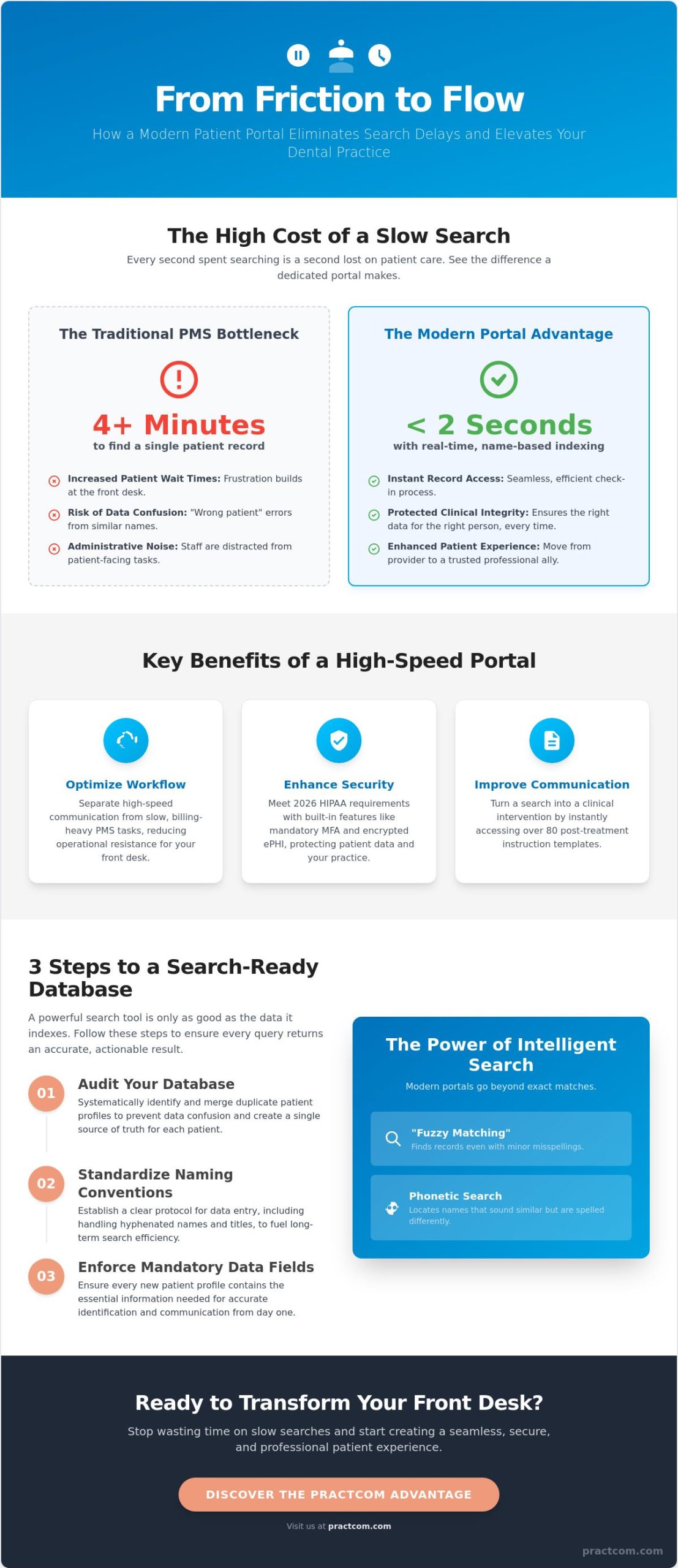
Efficiency in a high-pressure dental practice often hinges on the most basic interactions. When your front desk team can’t locate a file within seconds, the entire clinical schedule begins to slide. One of the primary dental patient portal benefits is the ability to transform a slow, manual indexing process into a lightning-fast digital search. This functionality serves as the essential gateway to the patient’s electronic health record (EHR), ensuring that every piece of clinical data is correctly mapped to the individual without delay.
The cost of manual record retrieval extends beyond simple time loss. It creates administrative noise that patients can feel. When a staff member is buried in a database or a filing cabinet, they aren’t focused on the person standing in front of them. Rapid identification acts as a clinical safeguard. It prevents “wrong patient” errors where treatment notes or prescriptions are accidentally attached to a similar name. Beyond safety, there is a profound psychological benefit to instant recognition. When you can pull up a record and greet a returning patient by name before they even reach the counter, you move from a cold service provider to a trusted professional ally.
The Bottleneck of Traditional Filing Systems
Friction points in legacy search methods often involve rigid parameters that don’t account for human error. If a name is misspelled by one letter, the record effectively disappears. These administrative delays at the front desk don’t stay there; they trickle down to clinical staff who must wait for charts before starting a procedure. This search latency directly impacts the dental patient experience, signaling a lack of organization that can erode trust. A modern portal removes this barrier, allowing for a seamless transition from check-in to the operatory.
Standardizing Data for Instant Retrieval
For a high-growth practice, standardized naming conventions are a business requirement. You need a system that utilizes “fuzzy matching” and phonetic search capabilities to account for diverse patient bases and hyphenated names. Clean data entry during the initial intake fuels this long-term efficiency. By establishing a protocol for mandatory data fields, you ensure that every search query returns an accurate, actionable result. This level of systematic control is another one of the dental patient portal benefits that protects your practice from the data confusion that often plagues growing clinics.
How Modern Portals Enhance the Search-by-Name Workflow
A standard Practice Management Software (PMS) is designed for clinical charting and ledger management. While these systems are robust, their search interfaces often feel heavy and slow during peak office hours. A dedicated portal offers a superior user interface specifically optimized for the high-velocity demands of the front desk. This specialized focus is one of the most practical dental patient portal benefits, as it allows staff to bypass the heavy processing load of a full PMS for simple administrative tasks. When the interface is built for speed, your team can move from a search query to a communication trigger in seconds.
Modern portals utilize real-time indexing to ensure that even a patient who registered moments ago is immediately searchable. This rapid response time is directly linked to better security and data protection. When search results appear instantly and accurately, there’s less risk of staff browsing through similar records or keeping sensitive data visible on a screen for extended periods while they wait for a page to load. Research regarding the Impact of Digital Patient Portals confirms that these efficiencies contribute significantly to both operational flow and patient satisfaction. By treating the search bar as a “digital front door,” you create a more organized environment for both staff and patients.
Cross-Platform Syncing and Searchability
A modern portal functions as a communication layer that sits on top of your existing database. It pulls data from the PMS to create a single source of truth for patient contact information. This ensures that whether you’re at a desktop or using a mobile device in the operatory, the “search by name” function remains consistent and fast. If you’re looking to streamline your internal communications, you might explore how a unified platform simplifies record access across your entire team. This cross-platform accessibility means that a clinician can verify a patient’s identity and history without returning to a central workstation.
Search Filters: Beyond the First and Last Name
In a large practice, searching for a common name might return dozens of results. Modern portals solve this by incorporating secondary identifiers like date of birth (DOB) or phone numbers into the primary search bar. You can also filter by “last seen” or specific “treatment types” to narrow down the list. This multi-parameter search capability is a critical safeguard for your practice’s legal standing. By requiring more than just a name to open a record, you drastically reduce the risk of HIPAA violations and ensure that clinical instructions are sent to the correct individual. This level of systematic oversight is a cornerstone of a protective and professional practice environment.
Overcoming the ‘PMS Search is Enough’ Objection
Many practice owners assume that because their Practice Management Software (PMS) includes a search bar, a dedicated portal is redundant. This perspective overlooks the fundamental difference between a billing-centric database and a communication-centric interface. A PMS is designed to manage heavy ledger data and complex insurance claims. While these functions are necessary, they create a heavy search experience that isn’t optimized for the rapid-fire needs of the front desk. When you focus on dental patient portal benefits, you’re investing in a streamlined layer that prioritizes clinical outreach over financial record-keeping.
Security also plays a significant role in this distinction. Most PMS platforms provide broad access once a user is logged in, which can be a liability in a busy office. Portals allow for more granular search permissions, ensuring that staff can find the right patient without necessarily having full access to sensitive billing history or private financial data. This targeted access aligns with the latest data on patient perspectives on dental portals, which shows that patients increasingly value the security and professional handling of their digital information. It’s about having the right tool for a specific professional task.
Billing Search vs. Clinical Communication
Searching for a ledger is a different technical process than searching for a follow-up recipient. In a PMS, a search often triggers the loading of years of financial history. In a portal, a search is designed to trigger a specific action, such as sending an automated follow-up or a digital consent form. This search-to-action workflow bridges the gap between raw clinical data and meaningful patient outreach. By prioritizing communication status in your search results, your team can see at a glance if a patient has received their instructions or if they require immediate attention. You can learn more about how PractCom optimizes these workflows to reduce administrative noise.
Reducing Operational Resistance
Operational resistance is the invisible friction caused by slow software interfaces. It might seem minor, but the difference between a 3-second search and a 30-second search adds up to hours of lost productivity every week. This constant delay erodes staff morale and increases the mental load on your administrative team. When you eliminate these micro-frustrations, you’re not just improving workflow; you’re creating a more stabilizing environment that supports staff retention. A fast, reliable portal acts as a guardian of your team’s time, allowing them to focus on personalized patient care instead of fighting with a lagging interface.
Step-by-Step: Optimizing Your Patient Database for Search
A fast search tool is only as effective as the data it indexes. If your database is cluttered with duplicate profiles, nicknames, or incomplete entries, your team will continue to face operational resistance. One of the primary dental patient portal benefits is the clarity it brings to your records, but this requires an initial commitment to data hygiene. By cleaning up your database now, you ensure that every future query is accurate and every clinical communication reaches the intended recipient. Systematic control over your data is not just a convenience; it’s a safeguard against the confusion that leads to medical errors.
Cleaning Up Legacy Data
Inconsistent naming conventions are a major source of administrative friction. You likely have records for “John Doe” and “Jonathan Doe” that refer to the same person, creating communication silos where vital information is split between two files. You should perform a systematic audit to merge these profiles and establish a single source of truth. Use automated dental post-op instructions as a trigger to prompt patients to update their contact information. When patients verify their own data through a digital form, they effectively clean your database for you. This self-service model is a key driver of dental patient portal benefits, as it shifts the burden of data entry away from your team and ensures your search index remains current.
Staff Training for Search Excellence
Technology works best when it’s paired with a “search first, ask later” office culture. Training your staff to use secondary identifiers, such as birth dates or the last four digits of a phone number, allows them to resolve identity conflicts during high-volume periods without interrupting clinical flow. It is a simple but powerful calculation: spending 10 seconds on a precise search saves 10 minutes of correcting a documentation error later. This proactive approach reduces the psychological stress of a busy front desk and reinforces a professional image. If you’re ready to implement these standards, start your free trial to see how PractCom simplifies database management.
To maintain a high-performance database, follow these essential steps:
- Establish a protocol for mandatory data fields like DOB and mobile number during every check-in.
- Audit your current database for duplicates every quarter to maintain peak search performance.
- Integrate digital consent forms to allow patients to update their own searchable info securely.
- Sync your portal with your PMS daily to ensure that new patient data is searchable within seconds of entry.
The PractCom Advantage: Search-Driven Patient Communication
PractCom transforms the search bar from a simple navigation tool into a powerful clinical intervention point. Once you identify a patient by name, you aren’t just viewing a static record; you are ready to initiate high-level care. This immediate transition is where the most impactful dental patient portal benefits move from administrative theory to clinical reality. You gain instant access to a library of over 80 post-treatment instruction templates, allowing you to move from a search query to a sent instruction in under 30 seconds. This speed ensures that patients leave your office with the guidance they need for a safe recovery.
Managing a diverse patient base requires more than just English-language records. PractCom allows your team to find a patient and immediately deliver those 80+ instruction templates in 15 different languages. This capability reduces the risk of post-operative misunderstandings and improves clinical compliance across your entire community. To help you track these improvements, our dental practice performance dashboard provides systematic oversight. It allows you to see exactly how reducing search latency and increasing communication speed correlates with practice growth and staff productivity. By treating search as a business requirement, you create a more predictable and profitable clinical environment.
Beyond the Search Bar: Automated Follow-Ups
Finding a patient by name is the essential first step toward automated compliance tracking. When you identify a patient within the PractCom ecosystem, you can trigger automated follow-ups that monitor their recovery status without further manual input. This functionality significantly reduces the administrative burden of dental patient follow-up after missed appointments, as the system handles the initial outreach for you. By integrating your referral management into this same searchable layer, you ensure that every patient journey is documented and every specialist communication is tracked. This creates a comprehensive ecosystem where no part of the professional communication process is left to chance.
Start Your Frictionless Workflow Today
Implementing PractCom does not require a complex overhaul of your current technology. It is designed to work alongside your existing PMS as a stabilizing force, providing the modern interface your staff needs for high-velocity communication. We understand the operational stresses of a busy clinic, which is why we’ve made our system as intuitive as possible. We invite you to start a free trial to test our search speeds and template access in real-time. You can experience firsthand how a dedicated communication portal reduces operational resistance and empowers your team. Give your staff the tools they need to search, find, and care with absolute confidence.
Transform Your Workflow with Precision Patient Search
Optimizing your practice begins with mastering the first interaction. When you replace the friction of manual record retrieval with a high-speed digital interface, you protect your staff from burnout and your patients from data confusion. We’ve explored how a dedicated communication layer allows you to bypass the heavy processing of your PMS, ensuring that clinical instructions and follow-ups are never delayed. These dental patient portal benefits provide the psychological security of knowing your documentation is accurate and your patient identity is verified every time.
PractCom offers a system built by dental professionals who understand the physical and logistical realities of your operatory. With a library of over 80 post-treatment templates and support for 15 languages, we ensure that your care is as precise as your search. It’s time to move from operational resistance to systematic control. Ready to eliminate administrative friction? Start your PractCom free trial today. You don’t have to settle for a lagging interface when a faster, more professional solution is within reach.
Frequently Asked Questions
How does a dental patient portal improve my front-desk speed?
A portal improves speed by providing a specialized interface that is separate from the heavy processing load of your Practice Management Software. Your staff can locate records and trigger actions, such as sending digital consent forms, in seconds rather than minutes. This efficiency reduces the administrative noise that often leads to front-desk bottlenecks during peak hours.
Can patients search for their own records in the portal by name?
Patients don’t need to search for their own records because they access a personalized, secure dashboard where their specific history is already filtered. Once they log in through the digital front door, they have immediate access to their own post-treatment instructions and clinical documents. This self-service model is one of the most practical dental patient portal benefits for reducing phone inquiries.
Is searching for a patient by name in a portal HIPAA compliant?
Yes, searching is compliant when the system utilizes mandatory encryption and multi-factor authentication, which are 2026 regulatory requirements for ePHI. Access is restricted to authorized personnel, and the system maintains an audit trail of every record accessed. This ensures that sensitive data is only visible to staff members who have a legitimate clinical need to see it.
What happens if I have two patients with the exact same name?
The system utilizes secondary identifiers like date of birth or phone numbers to resolve identity conflicts instantly. This multi-parameter search capability is a critical dental patient portal benefits feature that prevents clinical documentation errors. By requiring these additional data points, your team can be certain they are communicating with the correct individual every time.
Do I have to manually enter names into the portal for them to be searchable?
No, the portal syncs directly with your existing PMS to pull patient data automatically. Real-time indexing ensures that any new patient who completes an intake form is searchable within seconds. This eliminates the need for redundant data entry and ensures your communication database is always a perfect reflection of your clinical records.
Can I search for patients by their preferred language in PractCom?
You search for patients by name to identify them, and then PractCom allows you to deliver instructions in 15 different languages. Once you locate the patient, you can select their preferred language from the template library to ensure they understand their aftercare. This systematic approach to diversity improves clinical compliance and patient trust across your entire community.
How does search functionality help with dental referral management?
It creates a searchable ecosystem where you can track every referral status linked to a specific patient name. Instead of digging through paper files or separate email chains, you search for the patient and instantly see which specialist they were referred to and which documents were shared. This centralized oversight reduces the risk of patients falling through the cracks of your referral network.
Will a portal slow down my existing practice management software?
No, a portal operates as a lightweight communication layer that sits on top of your PMS without taxing its server resources. It actually improves overall system performance by offloading communication-heavy tasks to a platform specifically built for speed. This allows your PMS to focus on its core functions, like billing and clinical charting, without being slowed down by administrative outreach.

Article by
Cary Ganz DDS
Dr. Cary H. Ganz is a dentist, prosthodontist, entrepreneur, lecturer, and author with more than 50 years of experience in clinical dentistry and dental technology. Throughout his career, he has combined hands-on patient care with a deep understanding of how technology can improve dental practice operations, communication, documentation, and patient outcomes.
In addition to his clinical background, Dr. Ganz has held significant leadership roles in the dental technology industry, including Past Owner and Vice President of Clinical Affairs at DEXIS Digital Radiography and Past Vice President of Clinical Affairs at Denticon Practice Management Software. His business experience includes product development, clinical strategy, dental software innovation, practice management solutions, and educating dental professionals on the effective use of technology in modern dentistry.
Today, Dr. Ganz continues to focus on creating practical technology solutions for dental practices, including PractCom, a comprehensive dental practice communication platform designed to improve patient communication, documentation, compliance support, referrals, and overall practice efficiency. His work reflects a career-long commitment to helping dentists deliver better care while making their practices more organized, efficient, and protected.
No responses yet