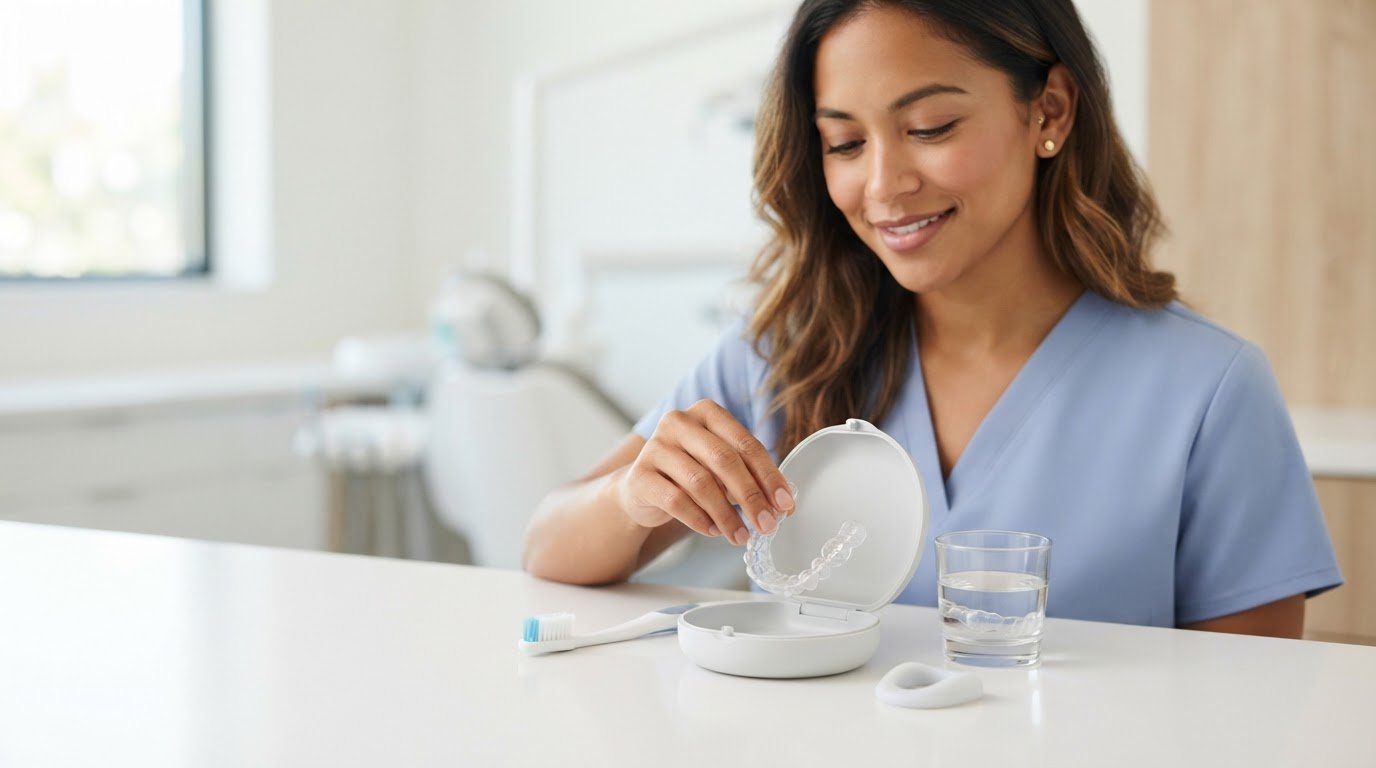
A poorly fitting aligner is a reason to pause, not push through. Follow clear aligner care instructions for patients by wearing trays 20-22 hours per day, removing them for meals and drinks other than water, and cleaning your teeth before putting them back in. If a tray doesn’t fit well, contact your dental practice before switching to the next one.
It’s easy to focus on wearing each new set and overlook the small daily habits that protect the trays and keep treatment on track. Knowing when to remove an aligner, how to clean and soak it, and what to do when fit or attachments change can make your routine clearer and help you respond calmly when something goes wrong.
This guide covers practical steps for removing, cleaning, storing, and reinserting aligners, using chewies, and keeping previous trays. It also explains when to pause a planned tray change and contact your dental practice.
Key Takeaways
- Remove trays before meals and drinks other than water, then store them in their case rather than wrapping them in a napkin.
- Use a gentle daily cleaning routine and a suitable soak to keep aligners fresh without damaging their fit.
- Seat new trays carefully with chewies, and keep previous sets so you have a practical backup and can bring them to appointments.
- Pause before switching trays if the current set fits poorly or an attachment breaks, and contact your dental practice for guidance.
Removing aligners before eating or drinking
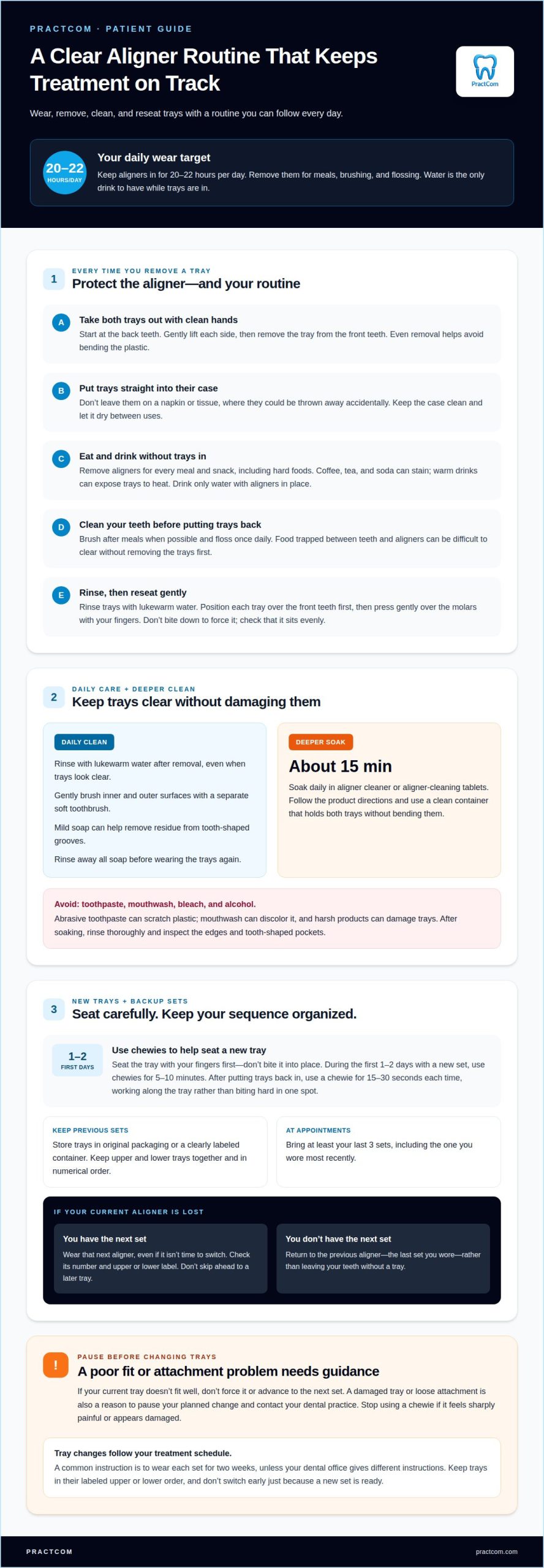
Keep aligners in for 20-22 hours per day, removing them for meals, brushing, and flossing. Drink only water while wearing them; remove trays before coffee, tea, soda, or any other drink.
- Before eating, remove both trays with clean hands. Start at the back teeth, pulling each side off gently, then lift the aligners away from the front teeth. Removing them evenly helps avoid bending the plastic. Put each tray in its case, not on a napkin or tissue, where it could be thrown away accidentally.
- Take aligners out for every meal and snack, including hard foods. Biting hard food through a tray can crack it. Coffee, tea, and soda can stain clear plastic, while warm drinks can expose trays to heat. Water is the only drink to have with aligners in place.
- After eating, brush and floss before reinserting your trays. Floss once daily, and brush your teeth after meals when possible. Food trapped between teeth and aligners can be difficult to clear without removing the trays first. Rinse the aligners with lukewarm water whenever you take them out.
- To put a tray back in, position it over the front teeth first. Then use your fingers to press it gently over the molars. Don’t bite down to force it into place. Check that the tray sits evenly over your teeth before continuing your day.
- Change to the next numbered set according to your treatment schedule. A common instruction is to wear each set for two weeks, unless your dental office gives different instructions. Keep trays in their labeled upper or lower order, and don’t switch early simply because a new set is ready.
- Brush and floss normally during treatment, removing aligners first. Inconsistent wear can mean you miss the advised 20-22 hours per day; staining from drinks and cracks from hard foods can also damage trays. If your current set doesn’t fit well, don’t force it or advance to the next tray.
Soaking aligners for deeper cleaning
- Clean each tray daily, even when it looks clear. Rinse it with lukewarm water after removal, then gently brush its inner and outer surfaces with a soft toothbrush. Mild soap can help remove residue from the grooves around each tooth. A daily routine complements, rather than replaces, a deeper soak.
- Use a separate soft toothbrush for aligners, and skip toothpaste. Abrasive particles can scratch the plastic and leave trays looking dull. Rinse away all soap before wearing the aligners again. These clear aligner care instructions for patients make daily cleaning specific without relying on harsh products.
- For deeper cleaning, soak trays in aligner cleaner or aligner-cleaning tablets for about 15 minutes a day. Follow the product’s directions for preparing the solution. Use a clean container that holds both trays without bending them, and keep the soaking time consistent.
- Don’t use mouthwash, bleach, or alcohol to clean aligners. Mouthwash can discolor the plastic, and harsh products can damage the trays. Choose an aligner cleaner instead of mixing household cleaning products. Keeping to one cleaning method at a time also makes it easier to spot residue.
- Rinse each tray thoroughly with lukewarm water after soaking. Inspect the tooth-shaped pockets and edges before reinserting it. If residue remains, gently brush the tray again with mild soap. These clear aligner care instructions for patients help separate routine brushing from soaking, so each step has a clear purpose.
- Store clean trays in their case whenever they’re out of your mouth. Keep the case clean and let it dry between uses. A regular place for the case helps keep trays together and protects them from being misplaced or damaged while you’re eating or completing oral care.
Using chewies and keeping previous aligners
- Seat each new tray with your fingers before using a chewie. Don’t bite the aligner into place. A chewie helps press the tray against your teeth and close small spaces between the plastic and tooth surfaces. During the first 1-2 days with a new set, use chewies for 5-10 minutes. Follow the clear aligner care instructions for patients provided by your dental practice.
- After putting trays back in, use a chewie for 15-30 seconds each time. Work along the newly seated aligner instead of biting hard in one spot. Even pressure helps the tray sit closely against your teeth. Stop if it feels sharply painful or appears damaged, and contact your practice about the problem.
- Keep previous aligners after moving to a new set. Store each tray in its original packaging or a clearly labeled container. Keep upper and lower trays together, and preserve their numerical order. Clear labels make it easier to identify the last set you wore if you need to explain a treatment interruption.
- Bring your previous trays to orthodontic appointments. Take at least your last 3 sets, including the one you wore most recently. The trays give your dental team a reference for your treatment sequence and fit. Pack them before leaving so you can show the sets instead of relying on memory.
- If you lose your current aligner and have the next set, wear that next aligner, even if it isn’t time to switch. Check its number and upper or lower label first. Don’t skip ahead to a later tray. Keep the remaining sets together so you can follow the planned sequence.
- If you lose the current tray and don’t have the next one, return to the previous aligner. Use the last set you wore rather than leaving your teeth without a tray. These clear aligner care instructions for patients help clarify which stored set to use after a loss. Keep your other trays organized for reference.
When to contact the dental practice
Pause your planned tray change when fit or attachments become a concern. A poor fit, a damaged tray, or a loose attachment calls for a clear next step.
Identify Lost or Damaged Aligners
If you lose your current tray, use the next aligner, even if it isn’t yet time to switch. If you don’t have the next tray, return to the previous one. For a crack or other damage, contact your dental practice rather than trying to repair the tray or force it into place.
Contact the Dental Practice About Aligner Problems
If your current aligner doesn’t fit well, call your practice and don’t advance to a new set. If an attachment comes off or partly breaks from a tooth, pause the switch and call about replacement. A missing tooth tab that helps the aligner snap on is also a reason to call promptly and ask whether you need an earlier visit.
- Check the tray number and upper or lower label before choosing a replacement. If you have the next tray, use it after losing the current one; if not, go back to the previous tray. Keep the remaining sets together so you can explain which aligners you have.
- Describe the problem clearly when you call. Mention whether the tray is missing, cracked, damaged, or poorly fitting, and identify any loose attachment or missing tab. These details help the practice understand what changed and what guidance you need.
- For significant pain that continues beyond 72 hours after changing trays, contact your dental practice. Note when you started the new set and when the pain began. Don’t treat poor fit or a broken attachment as a reason to switch ahead.
- Keep the affected tray and previous sets available for your appointment. Bring your last 3 sets when attending, so the practice can see the sequence and inspect the fit alongside your description.
Dental practices can make patient instructions easier to access and follow. Explore a consistent way to share patient guidance.
PractCom: Post-Treatment Instruction Library
PractCom’s Post-Treatment Instruction Library helps dental practices organize and share clear guidance with patients after treatment. With over 80 post-treatment templates, practices can provide written instructions that patients can revisit when questions come up at home. For aligner care, consistent patient education can reinforce steps such as cleaning trays, following wear instructions, and recognizing when to contact the practice.
Dental practices can pair patient instructions with PractCom’s Patient Portal, giving patients a dedicated digital channel for accessing documents. This makes guidance easier to revisit instead of relying on patients to remember every detail from an appointment.
To make patient instructions easier to organize and share, explore PractCom’s communication tools for dental practices.
Make your care routine easier to maintain
Make aligner care part of your daily routine. Pair cleaning with an existing habit, such as brushing after meals, and keep your trays and case in a consistent place. Clear aligner care instructions for patients are most useful when they’re easy to revisit and follow.
For dental practices, clear communication can support patients beyond the appointment. PractCom’s Post-Treatment Instruction Library helps organize patient guidance, while Digital Informed Consent Forms and a Referral Management System support other communication needs in the practice.
Whether you’re a patient seeking clarity or a practice improving how it shares instructions, take the next step that fits your needs. Contact PractCom with your questions. A steady routine and clear guidance can help you move forward with confidence.
Frequently Asked Questions
How many hours a day should clear aligners be worn?
Wear clear aligners for 20-22 hours per day, following the schedule provided for your treatment. A useful way to plan is to account for meals and oral hygiene together, rather than taking trays out repeatedly between meals. If your daily routine makes it hard to meet the wear time, note when trays are out and discuss the pattern at your next appointment.
How should patients clean clear aligners each day?
Rinse your aligners whenever you remove them, then gently brush them with a soft toothbrush and no toothpaste. Keep a separate brush with your aligner case so you can clean your trays after meals or before bed. Avoid mouthwash, which can discolor aligners. Regular cleaning also makes visible residue easier to spot and gently remove.
What should patients avoid eating or drinking while wearing aligners?
Remove aligners before eating or drinking anything other than water. Coffee, tea, and soda can stain trays, and heat from warm drinks can affect the plastic. Don’t chew gum or smoke while wearing aligners, as gum can stick to them and smoke can stain trays and teeth. Put aligners in their case before meals to help prevent damage or loss.
How should clear aligners be removed and reinserted safely?
With clean fingers, loosen the tray from the back teeth on both sides, then lift it away from the front teeth. To reinsert it, place it over the front teeth first and gently press it toward the molars. Don’t pull forcefully on one side or bite down to seat the tray. If it catches or resists, stop rather than bending the plastic.
How should patients store aligners when they are not wearing them?
Put aligners in their case whenever they’re out of your mouth, including during meals and oral care. A case helps prevent trays from being misplaced, crushed, or accidentally thrown away with a napkin. Don’t leave them loose on a counter or wrapped in tissue. Keep the case somewhere consistent and easy to find, such as beside your toothbrush or in your bag.
What should patients do if an aligner feels painful or does not fit?
Don’t force a tray that doesn’t fit or move ahead to the next set. Contact your dental practice if the aligner remains poorly fitting, or if an attachment has come loose. Some soreness can happen after changing trays, but significant pain lasting beyond 72 hours is a reason to call. Describe when the discomfort began and which tray you’re wearing.

Article by
Cary Ganz DDS
Dr. Cary H. Ganz is a dentist, prosthodontist, entrepreneur, lecturer, and author with more than 50 years of experience in clinical dentistry and dental technology. Throughout his career, he has combined hands-on patient care with a deep understanding of how technology can improve dental practice operations, communication, documentation, and patient outcomes.
In addition to his clinical background, Dr. Ganz has held significant leadership roles in the dental technology industry, including Past Owner and Vice President of Clinical Affairs at DEXIS Digital Radiography and Past Vice President of Clinical Affairs at Denticon Practice Management Software. His business experience includes product development, clinical strategy, dental software innovation, practice management solutions, and educating dental professionals on the effective use of technology in modern dentistry.
Today, Dr. Ganz continues to focus on creating practical technology solutions for dental practices, including PractCom, a comprehensive dental practice communication platform designed to improve patient communication, documentation, compliance support, referrals, and overall practice efficiency. His work reflects a career-long commitment to helping dentists deliver better care while making their practices more organized, efficient, and protected.
No responses yet