
Missed dental appointments often come down to work conflicts, forgetting, or difficulty reaching the office to reschedule. Reducing dental patient no-shows starts with making it easy to remember, confirm, or change a visit: send a reminder 48-72 hours ahead, then another 24 hours before the appointment.
When a patient cancels at the last minute or doesn’t arrive, the schedule gap can disrupt the day’s workflow. You can’t eliminate every barrier, but a clear, consistent process helps patients act sooner and gives your team more time to respond.
This article explains why patients miss appointments and how reminder timing, tracking, targeted scheduling, and clear cancellation policies can help. You’ll also learn how to make reminders easier to act on, spot patterns in missed visits, and communicate fees clearly and consistently.
Key Takeaways
- Confirm appointment details and make it simple for patients to ask questions or reschedule before a missed visit becomes a schedule gap.
- Review no-show patterns by visit type, provider, and booking lead time to identify where targeted scheduling changes may help.
- Pair automated text reminders with confirmation calls, and track whether each step is completed.
- Explain cancellation policies clearly and apply them consistently, with room for emergencies and unforeseen circumstances.
1. How far in advance should you send appointment reminders?
Use a two-step reminder schedule: send the first message 48-72 hours before an appointment, then a second 24 hours beforehand. The earlier reminder gives patients time to resolve work conflicts or contact the office to reschedule. The later message helps patients remember the reserved time. A same-day reminder can reinforce the appointment for patients who benefit from one final prompt.
Make every reminder easy to act on. Include the appointment date and time, the practice’s contact details, and a clear way to confirm or request a change. Ask patients to verify those details when booking, then invite them to correct any errors when the reminder arrives. This can also catch outdated contact information before a message goes unanswered.
Work conflicts, forgetfulness, and difficulty reaching the office to reschedule can all contribute to missed appointments. Offer a choice of suitable appointment times and explain how long the visit is expected to take. For patients who have missed appointments before, consider same-day appointments or booking only a day or two ahead. Shorter booking windows can make it easier to fit a visit around a changing schedule.
Automated text and email reminders keep messaging consistent without requiring staff to send every message manually. Schedule reminders in advance and ask patients to confirm directly. That request gives the team a chance to follow up on unconfirmed appointments, while some patients find a text easier to respond to than a voicemail.
A short-notice waitlist can help fill a cancellation. Ask patients whether they’re willing to come in sooner, note their preferred times, and contact suitable people when a slot opens. Make the offer specific by sharing the available appointment time and response deadline. This turns an unexpected cancellation into a chance to backfill the schedule.
2. No-show data tracking and targeted scheduling
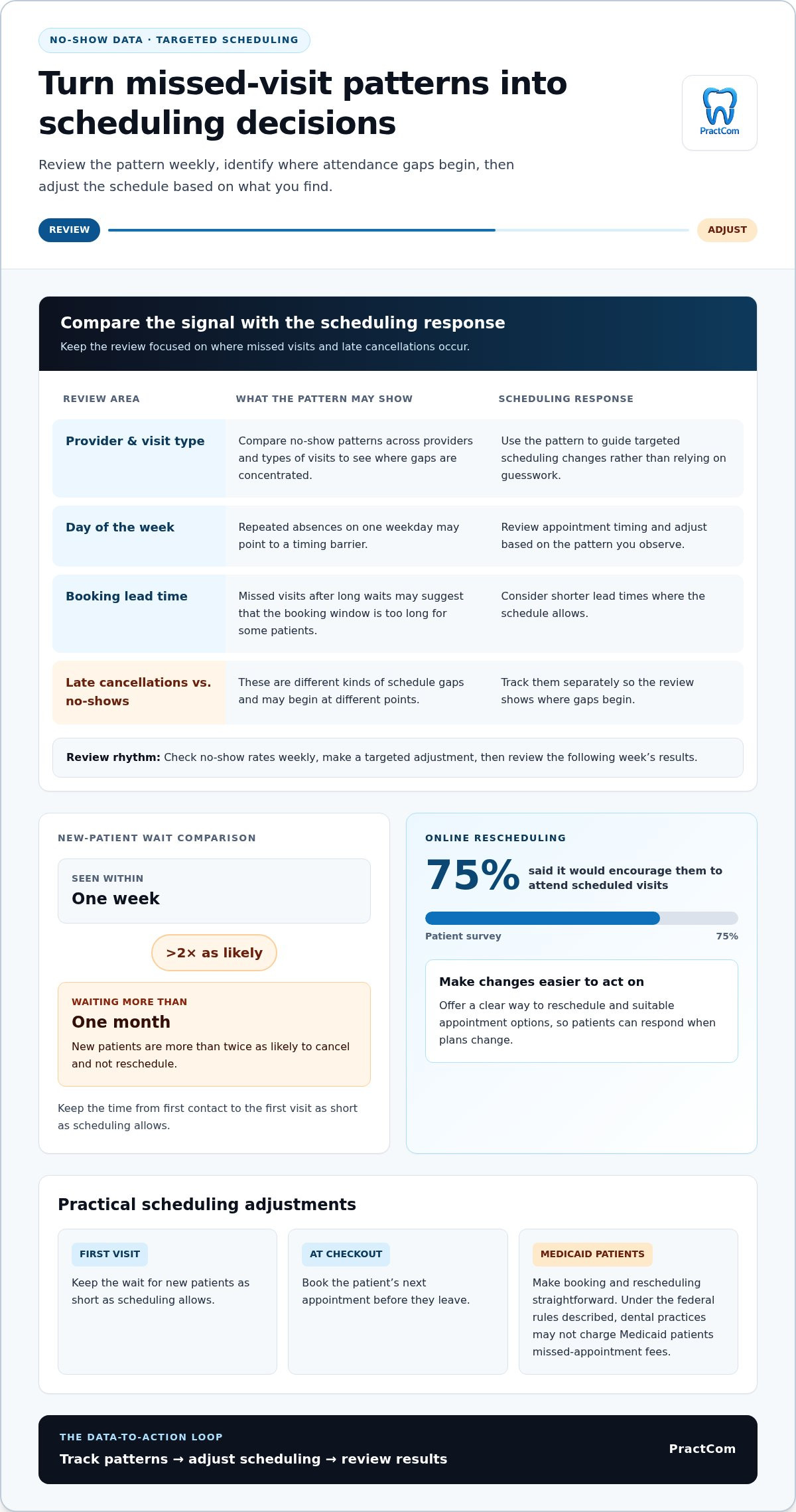
Review no-show rates weekly and compare patterns by provider, visit type, day of the week, and booking lead time. Track late cancellations separately from missed appointments to see where gaps begin. Repeated absences on one weekday, for instance, may point to a timing barrier; missed visits after long waits may suggest shorter booking lead times. Adjust scheduling based on the pattern, then review the following week’s results. This measured approach supports reducing dental patient no-shows through targeted changes rather than guesswork.
Pay particular attention to new patients: patients waiting more than one month for an initial appointment are more than twice as likely to cancel and not reschedule as patients seen within one week. Keep the time from first contact to the first visit as short as scheduling allows. At checkout, book the patient’s next appointment before they leave, making follow-through part of the visit rather than a task to remember later.
For new patients and patients with Medicaid, make booking straightforward, offer suitable appointment options, and provide a clear way to reschedule. Dental practices may not charge Medicaid patients missed-appointment fees under the federal rules described. Focus instead on clear communication and access, and use the same respectful process when attendance concerns arise. Reducing dental patient no-shows starts with identifying barriers and making the next step manageable for each patient.
Online rescheduling can help patients act as soon as plans change. In a patient survey, 75% said online rescheduling would encourage them to attend scheduled visits. Review how cancellations happen, then adjust scheduling practices based on the patterns. A short review of booking data can reinforce decisions about appointment timing and improve schedule stability. For a more organized view of practice communications, explore a dental practice communication workflow.
3. What reminder systems work best for reducing patient no-shows?
Use automated reminders for consistency, then add personal calls where follow-through needs attention. Verify each patient’s contact details and preferred reminder method at every check-in. Set automated messages to arrive on schedule, and record whether each courtesy call is complete. A clear workflow prevents staff from relying on memory during a busy clinic day. One patient survey found that 40% wanted more appointment reminders, so ask patients which channel they prefer.
Courtesy calls add a personal touch that automated messages can’t provide. Call new patients three to five business days before their visit to confirm details, offer help with directions or forms, and identify missing records or radiographs. For higher-risk or high-value appointments, make a personal confirmation call the day before. Keep the conversation focused: confirm the visit, answer practical questions, and explain how to contact the practice to reschedule.
Make reminders two-way. Ask patients to confirm and give them a simple option to request a call or change their appointment. Their response helps staff distinguish confirmed visits from those needing follow-up. If a patient doesn’t respond, assign a staff member to call and record the outcome. Track replies and completed calls in the same system so the team can see what remains to be done.
Digital reminders and patient portals can give patients a consistent place to view appointments, complete forms, and request changes. Keep text and email messages discreet: identify the practice, share essential appointment details, and leave out sensitive clinical information. Use clear wording and check each recipient’s preferred contact method. This creates a practical reminder process that supports clarity without burdening patients with unnecessary details.
4. Cancellation policies and patient fees
A written policy reduces uncertainty by telling patients what to do before plans change. Explain the notice period, how to cancel or reschedule, and what happens after a missed visit. A sample policy asks patients to provide at least 24 hours’ notice. Apply the stated process consistently, while allowing staff to consider emergencies or unforeseen circumstances.
In the United States, rules can depend on a patient’s coverage. The federal rules described here prohibit charging Medicaid patients missed-appointment fees; Medicare allows fees when the policy applies equally to all patients. Explain the policy before charging and make sure patients can understand its terms. This does not replace checking the requirements that apply to your practice.
Dental practices may consider a fee for cancellations made with less than 24 or 48 hours’ notice. There is no single typical amount to state here; the fee depends on the practice’s written policy and notice window. State the exact charge directly in your own policy, rather than surprising patients after a missed appointment.
Explain the policy before patients book. Include it in new-patient paperwork, display friendly signage at the front desk or in the waiting room, and reinforce it on appointment cards, the practice website, and reminder messages. Use plain language so patients know how to cancel and whom to contact. Consistent communication supports efficiency and gives patients a fair chance to act.
For a high-value appointment, explain any deposit or prepayment terms before booking. State what happens if the patient cancels, reschedules, or doesn’t arrive, and document that the patient received the terms. No single deposit rule or amount applies to every appointment based on the information here, so make the terms clear and consistent with the practice’s policy.
Start a proactive conversation when a patient is unsure about attending. Ask what might prevent them from coming, offer a suitable rescheduling option, and record the agreed next step. After a missed visit, contact the patient, explain any applicable charge, and offer a new appointment. This follow-up maintains a clear policy while giving the patient a practical way to return.
PractCom: Post-Treatment Instruction Library
PractCom’s Post-Treatment Instruction Library helps your team standardize the guidance patients receive after care. Clear follow-up communication supports continuity between visits, especially when patients need to understand next steps or prepare for a return appointment.
PractCom also offers Automated Patient Follow-ups and a Patient Portal. These tools support patient communication alongside appointment reminders and confirmation processes. Digital Informed Consent Forms help organize another part of the patient journey, with materials available through digital delivery.
Consider PractCom if your practice wants a more consistent way to share patient information and manage follow-ups. Its communication tools support these workflows, while your team remains responsible for scheduling and applying attendance policies. Explore PractCom’s patient communication platform to see how it can support your practice.
Make your next improvement deliberate
Reducing dental patient no-shows works best as an ongoing priority, not a one-time campaign. Treat each change as an operational test: define what a better patient experience should look like, listen to front-desk feedback, and keep the process simple enough to use during a busy clinic day. When staff understand why a step matters, they’re more likely to apply it consistently and notice where patients still encounter friction. Invite the team to share what works, then refine the workflow as needs change.
As your communication workflow develops, consider whether patients receive equally clear information before and after care. PractCom offers a Post-Treatment Instruction Library, Digital Informed Consent Forms, and a Referral Management System to support these parts of patient communication. The tools complement attendance processes without replacing your practice’s scheduling decisions.
Take the next step by discussing your practice’s communication needs with PractCom. Contact PractCom to discuss your practice. A more organized patient communication process starts with one practical improvement, and your team can build from there.
Frequently Asked Questions
Why Do Patients Cancel Dental Appointments?
Work conflicts, forgetfulness, and difficulty reaching the office to reschedule are common reasons patients cancel or miss visits. A patient may also be unsure what an appointment involves or how much time to set aside. Ask about obstacles when patients call to change a visit, then use their answers to address practical barriers before the next appointment.
How does this help reduce dental no-shows and improve performance?
A consistent attendance process gives your team clearer information about schedule gaps and their causes. Recording whether a patient canceled early, canceled late, or didn’t arrive, for example, helps distinguish a rescheduling issue from a reminder problem. Review those patterns alongside filled and unfilled appointment slots to plan staff time, prioritize follow-up, and make scheduling decisions based on actual practice activity.
How far in advance should you send appointment reminders?
A practical schedule is to send a reminder 48-72 hours before the visit, followed by another 24 hours beforehand. The earlier message gives patients time to flag a conflict, while the later one reinforces the reserved appointment. Include a clear way to confirm or request a change, so staff can respond before an opening becomes difficult to fill.
How much revenue do dental practices lose from no-shows?
There isn’t one reliable dollar figure for every practice. The impact depends on the appointment type, provider time reserved, staffing needs, and whether the opening can be filled. Estimate your practice’s exposure by comparing missed visits with unfilled chair time and the production normally associated with those appointments. Track late cancellations separately, since they may leave less time to backfill.
Is it possible to predict high-risk patients?
Past attendance patterns can help identify appointments that may need closer follow-up, but they shouldn’t replace individual judgment. Review each patient’s cancellation and attendance history alongside factors such as long booking waits or difficulty finding a suitable time. Use those signals to offer a more workable appointment or a personal check-in, rather than assuming a previous missed visit will happen again.
What is a courtesy call, and how does it reduce dental no-shows?
A courtesy call is a personal phone call before an appointment to confirm details and answer questions. Unlike an automated reminder, it lets staff clarify practical issues, such as where to find forms or how to contact the office about a change. Log the call outcome in the patient record, including whether the visit was confirmed or needs follow-up.

Article by
Cary Ganz DDS
Dr. Cary H. Ganz is a dentist, prosthodontist, entrepreneur, lecturer, and author with more than 50 years of experience in clinical dentistry and dental technology. Throughout his career, he has combined hands-on patient care with a deep understanding of how technology can improve dental practice operations, communication, documentation, and patient outcomes.
In addition to his clinical background, Dr. Ganz has held significant leadership roles in the dental technology industry, including Past Owner and Vice President of Clinical Affairs at DEXIS Digital Radiography and Past Vice President of Clinical Affairs at Denticon Practice Management Software. His business experience includes product development, clinical strategy, dental software innovation, practice management solutions, and educating dental professionals on the effective use of technology in modern dentistry.
Today, Dr. Ganz continues to focus on creating practical technology solutions for dental practices, including PractCom, a comprehensive dental practice communication platform designed to improve patient communication, documentation, compliance support, referrals, and overall practice efficiency. His work reflects a career-long commitment to helping dentists deliver better care while making their practices more organized, efficient, and protected.
No responses yet