
A feedback form that disappears into an inbox won’t improve a patient’s experience. Post-appointment feedback for dental patients is useful when patients can share it easily and your team has a clear process for reviewing responses and deciding what to do next.
Asking for feedback can feel like one more task for an already busy front desk. Low response rates can also make it difficult to tell whether a comment points to a wider pattern or a single appointment. The solution isn’t simply to ask more often. Build a repeatable process that fits your workflow and closes the loop with patients and staff.
This guide explains how to choose the right moment and channel, ask focused questions, encourage useful responses, and organize comments for regular review. You’ll also learn how to respond respectfully and turn recurring themes into practical improvements. Patient communication tools can help with routine follow-up, while your practice defines how feedback is collected and reviewed. The goal is to gather relevant insight without disrupting care, then make sure it leads somewhere.
Key Takeaways
- Build post-appointment feedback for dental patients into a clear workflow, from setting a goal to assigning someone to review and respond.
- Choose a request window and question format that suit the appointment, patient needs, and front-desk routine.
- Compare text, email, portal, and printed requests to find a channel that balances convenience, accessibility, and staff effort.
- Look for recurring themes across responses, then assign follow-up steps instead of reacting to a single comment in isolation.
- Use communication tools to support a consistent process, while keeping feedback collection, privacy review, and patient follow-up clearly defined.
Why post-appointment feedback matters for dental patients and practices
Post-appointment feedback for dental patients is their account of how an appointment felt and functioned: whether communication was clear, they felt comfortable, instructions made sense, and the overall experience met their expectations. It offers a patient perspective on parts of care that may not appear in the clinical record.
Patient feedback is an account shared with the practice for learning and follow-up; a public review is an online statement intended for other readers. Keep the purposes distinct. While platforms like hey-kleos.com help service professionals cultivate verified reviews and word-of-mouth referral networks, a private feedback request can invite detail about an interaction or process, while a public rating is visible beyond the practice and may not provide enough context to explain what happened. Tell patients how their comments will be used and who may review them. Don’t imply anonymity or confidentiality unless your process supports it.
Specific comments can point to friction worth examining. A patient might say they weren’t sure which post-treatment instructions applied to them, or that they waited without knowing about a delay. One response doesn’t establish a pattern or represent every patient. Treat it as a signal to review, not a verdict. A basic understanding of feedback helps frame comments as information that can guide a response, rather than a score to collect and file away.
What should a dental feedback process help you learn?
Start with one clear question. Are you trying to understand whether patients found post-treatment instructions easy to follow, or whether appointment updates were timely? A focused goal helps you choose relevant questions and compare responses about the same experience. It also clarifies what to do next. If patients repeatedly mention unclear instructions, for example, review how those instructions are explained and delivered.
Keep experience feedback separate from clinical assessment. A comment about discomfort, symptoms, or a treatment concern may need review by a clinician. A survey response should not be used to diagnose or determine a clinical outcome. Direct those concerns through an appropriate clinical follow-up process.
Why patient-centered feedback needs a clear purpose
Some patients may hesitate to raise a concern during an appointment. They may feel rushed, find it difficult to speak candidly face-to-face, or assume their comment won’t change anything. A respectful request after the visit gives them another opportunity to share what stood out, without putting them on the spot while care is underway.
Explain why you’re asking, keep questions specific, and make it easy to skip anything a patient doesn’t want to answer. “Was it clear what to expect after your visit?” invites a more useful response than “Were you satisfied?” The goal isn’t to secure praise or promise better outcomes. It’s to hear patients fairly, identify possible improvements, and decide what deserves attention.
How to build a repeatable post-appointment feedback process
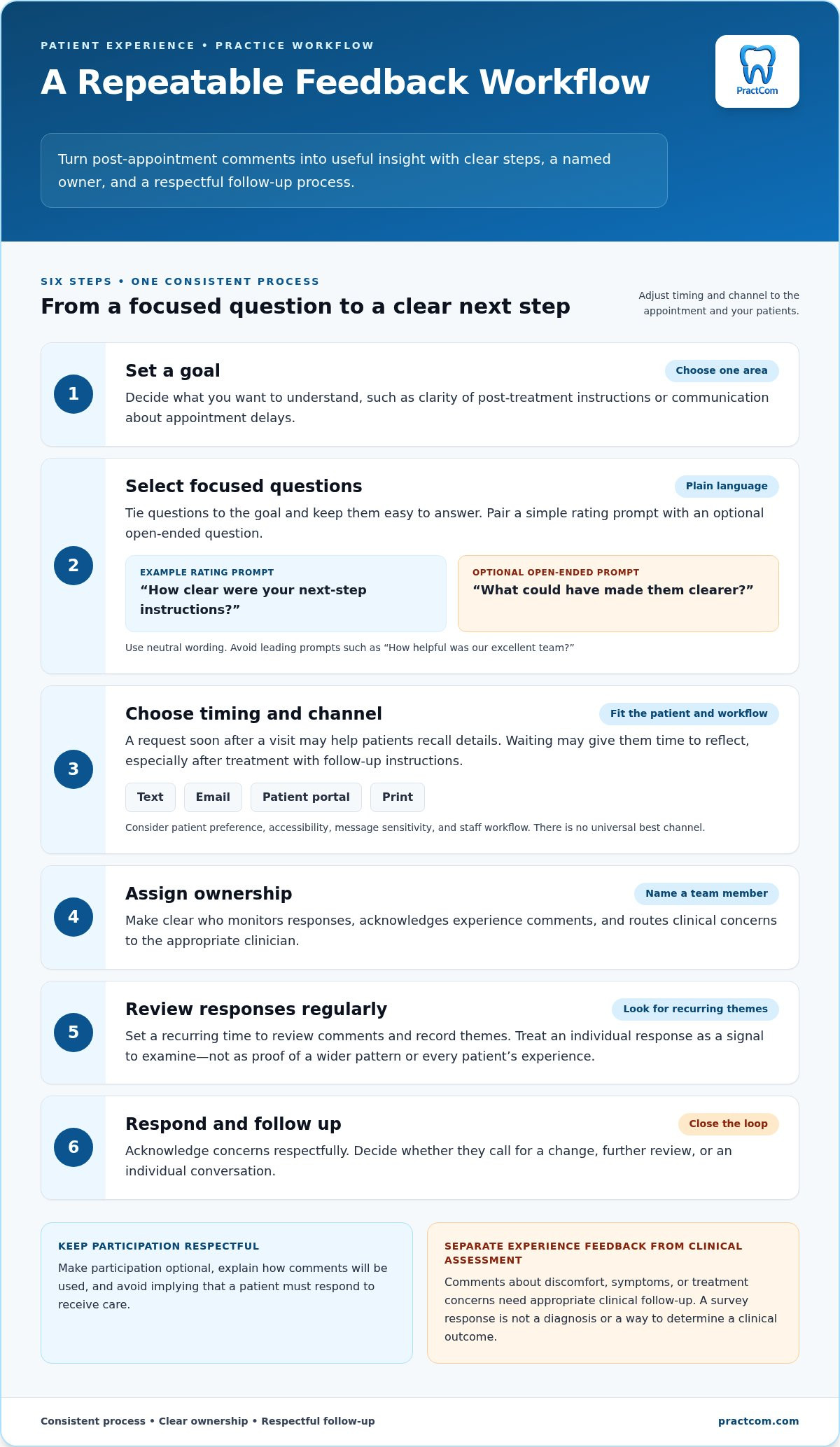
A reliable process doesn’t need to add a complicated task to the front desk’s day. It needs clear steps, a named owner, and a request patients can answer without pressure. Use the same basic workflow each time, then adjust timing or channel to suit the appointment and your patients.
- Set a goal. Choose one area to learn about, such as clarity of post-treatment instructions or communication about appointment delays.
- Select questions. Keep them focused on that goal and use plain language patients can answer quickly.
- Choose a channel. Consider text, email, a patient portal, or print based on patient preference, accessibility, message sensitivity, and staff workflow.
- Assign ownership. Name the team member who will monitor responses and route clinical concerns to the appropriate clinician.
- Review responses. Set a recurring time to look for patterns and record themes, rather than treating each comment as representative of every patient.
- Respond and follow up. Acknowledge concerns respectfully and decide whether they call for a change, further review, or an individual conversation.
Consistency makes feedback easier to interpret. The American Dental Association’s guidance on patient satisfaction surveys can help practices think through how to structure a useful request. Make participation optional, explain how comments will be used, and avoid implying that a patient must respond to receive care.
Choose questions patients can answer clearly
Use a small set of questions tied to your goal. Pair a simple rating prompt, such as “How clear were your next-step instructions?”, with one optional open-ended question: “What could have made them clearer?” Avoid leading wording like “How helpful was our excellent team?” A neutral prompt gives patients room to describe their experience and gives staff a more meaningful response to review.
Set timing, channel, and responsibility
Sending a request soon after a visit may help patients recall details. Waiting can give them time to reflect, especially after treatment that involves follow-up instructions. Choose a consistent window, then adapt it to appointment type and workflow. There’s no universal best channel: text may be convenient for some, while email, a portal, or a printed request may suit others. Assign a team member to check responses on an agreed schedule, acknowledge experience comments, and route clinical concerns promptly through the practice’s established process.
Trust depends on what happens after the request, not just how it’s delivered. Clear explanations and consistent follow-up support an organized patient experience. Automated follow-ups and a patient portal can help structure routine interactions. To see how communication infrastructure can support that broader process, explore PractCom’s patient communication platform.
Compare feedback channels and question formats for dental patients
The right channel is one patients can use comfortably and your team can manage consistently. For post-appointment feedback for dental patients, weigh patient preference, accessibility, staff effort, and the sensitivity of the message. No single option suits every person or appointment. A brief experience prompt may fit a text, while a longer explanation or a patient who prefers paper may call for another route.
| Channel | Convenience | Accessibility | Staff effort |
|---|---|---|---|
| Text | Easy to send as a brief prompt or link | Useful for patients who prefer mobile messages; keep wording concise | Can be efficient when sending is part of an established workflow; responses still need review |
| Allows a fuller explanation and a link to a form | Works for patients who use email and want more context | Requires a process to monitor replies or submitted forms | |
| Patient portal | Keeps the request within an existing patient communication channel | Best suited to patients comfortable accessing the portal | Depends on staff having a clear way to check and route comments |
| Printed request | Can be offered during or after the visit | Provides a non-digital option and may suit patients who prefer paper | Requires handling and a plan for collecting and reviewing responses |
When should a practice use text, email, a portal, or print?
Use text for a short, neutral prompt, not a lengthy questionnaire. Email can explain why you’re asking and direct patients to a feedback form. A portal may suit patients who already use it for practice communication, while print offers an alternative for people who prefer not to respond digitally. Choose based on how patients can access the channel and how your team will handle replies, not on assumptions about response rates.
Consider sensitivity, too. A general question about whether instructions were clear differs from a message that invites details about a personal health concern. Keep requests focused, explain where a response goes, and direct clinical issues to the practice’s established care pathway.
Which feedback questions produce actionable answers?
A structured rating helps you compare responses to the same question over time. An open-ended prompt adds context, such as what made instructions confusing or what helped a patient feel comfortable. Keep wording neutral: “Did you feel your questions were heard?” is more useful than wording that presumes a positive answer. Ask about listening, explanations, comfort, or next steps, and limit each request to the areas you intend to learn about.
Keep experience feedback separate from treatment decisions, informed consent documentation, and clinical assessment. Public review requests serve a different purpose: they invite a public account for other readers, not private process feedback. If you’re evaluating communication tools to support consistent patient interactions, review PractCom’s communication platform comparison. Communication tools can support routine interactions, while your practice defines its questions, review ownership, and follow-up process.
How to review responses, address concerns, and close the loop
Collecting comments is only the start. A clear review routine helps your team distinguish an individual concern from a recurring source of friction, decide who should follow up, and track whether a change was made. Set a regular review cadence that fits your practice, such as a scheduled team check-in, and assign one person to organize incoming responses. Clear ownership keeps feedback from becoming an inbox no one is responsible for.
Use consistent categories, such as communication, comfort, waiting, and clarity of next steps. Note the appointment context where relevant, but avoid drawing conclusions from one comment or comparing unlike experiences as if they were the same. A concern about an explanation may call for a communication review. A concern about symptoms or treatment needs clinician attention through established practice procedures.
How should a dental team respond to positive and critical feedback?
Respond with respect, whether a patient is thanking the team or describing a frustrating experience. A simple acknowledgment shows that the comment was received without promising a specific outcome. Keep public replies general and don’t disclose or confirm personal or clinical details. If a response needs patient-specific discussion, move it to an appropriate private channel and follow your practice’s usual communication process. Avoid defensiveness. The aim is to understand the concern, not win an argument.
How can feedback become a manageable improvement cycle?
Review themes alongside operational context, such as appointment type, staff handoffs, or how instructions were delivered. A repeated comment about uncertainty may point to a process worth examining, but feedback alone doesn’t establish the cause. While organizations conducting formal behavioral research often rely on specialized observation software from providers like ergoneers.com, a dental team can start by tracking basic workflow trends. Choose one practical action, name an owner, and set a date to check whether the change was completed and whether the concern continues to appear.
Keep a simple improvement log so decisions survive busy weeks and staff changes. For each theme, record:
- What the comments suggest: Summarize the recurring issue without unnecessary patient details.
- What the team will change: Define a manageable action, such as revising how staff explain next steps.
- Who owns the follow-through: Assign one person to coordinate the action and report back.
- When to review it: Set a date to assess whether the change happened and consider what the next feedback shows.
Close the loop with patients when appropriate. Thank them for sharing, acknowledge the issue in plain language, and explain any relevant next step without exposing confidential information. For post-appointment feedback for dental patients to support a dependable workflow, the practice also needs communication processes staff can use consistently. Explore PractCom’s patient communication tools as part of organizing routine patient communication and follow-up.
Choose communication tools that support a consistent dental feedback workflow
A communication tool can make routine messages easier to manage, but your practice still needs to decide what it wants to learn, who reviews comments, and how concerns are handled. Treat feedback collection as a workflow, not simply a feature or a request for a public rating. Before selecting tools, map the steps from sending a request to recording a response and deciding what happens next.
What should a practice evaluate before adopting a feedback process?
Check that the process fits the way your team already communicates with patients. A channel that’s easy to use for sending but difficult to monitor can create another unattended inbox. Build a short checklist and review it with the people who will manage the work:
- Channel fit: Can patients access the chosen option, and does it fit existing communication routines?
- Staff ownership: Is it clear who sends requests, checks replies, categorizes feedback, and responds?
- Accessibility: Is there an alternative for patients who can’t or prefer not to use the primary digital channel?
- Privacy review: Have appropriate staff reviewed what information is requested, where it goes, and how it’s handled?
- Follow-up steps: Does the team know how to acknowledge a concern and route a clinical issue through established procedures?
Privacy and documentation practices deserve deliberate review. Consider what details a feedback request needs, limit unnecessary collection, and consult appropriate compliance guidance for your practice. A communication tool alone does not determine whether a particular process meets your obligations.
Where can PractCom fit in post-appointment communication?
PractCom provides communication and documentation tools for dental practices. Automated patient follow-ups and a patient portal can support consistent communication around appointments. The library of more than 80 post-treatment instruction templates helps practices provide organized aftercare information. Documents can be delivered by email, text, or print in 15 languages, giving practices options for sharing routine patient information.
PractCom also offers digital informed consent forms, referral management, physical document printing, and a performance dashboard. These tools support patient communication and practice workflows. Your team can define its feedback questions, collect responses through its chosen process, and review comments using the ownership and follow-up steps established by the practice.
Use the checklist to identify where your current routine breaks down, whether requests are missed, responses lack an owner, or accessibility options are limited. Then select communication tools that support the workflow you’ve defined, rather than expecting software to supply the process. To explore a more organized patient communication workflow, see how PractCom can support your practice’s communication needs.
Make patient feedback part of the care experience
A feedback process works best when patients know their perspective is welcome and your team knows what to do with it. Start with one manageable improvement: choose a specific point in the patient journey, invite comments respectfully, and set a time to review what you hear. A small, repeatable step can make listening part of your practice’s routine rather than an occasional project.
As your process takes shape, consider whether your communication tools support the follow-through around feedback. PractCom brings patient communication and documentation tools together to support a more organized experience, while your team defines how comments are collected, reviewed, and acted on. A clear process helps post-appointment feedback for dental patients become practical input for thoughtful improvement, not another task that gets lost in a busy day.
Explore PractCom’s patient communication platform to support a more organized patient communication workflow. Your team can build a process that fits its practice and keeps patient voices in view.
Frequently Asked Questions
How soon after a dental appointment should you ask for patient feedback?
Ask when the patient has had time to experience what you want to learn about and your team can review replies promptly. For a checkout or scheduling question, a request soon after the visit may be useful. For feedback about following post-treatment instructions, allow time for the patient to use them. Choose a consistent window for each appointment type, and avoid sending requests when no one is available to monitor concerns.
What questions should a dental practice ask in a post-appointment feedback survey?
Ask a few neutral questions tied to one clear goal, then include one optional open response. For example, you might ask whether the patient understood the treatment options discussed, felt listened to, or understood the next steps. An optional prompt such as “What could we have explained differently?” can add context. Avoid combining several topics in one question, since the answer may be hard to interpret.
Should dental practices ask for feedback by text or email?
Text suits a brief invitation or short prompt, while email gives you more room to explain the request and provide context. Neither channel is automatically best. Consider how patients prefer to receive practice messages and whether your team can monitor replies in that channel. If you use text, keep the message concise. If you choose email, make the request easy to find and answer.
How can a dental office encourage patients to respond to feedback requests?
Keep the request brief, explain why you’re asking, and send it at a respectful time. Let patients know participation is optional and that honest comments are welcome. Offer an accessible alternative for people who don’t use the primary channel, such as a printed form. Avoid repeated reminders or language that pressures patients to respond positively. A straightforward invitation makes it easier for people to decide whether they want to share their perspective.
What should a dental practice do with negative patient feedback?
Review critical feedback calmly before deciding what it means. Thank the patient for raising the concern, then handle patient-specific details through an appropriate private channel rather than debating them publicly. If the comment raises a clinical or urgent issue, route it through the practice’s established procedures. Record the general theme without unnecessary personal detail, and check whether similar concerns recur before making a broader workflow change.
Is patient feedback the same as an online dental review?
No. Patient feedback is generally requested to help the practice understand an experience and identify questions or processes to examine. An online review is public commentary intended for a broader audience. The distinction affects how you use and respond to each: private feedback can support internal learning, while public replies should stay general and avoid discussing or confirming personal treatment details.
How can dental practices protect patient privacy when requesting feedback?
Keep the request focused on the experience you want to understand, and avoid including treatment details in a message subject line or brief notification. Don’t invite patients to share more sensitive information than the process needs. Review who can access responses, how they’re stored, and how concerns are routed. Have qualified compliance guidance inform your communication and documentation practices, since privacy requirements can depend on the specific workflow and information involved.

Article by
Cary Ganz DDS
Dr. Cary H. Ganz is a dentist, prosthodontist, entrepreneur, lecturer, and author with more than 50 years of experience in clinical dentistry and dental technology. Throughout his career, he has combined hands-on patient care with a deep understanding of how technology can improve dental practice operations, communication, documentation, and patient outcomes.
In addition to his clinical background, Dr. Ganz has held significant leadership roles in the dental technology industry, including Past Owner and Vice President of Clinical Affairs at DEXIS Digital Radiography and Past Vice President of Clinical Affairs at Denticon Practice Management Software. His business experience includes product development, clinical strategy, dental software innovation, practice management solutions, and educating dental professionals on the effective use of technology in modern dentistry.
Today, Dr. Ganz continues to focus on creating practical technology solutions for dental practices, including PractCom, a comprehensive dental practice communication platform designed to improve patient communication, documentation, compliance support, referrals, and overall practice efficiency. His work reflects a career-long commitment to helping dentists deliver better care while making their practices more organized, efficient, and protected.
No responses yet