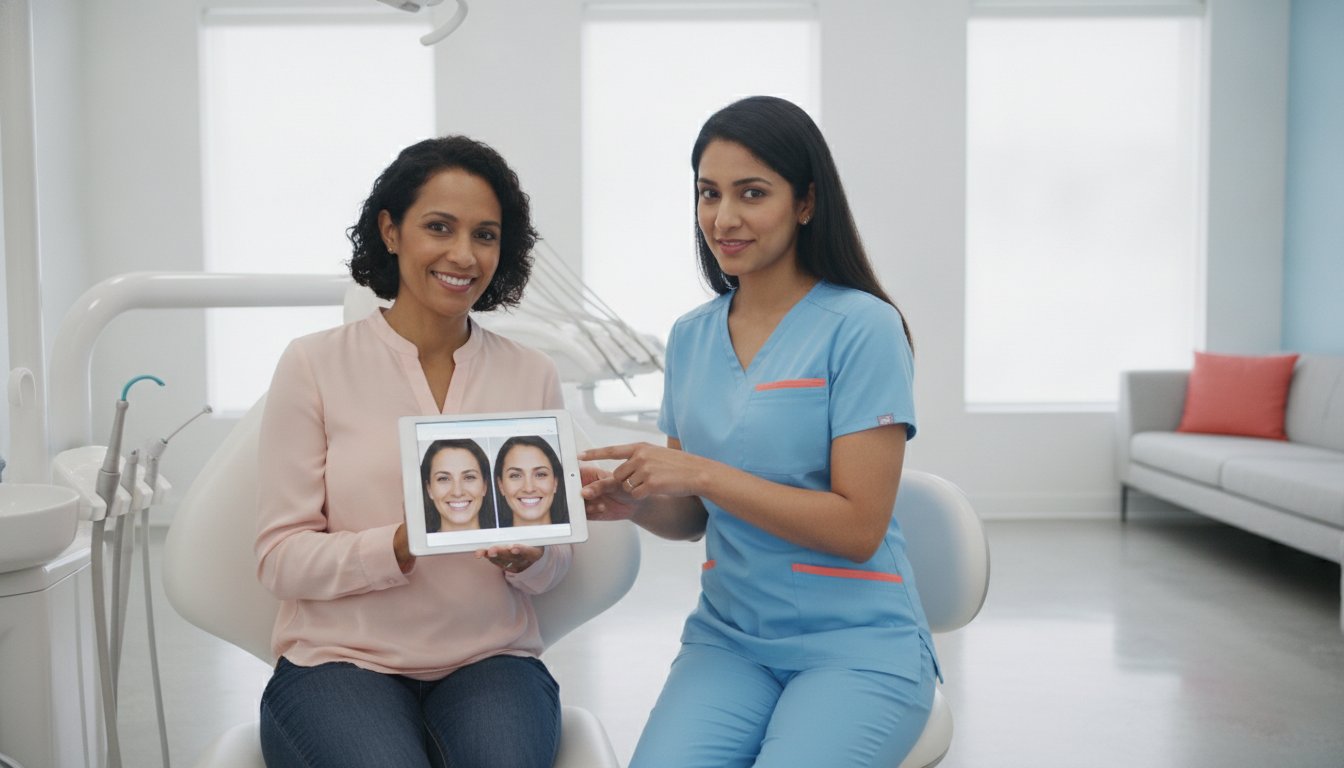
What if the primary barrier to your high-value cosmetic cases isn’t the cost, but a fundamental gap in visual communication? It’s a common stressor in the modern clinic to see a patient hesitate on a transformative veneer or Invisalign plan simply because they can’t bridge the distance between your verbal explanation and their future reflection. Utilizing a virtual smile try-on for dental patients effectively solves this by replacing abstract promises with a tangible, digital reality. You understand that when a patient struggles to visualize results, their default response is often a polite “let me think about it,” which stalls your practice growth and leaves potential health benefits on the table.
This approach standardizes your consultation process and reduces patient anxiety through immediate visual reassurance. In this 2026 guide, you’ll discover how to leverage smile simulations to boost case acceptance and create a seamless clinical workflow that integrates with your documentation. We will examine the transition from initial digital visualization to formal informed consent; this ensures your practice remains both efficient and compliant while delivering the aesthetic results your patients demand. You’ll learn to move from the resistance of manual tasks to the confidence of a standardized, tech-forward system.
Key Takeaways
- Overcome the “imagination tax” by replacing abstract verbal plans with tangible simulations that bridge the communication gap for cosmetic patients.
- Leverage the 2026 advancements in virtual smile try-on for dental patients to provide realistic 3D AI-generated results that build immediate clinical trust.
- Maximize your practice’s ROI by using visual tools to align patient expectations early, which reduces unproductive chair time during high-value cases.
- Connect initial smile designs to digital informed consent forms within a standardized workflow to protect your reputation and legal standing.
- Maintain case momentum after the try-on through automated follow-ups and a library of 80+ post-treatment instructions for superior patient outcomes.
The Mental Visualization Gap: Why Cosmetic Consultations Stall
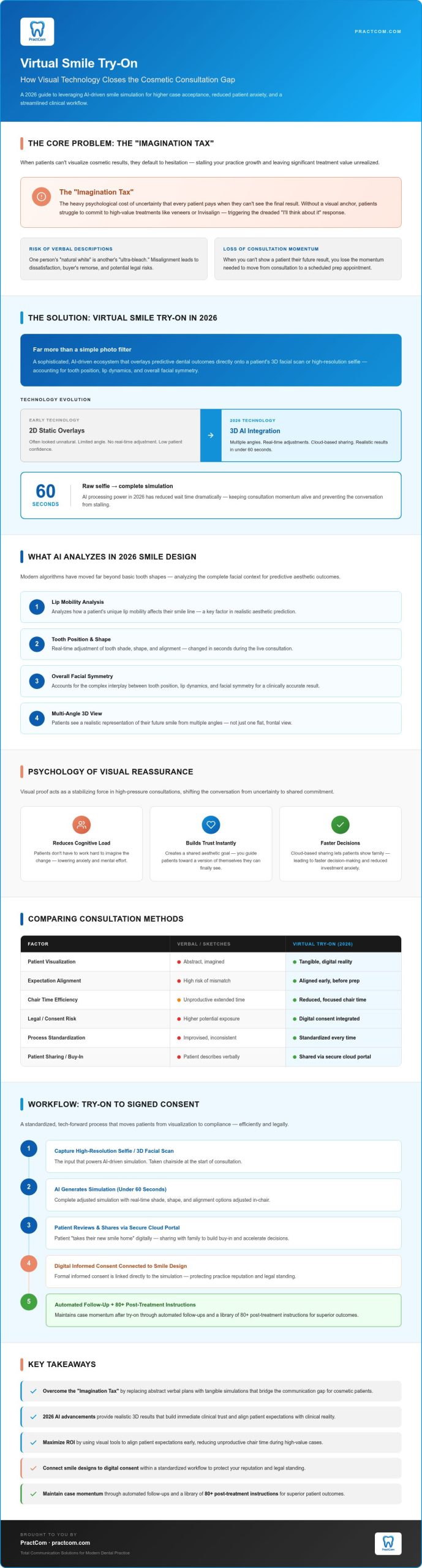
When a patient sits in your chair for a cosmetic consultation, they aren’t just evaluating a clinical procedure; they’re weighing a significant emotional and financial investment. The “Imagination Tax” is the heavy psychological cost of uncertainty that every patient pays when they can’t see the final result. Without a visual anchor, patients struggle to commit to high-value treatments like veneers or Invisalign. They can’t see the end result, so they hesitate. This hesitation often manifests as the dreaded “I’ll think about it” response. It’s a protective mechanism against the fear of a permanent change they can’t quite picture. Implementing a virtual smile try-on for dental patients bridges this gap immediately by replacing abstract promises with digital reality.
Relying on verbal descriptions or hand-drawn sketches is inherently risky. It leaves too much to chance and human error. One person’s definition of a “natural white” might be another’s “ultra-bleach.” This misalignment leads to dissatisfaction, buyer’s remorse, and potential legal risks. You understand that clinical necessity is only half the battle in cosmetic dentistry. The other half is meeting a patient’s aesthetic desire. When you can’t show them what that looks like, you lose the momentum required to move from a consultation to a scheduled prep appointment.
The Psychology of Aesthetic Commitment
Visual proof acts as a stabilizing force in high-pressure consultations. It moves the conversation from abstract clinical necessity to shared aesthetic goals. By showing a simulation, you reduce the cognitive load on the patient. They don’t have to work hard to imagine the change, which lowers their anxiety. This creates an immediate bond of shared professional experience. You aren’t just selling a service; you’re guiding them toward a version of themselves they can finally see. This psychological security is essential for moving a patient toward a firm commitment.
Standardization vs. Improvisation
Many practices rely on improvised visual aids or outdated physical portfolios. This lack of a system creates operational disorganization and undermines your professional authority. A standardized process using digital tools builds practice authority and signals that your clinic is forward-thinking and precise. You move from the resistance of manual, inconsistent explanations to the confidence of a standardized system. This consistency protects your reputation and ensures every patient receives the same high level of visual reassurance. You can learn more about how a standardized communication platform helps stabilize your practice operations.
What is Virtual Smile Try-On Technology in 2026?
In 2026, a virtual smile try-on for dental patients is far more than a simple photo filter. It represents a sophisticated, AI-driven ecosystem that overlays predictive dental outcomes directly onto a patient’s 3D facial scan or high-resolution selfie. While early iterations relied on static 2D overlays that often looked unnatural, modern technology utilizes 3D facial integration. This allows you to account for the complex interplay between tooth position, lip dynamics, and overall facial symmetry. It’s a clinical communication bridge that transforms a patient’s vague desires into a precise, visual roadmap.
The transition from 2D to 3D means patients see a realistic representation of their future self from multiple angles. This depth of visualization is critical for establishing trust. You can perform real-time adjustments during the consultation, changing tooth shade, shape, and alignment in seconds. This speed prevents the momentum of the consult from stalling. Because these tools are cloud-based, patients can “take their new smile home” digitally via a secure portal. This allows them to share the vision with family, which often leads to faster decision-making and reduced anxiety about the investment.
The Role of AI in 2026 Smile Design
Modern algorithms have moved beyond basic tooth shapes. They now analyze how a patient’s unique lip mobility affects their smile line. AI-driven smile simulation is a tool for predictive aesthetic outcomes that aligns patient expectations with clinical reality. The processing power available in 2026 has reduced the wait time significantly. You can now move from a raw selfie to a complete, adjusted simulation in under 60 seconds. This efficiency mirrors the streamlined workflow your modern practice requires, allowing you to spend more time on clinical strategy and less on technical troubleshooting.
Multi-Language Accessibility
A visual simulation is powerful, but it must be paired with clear, verbal understanding. Explaining complex cosmetic changes in a patient’s native tongue is not just a courtesy; it’s a professional necessity for informed consent. PractCom supports this inclusive communication by offering documentation and follow-ups in 15 different languages. This ensures that every patient, regardless of their primary language, feels fully informed and secure in their choice. Understanding why PractCom’s multi-language support matters helps you eliminate the communication barriers that often lead to administrative failures. If you are ready to see how these tools fit into your clinical routine, you can explore our integrated platform today.
The ROI of Visual Reassurance: Comparing Try-On Methods
Implementing a virtual smile try-on for dental patients isn’t a marketing gimmick; it’s a calculated clinical strategy to drive practice ROI. When you quantify the impact, the data often reveals a stark contrast between consultations that use visual aids and those that rely on verbal descriptions alone. By providing visual reassurance, you bridge the communication gap that typically stalls high-value cases. This alignment on goals happens before the first prep, which significantly reduces unproductive chair time. You don’t want to spend expensive clinical hours adjusting a patient’s expectations when those expectations could have been solidified during the initial consult.
Beyond the clinical benefits, there is a distinct marketing value. Patients who feel excited about their simulated results are likely to share these visuals on social media, acting as organic ambassadors for your practice. This creates a baseline for clinical documentation that protects your reputation. You can use the initial simulation to demonstrate the progress made, providing a clear “before and after” narrative that reinforces the value of your work. This systematic approach ensures that the patient remains committed to the treatment plan from the first visit to the final reveal.
Selfie-Based vs. Intraoral Scan Simulations
A selfie-based virtual smile try-on for dental patients serves as a low-friction entry point for initial engagement. It’s an ideal tool for middle-of-the-funnel interactions where a patient is curious but not yet ready for an intensive clinical scan. While an intraoral scan offers greater clinical depth for full digital wax-ups, the selfie simulation provides immediate gratification. Balancing speed and accuracy in the consultation room is vital. You should use the selfie to capture interest and the scan to finalize the clinical roadmap. This tiered approach ensures you don’t overwhelm the patient too early while still maintaining technical precision.
Measuring Practice Growth
Tracking the conversion funnel from the first simulation to the signed consent form is essential for justifying your tech investment. You need to see exactly where patients drop off to refine your standardized consultation process. Integrating these metrics into a practice performance dashboard allows you to move from operational disorganization to systematic control. For a deeper look at streamlining these processes, see our guide on optimizing dental practice workflow. This oversight ensures that your communication tools are functioning as a professional necessity rather than just an added expense. By monitoring these trends, you can identify which cosmetic procedures are resonating most with your patient base and adjust your clinical focus accordingly.
Workflow Integration: From Virtual Try-On to Signed Consent
A successful clinical workflow transforms the virtual try-on from a novelty into a standardized system for case acceptance. It begins with the “Hook.” You invite patients to upload a high-resolution selfie through a secure portal before they even arrive at the practice. This pre-consultation engagement sets the stage for a collaborative design session. During the appointment, you use the virtual smile try-on for dental patients to adjust parameters like incisal edge length and shade in real-time. This interactive phase builds the patient’s psychological security by making them an active participant in their own treatment planning. It replaces the resistance of manual explanations with the confidence of a shared visual goal.
The most critical phase is the “Compliance Bridge.” You must link the agreed-upon simulation directly to your documentation ecosystem to ensure that the aesthetic goal is anchored by a formal agreement. Once the patient is satisfied with the visual outcome, you can immediately generate digital dental informed consent forms that reference the specific design. Finally, the “Automated Follow-up” maintains momentum. Sending the simulation and post-operative expectations via SMS ensures the vision remains top-of-mind long after they leave the office. This creates a comprehensive ecosystem where no part of the communication process is left to chance.
Mitigating Risk with Digital Documentation
A simulation is a powerful communication tool, but it must be paired with a clear explanation of clinical limitations. You protect your reputation and legal standing by standardizing the “expectation talk” through automated templates. These templates clarify that the simulation is a predictive guide rather than a guaranteed medical outcome. This systematic oversight alleviates the anxiety of practitioners regarding documentation and potential compliance failures. By moving from improvised verbal warnings to a standardized system, you establish yourself as a protective and forward-thinking professional ally.
Post-Simulation Communication
Reducing administrative friction is the primary goal of any modern practice. Automating the next steps, such as follow-up reminders and educational resources, ensures that the patient doesn’t lose interest during the “thinking” phase. Using SMS to keep the “new smile” top-of-mind acts as a pre-emptive strike against common administrative failures. If you have common questions about dental communication tech, reviewing our standardized resources can provide the technical precision you need. To begin standardizing your own cosmetic workflow and reducing operational resistance, you can start your integrated communication trial today.
PractCom Smile Design: A Total Communication Solution
PractCom provides a comprehensive patient communication platform that moves beyond simple aesthetics. While a virtual smile try-on for dental patients acts as the initial “hook” for your cosmetic cases, our system ensures that this visual promise is backed by clinical documentation and systematic follow-ups. We integrate smile design directly into a secure patient portal, which allows you to manage the entire journey from the first selfie to the final restoration. This creates a stabilizing force in your practice, ensuring that no detail is lost to human memory or administrative disorganization. You aren’t just showing a picture; you’re building a professional roadmap.
The true power of the platform lies in its ability to connect these visuals to a library of over 80 post-treatment instruction templates. This ensures that once the aesthetic goal is achieved, the patient receives the technical guidance they need to maintain their results. Our support for 15 languages allows you to reach diverse national dental markets with technical precision and administrative warmth. By using PractCom, you position your brand as a protective and forward-thinking professional ally that values both accuracy and patient understanding. It’s a system designed to alleviate the anxiety of practitioners regarding documentation and compliance.
Efficiency Over Complexity
We designed our system to prioritize efficiency over complexity. PractCom is a specialized communication solution rather than a full Practice Management Software (PMS), making it an easy add-on that doesn’t require you to overhaul your existing clinical infrastructure. You can see how we stack up against other tools in our PractCom vs. Modento comparison. This focus allows us to provide a deeper level of oversight for informed consent and referral management, setting your practice up for national-scale communication excellence. We help you move from the resistance of manual tasks to the confidence of a standardized system.
Get Started with Visual Reassurance
Implementing PractCom in a high-pressure clinical environment is straightforward and logical. Our problem-solver persona anticipates common administrative failures, offering you a pre-emptive strike against operational resistance. You can start your free trial and transform your consults today to experience the confidence of a standardized system. This transition from manual tasks to automated oversight protects your reputation while driving significant practice growth. In the clinical landscape of 2026, visual communication is no longer an optional luxury but a professional necessity for every modern dental practice.
Transforming Consultations into Clinical Certainty
The transition from abstract verbal treatment plans to a standardized digital workflow is the hallmark of a successful 2026 practice. By implementing a virtual smile try-on for dental patients, you effectively eliminate the uncertainty that often stalls high-value cosmetic cases. You’ve seen how visual reassurance reduces patient anxiety and builds an immediate bond of shared professional experience. This technology isn’t just about the “before and after” picture; it’s about creating a comprehensive ecosystem where clinical necessity meets aesthetic desire.
PractCom serves as your reliable professional ally by providing the tools needed to stabilize your practice operations. With digital consent integration, 15-language support for all documents, and a library of 80+ post-treatment templates, we ensure your practice remains compliant and efficient. You can move from the resistance of manual tasks to the confidence of a systematic approach that protects your reputation. Scale your cosmetic case acceptance with PractCom and start building the future of your practice today. Your patients deserve the clarity that only modern visual communication can provide.
Frequently Asked Questions
Is virtual smile try-on accurate enough for clinical planning?
Virtual smile try-on for dental patients serves as a sophisticated communication bridge rather than a final clinical blueprint. While it provides a realistic predictive aesthetic outcome, you should use it to align expectations before moving to technical 3D scans. It replaces abstract verbal plans with a tangible digital reality. This ensures the patient understands the visual goal while you maintain control over the technical requirements for lab-side production.
How do I ensure patients don’t have unrealistic expectations after a simulation?
You manage expectations by pairing every simulation with standardized digital informed consent forms. PractCom allows you to link the visual design directly to documentation that outlines clinical limitations. This systematic approach ensures the patient understands the simulation is a predictive guide. By using automated templates to standardize the “expectation talk,” you protect your reputation and alleviate anxiety regarding compliance. It moves the conversation from a mere “fun” app to a professional necessity.
Can I use virtual smile try-on for Invisalign and veneers?
Yes, these tools are highly effective for both Invisalign and veneer consultations. They allow you to show potential tooth alignment and shade improvements in seconds. This visual reassurance is often the “hook” that increases case acceptance for high-value procedures. By bridging the mental visualization gap, you help patients commit to transformative treatments. It turns a complex clinical explanation into a clear, shared visual goal that feels achievable.
Does PractCom’s smile design tool integrate with my current PMS?
PractCom is a dedicated communication and documentation solution, not a full Practice Management Software (PMS). It’s designed to function as a specialized add-on that bridges the gaps common in traditional systems. You can use our platform alongside your current PMS to manage smile design, consent forms, and automated follow-ups. This focus on communication efficiency ensures you have a stabilized, high-utility ecosystem without the need to overhaul your entire clinical infrastructure.
How much time does it add to a standard consultation?
Modern AI processing is remarkably fast; it typically generates a full simulation from a selfie in under 60 seconds. Instead of adding a burden to your schedule, it actually saves time by reducing the “imagination tax” that causes consultations to stall. You spend less time explaining abstract concepts and more time on clinical strategy. This efficiency allows you to maintain a brisk, high-utility rhythm during your busy day.
Is the patient’s data secure when uploading photos for a simulation?
Patient data security is a fundamental part of our professional communication platform. All photos and scans are handled through a secure patient portal that prioritizes regulatory compliance. This systematic oversight protects your practice from administrative failures and ensures sensitive information remains private. You can offer visual reassurance to your patients with the confidence that their digital assets are protected by modern encryption and strict data management protocols.
What happens if a patient wants a result the AI suggests but I can’t clinically provide?
You should use the simulation as a collaborative design tool rather than a rigid promise. If the AI suggests an outcome that isn’t clinically viable, you can adjust the parameters in real-time during the consult. This interactive process allows you to explain anatomical constraints while still showing the best possible aesthetic result. It transforms you from a “seller” into a clinical guide, establishing a peer-to-peer bond through shared, realistic visual goals.
How do automated follow-ups work after the smile design session?
Automated follow-ups trigger immediately after the session, sending the simulation and relevant documentation via SMS or email. You can include specific resources from our library of over 80 post-treatment templates to keep the momentum going. These follow-ups ensure the “new smile” stays top-of-mind while reducing administrative friction for your team. It’s a pre-emptive strike against patient hesitation, providing the psychological security they need to move forward with their treatment plan.
Article by
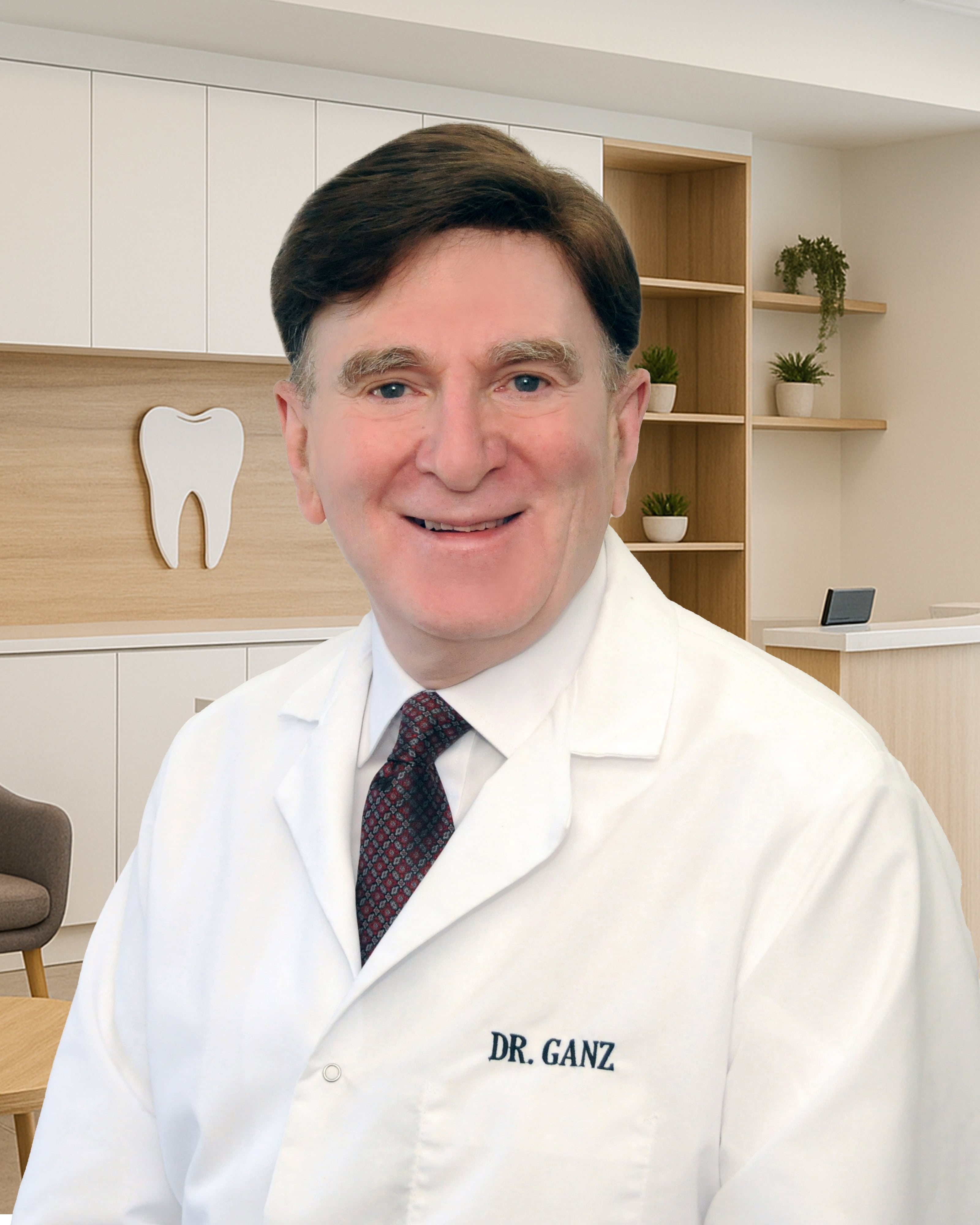
Cary Ganz DDS
Dr. Cary H. Ganz is a dentist, prosthodontist, entrepreneur, lecturer, and author with more than 50 years of experience in clinical dentistry and dental technology. Throughout his career, he has combined hands-on patient care with a deep understanding of how technology can improve dental practice operations, communication, documentation, and patient outcomes.
In addition to his clinical background, Dr. Ganz has held significant leadership roles in the dental technology industry, including Past Owner and Vice President of Clinical Affairs at DEXIS Digital Radiography and Past Vice President of Clinical Affairs at Denticon Practice Management Software. His business experience includes product development, clinical strategy, dental software innovation, practice management solutions, and educating dental professionals on the effective use of technology in modern dentistry.
Today, Dr. Ganz continues to focus on creating practical technology solutions for dental practices, including PractCom, a comprehensive dental practice communication platform designed to improve patient communication, documentation, compliance support, referrals, and overall practice efficiency. His work reflects a career-long commitment to helping dentists deliver better care while making their practices more organized, efficient, and protected.
No responses yet