
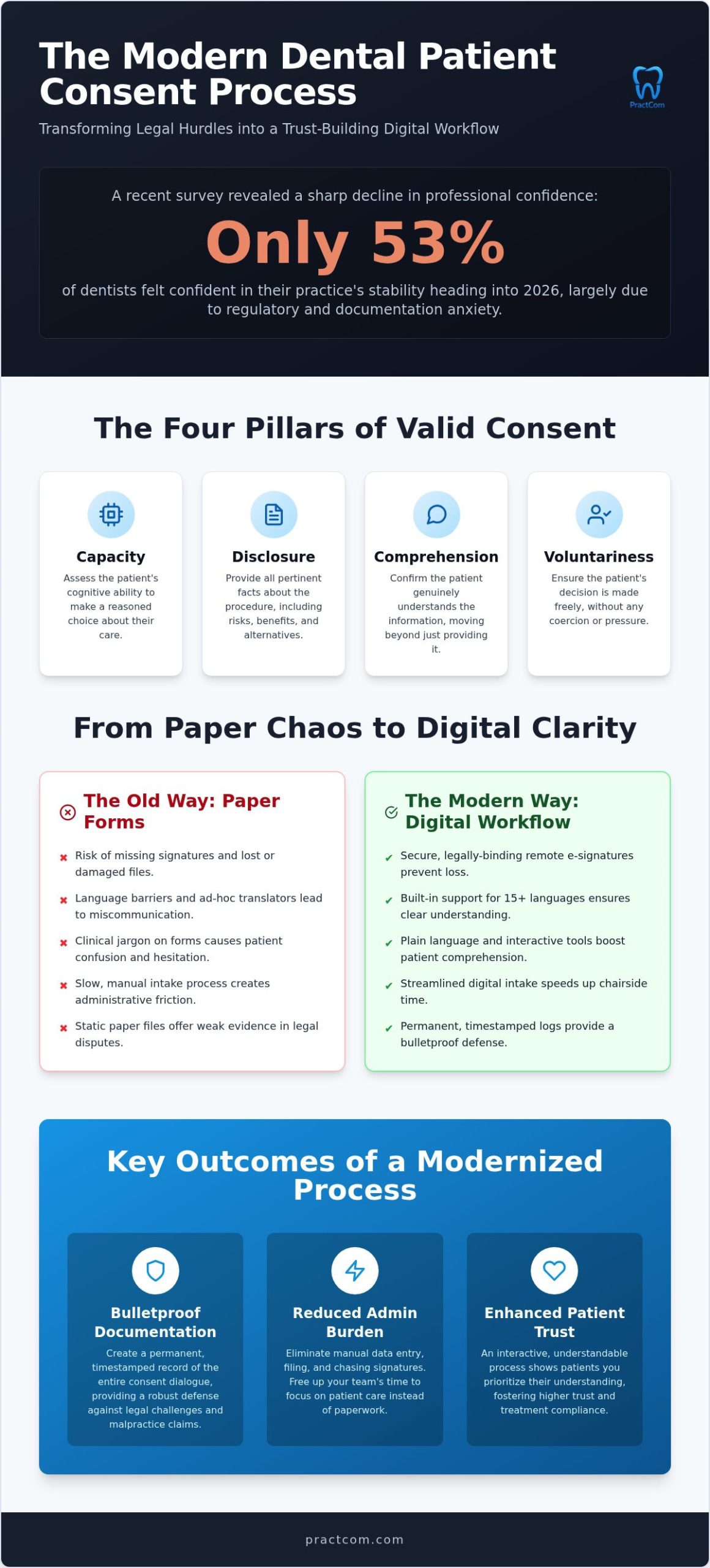
Did you know that only 53% of dentists felt confident in their practice’s stability heading into 2026? This sharp decline in professional confidence stems largely from a tightening regulatory landscape, including the mandatory HIPAA updates for substance use records and the latest ADA sedation guidelines. When your team is buried under stacks of paper forms, it’s easy to feel like the dental patient consent process is a source of anxiety rather than a clinical asset. You’re likely tired of the friction caused by technical confusion and language barriers that slow down your chairside time.
We’re here to help you reclaim your clinical autonomy and your schedule. In this guide, you’ll learn how to transform these legal formalities into a streamlined, trust-building digital workflow. We’ll show you how to move from operational disorganization to systematic control, ensuring your documentation is legally bulletproof while speeding up patient intake. We’ll explore the latest 2026 compliance standards, the importance of documented dialogue, and provide a blueprint for a standardized communication ecosystem that protects your reputation and your patients.
Key Takeaways
- Modernize your approach by shifting from passive signing to an interactive dental patient consent process that prioritizes patient understanding over mere compliance.
- Eliminate the risk of missing signatures and lost files by transitioning to a digital workflow that allows for remote signing and faster patient intake.
- Bridge the communication gap with non-English speaking patients using multi-language support in 15 languages to ensure ethical and professional standards are met.
- Replace technical jargon with plain language to reduce patient confusion, fostering higher trust and treatment compliance.
- Achieve legally bulletproof documentation and a reduced administrative burden by integrating a standardized digital system into your daily clinical operations.
Defining the Modern Dental Patient Consent Process
In the high-pressure environment of a modern clinic, the dental patient consent process is often viewed as a final hurdle before treatment begins. However, in 2026, this perspective is dangerously outdated. Modern consent has evolved from a passive signature on a paper form into a dynamic, digital-first dialogue. It’s the ethical and legal foundation of your practice. This process ensures every patient fully grasps the risks, benefits, and alternatives of their care plan. Standardization is no longer optional. It’s a stabilizing force that ensures no critical clinical detail is missed when your schedule is at its most chaotic.
Effective communication in the digital era requires more than just handing over a clipboard. It demands a system that documents active participation. When patients feel confused by clinical jargon, they hesitate. This hesitation leads to lower case acceptance and higher administrative friction. By utilizing interactive tools, you bridge the gap between complex professional procedures and general understanding. This transition moves your practice from the resistance of manual tasks to the confidence of a standardized system.
The Four Pillars of Valid Consent
To ensure your process is legally sound and ethically robust, you must verify four specific criteria during every consultation. These pillars serve as anchors for your value proposition and legal standing. First is Capacity, which requires assessing the patient’s cognitive ability to make a reasoned choice. Second is Disclosure. You must provide all pertinent facts about the dental procedure, including potential side effects. Third is Comprehension, the most critical pillar in 2026. It’s not enough to speak; you must confirm the patient actually understands the information. Finally, Voluntariness ensures the decision is made without any perceived pressure or coercion. This framework for Informed consent transforms a legal formality into a professional necessity.
Why Documentation is Your Best Malpractice Defense
Signed forms are only one part of a “standard of care” defense. If a dispute arises, contemporaneous digital logs provide significantly stronger evidence than static paper files. These logs prove that a genuine dialogue occurred and that the patient was an active participant in their treatment planning. By moving to a digital system, you create a permanent, timestamped record of the entire interaction. This level of systematic oversight within the dental patient consent process directly enhances the dental patient experience by building a foundation of transparency and trust. You aren’t just protecting your license; you’re creating a psychological safety net for both your team and your patients. It’s a pre-emptive strike against administrative failure and legal vulnerability.
Core Legal and Ethical Requirements for Informed Consent
Compliance is your practice’s shield against regulatory scrutiny. You must align your operations with state-specific dental board regulations and rigorous HIPAA standards. The dental patient consent process must be precise to withstand legal challenges. Using “plain language” instead of clinical jargon is a professional necessity. It ensures patients don’t just sign; they truly understand the scope of their care. When you simplify complex terminology, you eliminate the confusion that often leads to treatment hesitation or post-operative disputes.
Handling minors or patients with legal guardians requires an additional layer of oversight. You must verify legal authority before any signature is captured to ensure the documentation is valid. For high-risk procedures like extractions or dental implants, general consent isn’t sufficient. You need specific documentation that details procedure-specific risks and recovery expectations. Understanding different Types of Consent is essential for maintaining clinical compliance. Modern digital signatures now meet federal E-SIGN Act requirements, providing a secure, timestamped record that traditional paper forms simply can’t match.
Addressing Language Barriers in Clinical Settings
Treating a patient who doesn’t fully grasp the consent form is a major ethical and legal risk. Relying on “ad-hoc” family translators often leads to the miscommunication of critical risks or technical details. Professional translation is a stabilizing force in diverse communities. Implementing multi-language support in 15 languages ensures every patient achieves true “informed” status regardless of their native tongue. This standardization reduces operational resistance and protects your reputation from claims of inadequate disclosure. You can explore digital forms in 15 languages to bridge these communication gaps effectively.
Managing Procedural Risks and Alternatives
Every valid consent discussion must include the “no-treatment” alternative as a standard part of the dialogue. Patients need to know the consequences of declining care as clearly as they understand the benefits of accepting it. Using visual aids, such as a tooth loss chart or smile design visualizations, transforms abstract risks into tangible realities. Visual tools act as a bridge between your technical diagnosis and the patient’s physical reality. This clarity builds higher trust and improves long-term treatment compliance by removing the ambiguity from the decision-making process.
Digital vs. Paper-Based Consent: A Practical Workflow Analysis
Traditional paper workflows are a primary source of operational resistance in the modern clinic. When you rely on physical forms, you risk missing signatures or losing critical files in a sea of paperwork. This creates a dangerous legal vulnerability that no practitioner should ignore. In contrast, a digital dental patient consent process allows for remote signing via email or text. This simple shift saves valuable chairside time, as patients can review and sign documents from the comfort of their own homes. It ensures that your clinical team remains focused on treatment rather than chasing down missing paperwork during a busy shift.
Systematic oversight is the hallmark of a high-utility digital system. Automated tracking provides a pre-emptive strike against administrative failures by flagging any missing documents before the patient even enters the operatory. This integration is a critical component of optimizing dental practice workflow, as it significantly reduces front-desk friction. By adhering to the legal and ethical requirements for informed consent through a standardized digital medium, you protect both your license and your practice’s professional standing. You’re moving from a state of documentation anxiety to one of regulatory reassurance.
The Cost of Inefficiency: Administrative Burden
Consider the time your team spends scanning, filing, and manually retrieving paper consent forms every week. These small, repetitive tasks accumulate into a massive administrative burden that drains your practice’s productivity. Digital systems eliminate this manual resistance, allowing for instant document retrieval with a few clicks. Beyond the internal efficiency, a paperless system signals to your patients that your practice is modern and deeply organized. It replaces the logistical headache of lost files with the confidence of a secure, searchable database.
Security and Accessibility of Patient Records
Physical filing cabinets are prone to fire, theft, and simple misplacement. Transitioning to encrypted cloud storage offers a level of psychological security that paper cannot match. Digital consent forms are accessible to your entire clinical team in real-time, ensuring everyone is aligned on the patient’s treatment choices and documented risks. Utilizing a dedicated patient portal further streamlines this access. It provides a centralized ecosystem where patients can view their signed documents at any time, fostering a sense of transparency and long-term trust that manual systems simply can’t provide.
Implementing a Frictionless Consent Workflow in Your Practice
Achieving a frictionless dental patient consent process requires moving from a reactive stance to a proactive, standardized system. You must first identify which procedures require specialized documentation, such as oral surgery or endodontic treatments. Once identified, selecting a digital platform that supports multi-language delivery is an ethical and professional necessity. In 2026, providing forms in 15 different languages isn’t just about convenience; it’s about ensuring every patient has a clear understanding of their care plan. This level of systematic oversight eliminates the operational resistance caused by language barriers. Your clinical team also needs specific training to present these forms with administrative warmth, positioning the consent dialogue as a supportive part of the treatment journey. Regular audits are the final step, providing the regulatory reassurance that your practice is 100% compliant before any procedure begins.
Step-by-Step: The Digital Consent Hand-Off
The most efficient workflow starts before the patient ever arrives at your clinic. By sending digital forms via text or email, you drastically reduce waiting room congestion and administrative friction. When the patient is in the chair, your team can review the pre-filled digital form to answer specific questions, ensuring the dialogue is focused on care rather than data entry. Once the digital signature is captured, the system should automatically archive the document to your secure portal. This creates a seamless transition from clinical necessity to administrative efficiency, ensuring no part of the professional communication process is left to chance.
Enhancing Compliance with Automated Follow-ups
Automation acts as a guardian of your schedule and your legal standing. Using automated reminders ensures that unsigned forms are completed well before the appointment time. These automated reminders serve as a final confirmation of the patient’s commitment, which significantly reduces the frequency of day-of-procedure cancellations. For a truly comprehensive ecosystem, you should link your consent documents to automated dental post-op instructions. This ensures the patient receives a consistent, high-utility stream of information from the initial agreement through to their recovery. You can standardize your patient communication today to experience these efficiency gains firsthand and eliminate the anxiety of incomplete documentation.
Elevating Documentation with PractCom’s Digital Solutions
In the high-pressure setting of a modern clinic, manual documentation systems are a professional liability. You need a reliable ally that functions as a guardian for your reputation and legal standing. PractCom provides a comprehensive suite of digital dental informed consent forms designed to eliminate operational resistance. By supporting 15 languages via email, text, or print, our platform ensures every patient truly understands their treatment path. This isn’t just a tool; it’s an ethical necessity that ensures your dental patient consent process is both legally bulletproof and administratively warm. With a library of over 80 post-treatment templates, you can standardize your clinical workflow and position your practice as a modern leader in patient communication.
Why Standardization is a Professional Necessity
Reducing the cognitive load on your practitioners is vital for maintaining accuracy during a busy shift. Pre-vetted templates allow your clinical team to focus on the patient rather than worrying about potentially omitted details. This consistency is especially critical for those managing multiple providers or expanding into new markets. You can learn more about PractCom for DSOs to see how we help scale your consent protocols across a larger organization. It provides the systematic oversight required to maintain a high standard of care across every location, moving your team from the anxiety of manual tasks to the confidence of a standardized system.
Beyond Consent: A Complete Communication Ecosystem
A truly modern practice looks beyond the initial signature. Consent is only one component of a high-utility communication ecosystem. Our platform integrates the dental patient consent process with a robust referral management system and automated patient follow-ups. This ensures no patient falls through the cracks after they leave your chair. To boost case acceptance, you can utilize our Smile Design tools to show patients their potential cosmetic changes before they sign. This visual clarity builds the psychological security and trust necessary for complex treatment plans. It’s time to replace operational disorganization with systematic control. Start your journey toward a paperless, high-efficiency office with a free trial today.
Future-Proofing Your Clinical Documentation
Modernizing your clinic requires moving beyond the friction of paper-based systems. By standardizing your dental patient consent process, you transform a legal requirement into a high-utility asset that builds lasting trust. You’ve seen how digital delivery ensures regulatory compliance while providing the psychological security your team needs during high-pressure shifts. This shift allows you to move from operational disorganization to systematic control.
Utilizing 15-language support for all clinical documents ensures that every patient, regardless of their native tongue, understands their care plan completely. With over 80 post-treatment instruction templates and an automated patient follow-up system, you can eliminate manual errors and maintain oversight because these tools provide a pre-emptive strike against administrative failure. This transition allows you to focus on what matters most: delivering exceptional clinical care. Streamline your practice with PractCom’s digital consent forms today. You have the tools to lead a more organized, protective, and efficient practice starting right now.
Frequently Asked Questions
Is a digital signature on a dental consent form legally binding?
Yes, digital signatures carry the same legal weight as traditional ink signatures under the federal E-SIGN Act and the Uniform Electronic Transactions Act (UETA). These digital records provide a secure, timestamped log that is often more reliable during an audit than physical paperwork. Your dental patient consent process benefits from this added layer of security, as it ensures every signature is verified and easily retrievable, protecting your practice from claims of missing documentation.
How long should a dental practice keep signed consent forms?
Retention requirements vary by state, but most dental boards recommend keeping signed forms for seven to ten years. HIPAA regulations specifically require you to maintain documentation for at least six years from the date of creation or last effect. Because statutes of limitations for malpractice can be lengthy, storing these records in a secure digital portal is a professional necessity. This systematic oversight prevents the loss of physical files and ensures long-term regulatory compliance.
Does every minor dental procedure require a written consent form?
While implied consent might cover routine examinations or cleanings, written consent is a professional necessity for any invasive procedure. Even minor treatments like sealants or small restorations benefit from documented understanding to avoid future disputes. Using a standardized digital system allows you to capture this agreement quickly without slowing down your workflow. It functions as a guardian for your reputation, ensuring that every clinical decision is backed by clear, documented patient participation.
Can I use a general consent form for all dental treatments?
No, a general consent form is typically insufficient for specific clinical procedures. While a general form covers basic office policies and exams, high-risk treatments like extractions or implants require procedure-specific documentation. These forms must detail the unique risks and alternatives associated with that specific care plan. PractCom offers a library of over 80 post-treatment and consent templates to ensure you have the precise documentation needed for every clinical scenario your team encounters.
What happens if a patient refuses to sign a consent form?
If a patient refuses to sign, you should not proceed with the recommended treatment. This situation requires you to document an “informed refusal,” where you record the patient’s decision and confirm they understand the risks of declining care. Proceeding without a signed form creates significant legal vulnerability and violates the core ethics of the dental patient consent process. Clear communication through visual tools can often resolve the patient’s underlying anxiety and lead to a signed agreement.
How do I handle informed consent for patients who don’t speak English?
Handling non-English speakers requires providing consent documentation in the patient’s primary language to ensure true comprehension. Relying on family members for ad-hoc translation is an ethical and legal risk that can lead to dangerous miscommunication. PractCom supports 15 different languages for all digital forms and instructions, allowing you to bridge this communication gap professionally. This standardization ensures that every patient, regardless of their language, can participate fully in their own care decisions.
Is informed consent the same as a treatment plan?
No, these are two distinct components of clinical communication. A treatment plan outlines the recommended procedures and associated costs, while informed consent focuses on the patient’s understanding of risks, benefits, and alternatives. The consent process is the ethical dialogue that validates the treatment plan. Integrating these steps within a digital portal ensures that the patient has reviewed both the clinical path and the legal disclosures before the procedure actually begins.
Can a patient withdraw consent after the procedure has started?
Yes, a patient has the legal right to withdraw their consent at any point during a procedure. If this occurs, you must stop the treatment as soon as it is clinically safe to do so. You should then document the reason for the withdrawal and any potential risks associated with stopping the treatment mid-procedure. This documentation is a critical safeguard for your practice, providing a clear record of the patient’s decision and your professional response.

Article by
Cary Ganz DDS
Dr. Cary H. Ganz is a dentist, prosthodontist, entrepreneur, lecturer, and author with more than 50 years of experience in clinical dentistry and dental technology. Throughout his career, he has combined hands-on patient care with a deep understanding of how technology can improve dental practice operations, communication, documentation, and patient outcomes.
In addition to his clinical background, Dr. Ganz has held significant leadership roles in the dental technology industry, including Past Owner and Vice President of Clinical Affairs at DEXIS Digital Radiography and Past Vice President of Clinical Affairs at Denticon Practice Management Software. His business experience includes product development, clinical strategy, dental software innovation, practice management solutions, and educating dental professionals on the effective use of technology in modern dentistry.
Today, Dr. Ganz continues to focus on creating practical technology solutions for dental practices, including PractCom, a comprehensive dental practice communication platform designed to improve patient communication, documentation, compliance support, referrals, and overall practice efficiency. His work reflects a career-long commitment to helping dentists deliver better care while making their practices more organized, efficient, and protected.
No responses yet