
Is your clinical workflow one misunderstood consent form away from a malpractice claim? You likely recognize the daily friction of a packed schedule where a language barrier turns a routine consultation into a high-risk struggle. It’s exhausting to manage the anxiety of potential compliance failures while trying to maintain a high volume of care. You want to provide excellent treatment, but communicating with non-english speaking dental patients shouldn’t feel like an operational gamble every time you pick up a handpiece.
We agree that your focus should stay on clinical excellence, not acting as a part-time translator. This guide will teach you how to bridge language gaps, ensure strict clinical compliance, and improve patient outcomes through a systematic multi-language communication approach. You’ll learn how to navigate the 2026 SPEAK Act requirements and implement high-fidelity data transmission standards for every visit. We will preview how a standardized library of post-treatment instructions and digital consent forms in 15 languages can reduce your clinical risk, streamline your documentation, and finally eliminate the inefficiency of manual translation.
Key Takeaways
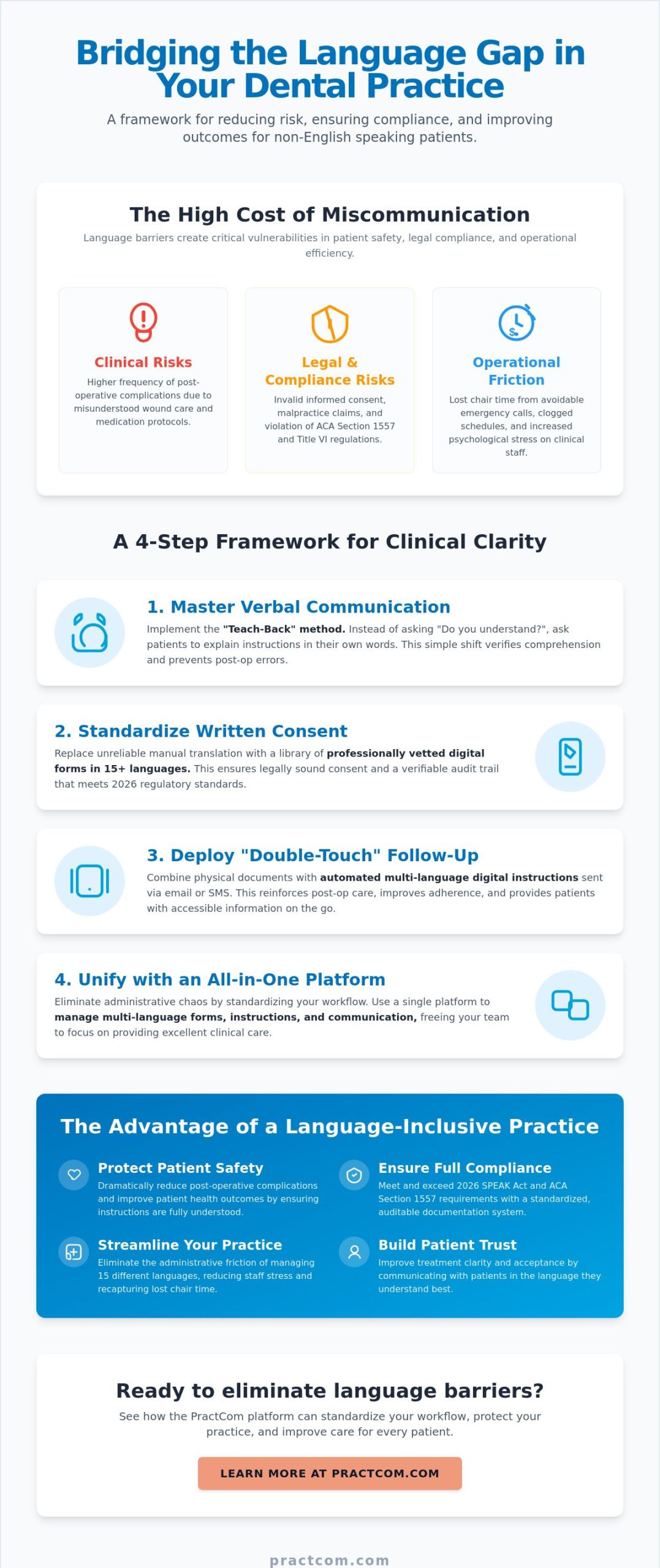
- Identify the direct link between language barriers and increased post-operative complications to protect patient safety and your clinical reputation.
- Master the “Teach-Back” method and visual smile design tools for communicating with non-english speaking dental patients to ensure total treatment clarity.
- Replace unreliable manual translation with professionally vetted digital informed consent forms that meet 2026 regulatory standards.
- Deploy a “Double-Touch” follow-up strategy that combines physical documents with automated multi-language digital instructions to improve post-op adherence.
- Standardize your practice workflow using an all-in-one platform to eliminate the administrative friction of managing 15 different languages.
The Clinical and Legal Impact of Language Barriers in Dentistry
In a clinical dental setting, Limited English Proficiency (LEP) refers to a patient’s inability to communicate effectively in English. This directly impacts their capacity to navigate complex treatment plans. This isn’t just a simple language gap; it’s a fundamental barrier to understanding health literacy and making informed decisions about oral health. When you’re communicating with non-english speaking dental patients, the stakes are clinical, not just conversational. Research consistently shows that language barriers correlate with a higher frequency of post-operative complications. Patients often fail to follow specific wound care or medication protocols simply because they didn’t fully grasp the instructions provided chairside.
Compliance isn’t optional for the modern practitioner. Under Title VI of the Civil Rights Act and Section 1557 of the Affordable Care Act (ACA), dental practices receiving federal financial assistance must provide meaningful access to LEP individuals. This legal mandate ensures that national origin doesn’t become a barrier to quality healthcare. Relying on ad-hoc interpreters, such as a patient’s bilingual relative or a non-clinical staff member, is a significant liability risk. These individuals often lack training in medical terminology and may inadvertently omit critical clinical details. This leaves your practice vulnerable to litigation and regulatory scrutiny.
Malpractice Risks and Informed Consent
Legally, a patient cannot consent to a procedure they don’t understand. If a patient signs a form they can’t read, that consent is effectively void in a court of law. Using children as interpreters for complex oral surgery is especially dangerous. They often lack the emotional maturity or vocabulary to explain surgical risks accurately. Standardized documentation protects your reputation because it provides a verifiable audit trail. By using professionally translated forms, you ensure that your practice remains compliant with Section 1557 requirements while offering the psychological security that comes from knowing your patient is truly informed.
The Cost of Miscommunication in Post-Op Care
Miscommunication hits your bottom line through operational friction. When instructions are misunderstood, you face a high volume of emergency calls and avoidable appointments that clog your schedule. This lost chair time is an expensive administrative failure that disrupts your workflow. Beyond the financial burden, there’s a heavy psychological toll on your clinical staff. It’s stressful for assistants and hygienists to provide care when they aren’t certain the patient understands the recovery steps. Moving to a standardized system for communicating with non-english speaking dental patients reduces this resistance and restores order to your high-pressure environment.
Implementing Verbal and Cultural Communication Strategies
The “Teach-Back” method is one of the most effective tools for verifying comprehension in a clinical setting. Instead of asking a patient if they understand, which often results in a polite but misleading “yes,” you ask them to explain the instructions back to you in their own words. This shift from passive listening to active demonstration ensures that post-op care isn’t lost in translation. When communicating with non-english speaking dental patients, this technique serves as a real-time audit of your communication efficacy. It’s a simple step that prevents the high-volume emergency calls caused by misunderstood recovery protocols.
Cultural nuances also play a critical role in treatment acceptance. Different cultures may have varying perceptions of pain tolerance or specific aesthetic goals for restorative work. Some patients might prioritize functional longevity over cosmetic perfection, while others may view dental pain as something to be endured rather than treated immediately. Understanding these perspectives allows you to tailor your clinical presentation. Citing established guidelines on serving non-English speaking patients can help your team develop the cultural competency needed to bridge these subtle gaps.
Effective Use of Interpretive Services
Working with interpreters requires a specific clinical etiquette. You must maintain eye contact and address the patient directly, even when an interpreter is speaking. This builds a bond of trust and ensures the patient feels like the center of the clinical encounter. Video Remote Interpreting (VRI) is often superior to over-the-phone services for complex consultations because it allows for non-verbal cues. If you use bilingual staff, ensure their involvement doesn’t disrupt their primary clinical roles. Their presence should provide “administrative warmth,” making the patient feel secure in a high-pressure environment.
Visual Aids as a Universal Language
Visual communication transcends language. Using 3D models and pathology diagrams allows you to explain complex procedures without relying solely on technical jargon. Specifically, smile design tools can communicate treatment outcomes by showing before-and-after cosmetic changes. This visual evidence provides a clear justification for the procedure, making it easier for patients to commit to care. For chairside efficiency, standardizing the use of ‘Yes/No’ cards allows patients to communicate comfort levels during a procedure without needing a full-time interpreter. You can explore how a standardized system simplifies these interactions to reduce operational resistance.
Standardizing Written Communication and Informed Consent
Many industry resources suggest learning basic greetings to bridge language gaps. While polite, this approach is clinically insufficient when communicating with non-english speaking dental patients about complex oral surgery. You can’t rely on a handful of memorized phrases when explaining the risk of dry socket or the nuances of nerve damage. Relying on free tools like Google Translate is a liability trap because these platforms lack the technical precision required for medical terminology. Professionally translated documents provide the regulatory reassurance you need to ensure every clinical detail is accurate, culturally appropriate, and legally defensible.
Standardizing your written materials involves more than just word-for-word translation; it requires the application of Plain Language principles. Even in a patient’s native tongue, dense clinical jargon can create confusion and anxiety. By using simplified terms and clear structures in your translated texts, you bridge the understanding gap before the patient ever leaves the chair. This systematic control replaces the operational disorganization of ad-hoc explanations with a professional, standardized workflow.
Building a Multi-Language Post-Op Library
Efficiency is the cornerstone of a modern clinical environment. Maintaining a library of 80+ templates for common procedures like extractions and root canals allows your team to act with speed and accuracy. You can manage 15 different languages without overwhelming your front desk by using a standardized delivery system that automates the selection process. While digital delivery via email or text is the fastest route to compliance, offering physical document printing is essential for patients with low digital literacy. This ensures your practice functions as a guardian of health for all patients, regardless of their comfort with technology.
The Ethics of Informed Consent
Ethical care requires that every risk, benefit, and alternative is articulated in a language the patient speaks fluently. Using digital informed consent forms ensures that consent is a meaningful process rather than a signature on a page the patient can’t read. Digital signatures on these translated forms create a verifiable audit trail, protecting your reputation and legal standing. This process ensures you address the “Understanding Gap” thoroughly, moving from the resistance of manual tasks to the confidence of a standardized system. It’s a pre-emptive strike against the administrative failures that lead to malpractice claims.
Leveraging Technology for Multi-Language Patient Follow-Up
Technology acts as a stabilizing force when manual systems fail. In a modern clinic, relying on your staff’s memory to provide follow-up care in multiple languages is an operational risk. By leveraging automated patient follow-ups, you ensure that every interaction is standardized and documented. When you’re communicating with non-english speaking dental patients, the goal is to eliminate human error. Automated systems deliver instructions via SMS or Email in 15 different languages, providing the psychological security that your clinical guidance is being received and understood. This systematic approach transforms a high-pressure task into a background process that runs with technical precision.
We advocate for a “Double-Touch” approach to patient education. This involves providing physical document printing during the appointment followed by a digital version sent directly to the patient’s phone. This redundancy is a guardian for your practice’s reputation. If a patient misplaces their physical paperwork, the digital copy remains a click away. It’s a practical solution that bridges the gap between the chairside consultation and home recovery. By providing instructions in multiple formats, you accommodate different levels of digital literacy while ensuring compliance is never left to chance.
SMS and Email Automation for LEP Patients
Timing is critical for post-operative success. Scheduling messages to arrive approximately 2 hours post-treatment reaches the patient exactly when anesthesia typically subsides. This is the moment they most need guidance on pain management or bleeding control. To maintain security and high deliverability, ensure your practice uses 10DLC registered messaging for all dental communications. This isn’t just about recovery; using these same multi-language channels for appointment reminders is a proven way to reduce “No-Shows” and keep your daily schedule optimized and profitable.
Monitoring Compliance via Digital Portals
A centralized patient portal is an essential business requirement for the 2026 clinical environment. It provides a single, secure location for all dental patient experience documents, from signed consent forms to detailed post-op guides. This significantly reduces the time your front desk spends searching for and re-sending lost paperwork. Crucially, these portals allow you to monitor compliance in real-time. By tracking when a patient accesses their digital instructions, you can identify high-risk individuals who haven’t reviewed their recovery steps. This level of systematic control moves your practice away from reactive crisis management and toward proactive patient care.
Start your free trial of the all-in-one patient communication platform to streamline your multi-language follow-up workflow and reduce clinical risk.
Building a Language-Inclusive Practice with PractCom
PractCom provides an all-in-one patient communication platform for dental practices that transforms linguistic barriers from a liability into a streamlined workflow. Communicating with non-english speaking dental patients no longer requires multiple fragmented tools or the constant disruption of bilingual staff. Instead, our platform integrates digital informed consent forms and a post-treatment instruction library into your existing daily routine. This shift moves your office from the resistance of disorganized manual tasks to the confidence of systematic clinical control. By centralizing your multi-language efforts, you ensure that no patient is left behind due to a lack of resources.
A standardized approach to communication directly influences practice growth and referral quality. When patients receive professional, translated documents in their native tongue, their trust in your clinical expertise increases. This leads to higher compliance with treatment plans and a significant reduction in post-operative complications. By implementing a system that handles 15 languages with technical precision, you position your practice as a stabilizing force in your community. You’re not just providing dental care; you’re providing psychological security for a diverse patient base.
Why Standardization is the Ultimate Peer Ally
Standardization is more than a convenience. It is your most reliable professional ally. We understand the practitioner anxiety that stems from potential documentation gaps. PractCom functions as a guardian of your reputation and legal standing by providing a standardized, verifiable audit trail for every consent form and post-op instruction sent. This includes a referral management system designed to support diverse patient needs across 15 different languages. When your referrals are handled with the same linguistic precision as your in-house treatments, you build a reputation for excellence that attracts more complex and profitable cases.
Next Steps: Transitioning to a Paperless, Multi-Language Office
Transitioning to a paperless, multi-language office is a logical step toward modernizing your practice. Start by auditing your current language gaps and patient demographics to identify which of our 15 languages are most critical for your community. Our platform is designed for extreme ease of use in a high-pressure environment. We use specific numerical shortcuts and pre-built templates that allow for task completion in seconds. This efficiency ensures that your team can focus on clinical care while the system handles the complexities of communicating with non-english speaking dental patients. You can start your free trial with PractCom today to see how we restore order to your clinical environment.
Mastering Linguistic Compliance in Your Clinical Workflow
Effective care in a modern dental environment requires more than just clinical skill. It demands a standardized system that eliminates the friction of language barriers. You’ve seen how moving away from ad-hoc translation protects your practice from the significant legal risks associated with Section 1557. By implementing the “Teach-Back” method and leveraging visual smile design tools, you can ensure higher patient compliance and reduce the financial burden of lost chair time.
Communicating with non-english speaking dental patients shouldn’t be an operational gamble. Transitioning to a systematic workflow ensures that your documentation is both accurate and legally defensible. This level of control provides the psychological security you need to manage a high-pressure schedule without compromising on patient safety. It’s about moving from the resistance of manual tasks to the confidence of a professional, automated ecosystem.
Streamline your practice with PractCom’s 15-language communication suite. Our platform offers a library of 80+ post-treatment templates and digital informed consent forms with verifiable audit trails. By supporting 15 languages out-of-the-box, we act as a guardian for your reputation and legal standing. Take the first step toward a more efficient, inclusive, and compliant office today. You have the expertise to treat; we have the tools to help you communicate it.
Frequently Asked Questions
Is it legal to use a family member as a dental interpreter?
Relying on family members, especially minors, is generally prohibited under Section 1557 of the ACA for critical clinical discussions. It introduces a significant liability risk because family members often lack the technical precision required to translate medical terminology accurately. Using an untrained interpreter can lead to misunderstandings that jeopardize patient safety and your legal standing.
How many languages should a standard dental practice support?
A modern practice should ideally support at least 15 languages to remain competitive and compliant in a diverse clinical environment. While your local demographics may favor one or two specific groups, having a broad library of templates ensures you can handle emergency cases without operational friction. This standardized approach protects your reputation across all patient populations.
Can I use Google Translate for dental consent forms?
You shouldn’t use Google Translate for clinical documentation because it lacks the accuracy needed for informed consent. Automated translation tools often struggle with complex dental procedures and legal nuances, which can lead to a total failure of documentation. Using professionally vetted forms is an ethical necessity that provides the regulatory reassurance your practice requires.
What are the most common languages needed in US dental practices in 2026?
Spanish, Chinese, Vietnamese, Tagalog, and Arabic are the most frequently requested languages in the current dental landscape. Supporting these languages allows you to reach a broader demographic and reduces the number of confused consultations. Implementing a system that handles these out-of-the-box is a pre-emptive strike against administrative failures and lost chair time.
How do I provide post-op instructions to a patient who can’t read English?
You can provide effective recovery guidance by using a “Double-Touch” approach that combines physical document printing with automated digital follow-ups. When communicating with non-english speaking dental patients, delivering instructions in their native tongue ensures they understand wound care and medication protocols. This systematic control reduces the volume of emergency calls and improves clinical outcomes.
Does HIPAA apply to translated digital dental documents?
Yes, HIPAA regulations apply to all digital communications containing protected health information, regardless of the language. Your patient portal and automated messaging systems must use encrypted, 10DLC-registered channels to ensure data security. Maintaining this standard of care protects your patient’s privacy while fulfilling your legal obligations as a healthcare provider.
What happens if a patient signs a consent form they didn’t fully understand?
The consent is legally invalid if the patient didn’t grasp the risks, benefits, and alternatives of the procedure. This leaves your practice vulnerable to malpractice claims and regulatory scrutiny. Using digital informed consent forms in the patient’s primary language ensures that the agreement is meaningful and creates a verifiable audit trail for your protection.
How can I automate my dental patient follow-ups for non-English speakers?
You can automate this workflow by using an all-in-one patient communication platform that schedules messages based on procedure codes. This system delivers SMS or email follow-ups in the patient’s preferred language, ensuring they feel supported during recovery. It’s a practical way to maintain high-fidelity communication without increasing the administrative burden on your clinical staff.

Article by
Cary Ganz DDS
Dr. Cary H. Ganz is a dentist, prosthodontist, entrepreneur, lecturer, and author with more than 50 years of experience in clinical dentistry and dental technology. Throughout his career, he has combined hands-on patient care with a deep understanding of how technology can improve dental practice operations, communication, documentation, and patient outcomes.
In addition to his clinical background, Dr. Ganz has held significant leadership roles in the dental technology industry, including Past Owner and Vice President of Clinical Affairs at DEXIS Digital Radiography and Past Vice President of Clinical Affairs at Denticon Practice Management Software. His business experience includes product development, clinical strategy, dental software innovation, practice management solutions, and educating dental professionals on the effective use of technology in modern dentistry.
Today, Dr. Ganz continues to focus on creating practical technology solutions for dental practices, including PractCom, a comprehensive dental practice communication platform designed to improve patient communication, documentation, compliance support, referrals, and overall practice efficiency. His work reflects a career-long commitment to helping dentists deliver better care while making their practices more organized, efficient, and protected.
No responses yet